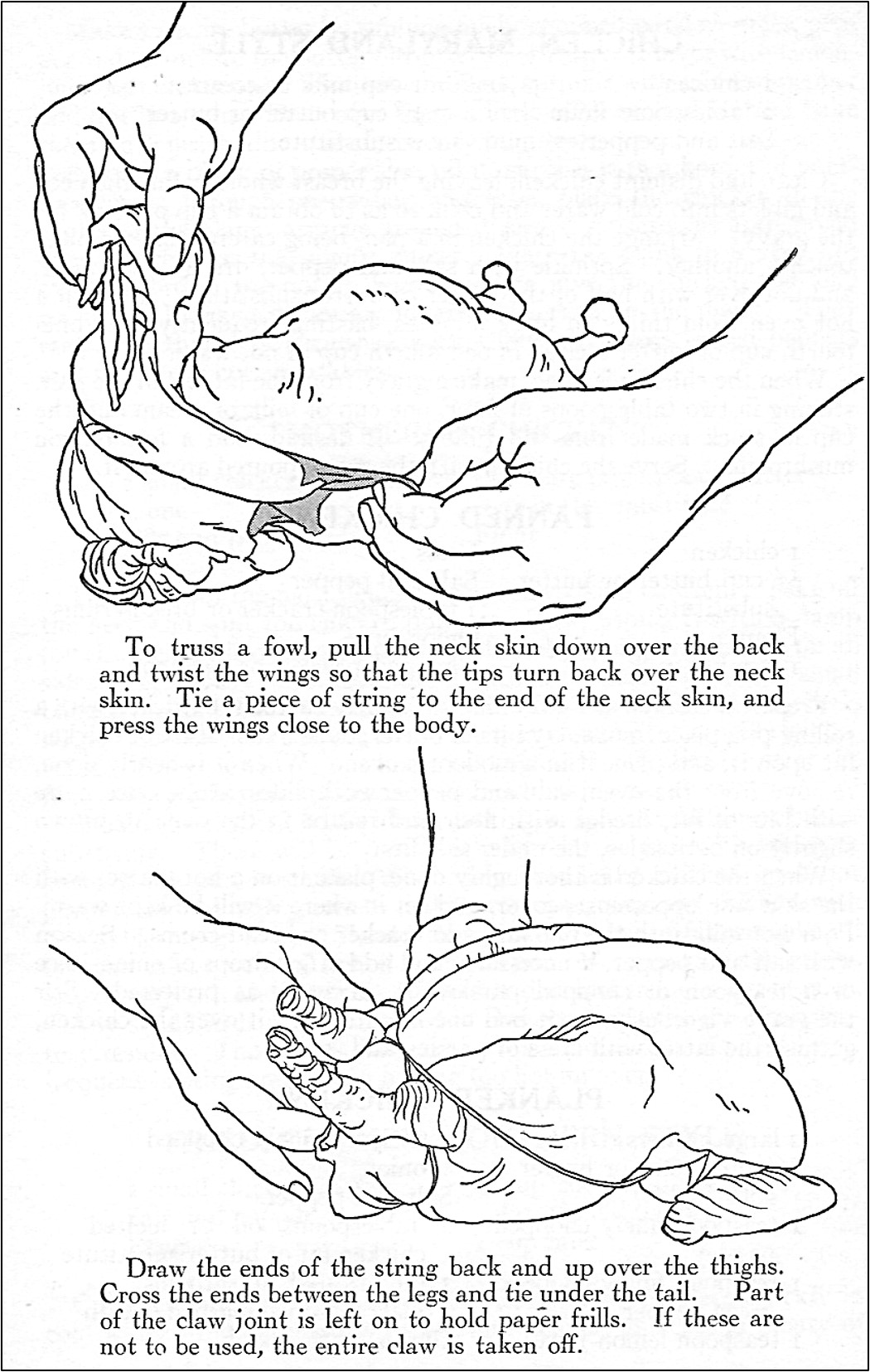
1924 Directions for Trussing a Fowl

Directions for trussing a fowl
Source: The New Butterick Cook Book (1924)

There are so many things to think about when planning a Thanksgiving dinner. Worried that your turkey won’t  keep its shape or roast evenly? Maybe you should use string to truss it to pull the bird into a more compact shape that will help ensure that it roasts evenly. Here are the directions in a hundred-year-old cookbook.

1924 Thanksgiving Menus

Thanksgiving menus
Source: American Cookery (November, 1924)

I’m currently planning my Thanksgiving menu, and trying to decide if I want to pull in some hundred-year-old recipes. The Thanksgiving menus in the November, 1924 issue of American Cookery give lots of options.  Cranberry sauce, pumpkin pie – yes. Brussels sprouts,  stuffed olives – maybe; Roast squabs with peanut stuffing, Roquefort cheese – no. By the way, what are bent crackers?

Hundred-Year-Old Directions for Where to Put Knife and Fork When Finished Eating

plate, knife, and fork

I’ve never given much thought as to what I should do with my knife and fork when I finish eating a meal. I typically just put the knife across the top of my plate and let the fork tines lay somewhere on my plate. But apparently a hundred years ago people worried about proper etiquette. Here’s what it said in a 1924 magazine:

What to Do with the Knife and Fork at the Close of Dinner

At the close of dinner, or at the close of a course, the knife and fork should be laid side by side, fork with the tines up, knife with the sharp edge nearest the fork, and a little to the right side of the dinner plate, and at right angles to the edge of the table. This should be the signal that the guest has finished the meal, or the course, and is ready to have his plate removed.

American Cookery (November, 1924)

I decided to see what this looked like, and tried to follow the directions (though used a clean plate rather than one with food scraps after I’d eaten). It looks really strange to me. And, why aren’t there any directions for what to do with the spoon?

Cranberry-Raisin Roll

cranberry raisin roll

Cranberries are a Fall favorite, so when I saw a recipe for Cranberry-Raisin Roll in a hundred-year-old cookbook I decided to give it a try.

Chopped cranberries and raisins were rolled into a baking powder dough and then steamed, which results in the roll having a different texture than if it had been baked. It is served with lemon sauce. The Cranberry-Raisin Roll was delightful and almost seemed elegant. It was soft, but slightly chewy, with the lovely tartness of cranberries that were slighted moderated by the sweetness of the raisins.

Slice of Cranberry-Raisin Roll

Cranberry-Raisin Roll in Steamer

Here’s the original recipe:

Recipe for Cranberry-Raisin Roll
Source: Modern Priscilla Cook Book (1924)

The dough seemed too thick when I rolled it to a thickness of 1/2 inch, so I rolled it a little more until it was about 1/4-inch thick.

And, here is the recipe for Lemon Sauce:

Recipe for Lemon Sauce
Source: Modern Priscilla Cook Book (1924)

I didn’t stir in boiling water when I made the Lemon Sauce. It didn’t seem necessary since the mixture was heated on the stove. I just used room temperature water.

Cranberry Raisin Roll in Steamer

Here are the recipes updated for modern cooks:

Cranberry Raisin Roll

  • Servings: 6 - 8
  • Difficulty: moderate
  • Print

1 cup cranberries

1/2 cup raisins

1/2 cup sugar

2 teaspoons baking powder

2 teaspoons sugar

1/2 teaspoon salt

2 cups flour

2 tablespoons butter

3/4 – 1 cup milk

Chop cranberries and raisins. (A blender or food processor works well to chop them.) Then put in a bowl and stir in the sugar. Set aside.

Put baking powder, sugar, salt, flour, and butter in a bowl. Add 3/4 cup milk, and mix using a fork until dough starts to cling together. If it is too dry, add additional milk. Turn onto a flour-prepared surface, and roll dough into an approximate 11-inch X 18-inch rectangle that is 1/4 inch thick. Evenly spread  the cranberry and raisin mixture on the rolled dough to within 1/2 inch of the edges. Start at one of the narrower sides and roll, then put in a steamer over quickly boiling water and cover. Steam for 1 1/2 hours. Remove from steamer and serve with Lemon Sauce.

Lemon Sauce

1/2 cup sugar

1 tablespoon corn starch

dash salt

1 cup water

2 tablespoons butter

1 1/2 tablespoons lemon juice

1/4 teaspoon grated lemon rind

1/8 teaspoon nutmeg

Mix the sugar, cornstarch, and salt together in a saucepan. Stir in the water, and heat using medium heat until the mixture boils. Reduce heat and simmer until the mixture thickens.  Stir in the butter, lemon juice, grated lemon rind, and nutmeg. Serve hot.

http://www.ahundredyearsago.com
1924 Halloween Dinner Menu

Halloween Dinner Menu
Source: American Cookery (October, 1924)

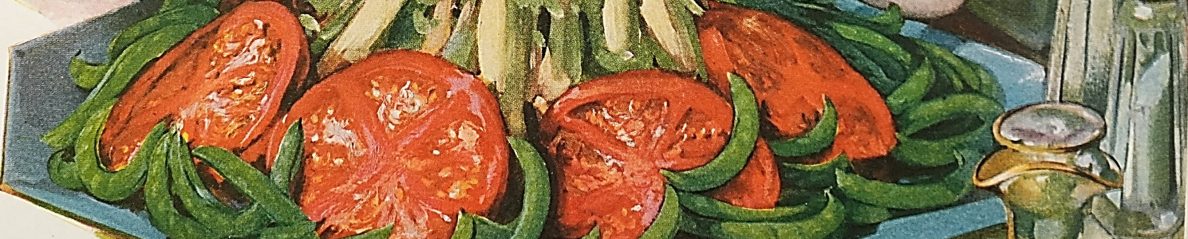
Need some ideas for a Halloween dinner? Look no further than the October, 1924 issue of American Cookery magazine. The menu calls for serving 16 foods plus coffee. Whew, what a lot of food! That said, I’m off to a good start making the foods on the menu:

Stuffed Celery

Witches’ Layer Cake

If this isn’t enough, you could also serve an additional dessert option that I made years ago back when I was posting my grandmother’s diary entries:

Ice Cream Served in Orange Jack-o’-Lantern Shells

And, you could make these crafts to decorate for the dinner:

Halloween Bogeyman

Shrunken Apple-Head Witch

1924 List of Best Apples for Cooking, Dessert, and Cider

List of Apple Varieties
Source: Canadian Grown Apples: Delight in Every Bite (1924)

Many popular apple varieties today did not exist a hundred years ago; and some popular varieties a hundred years ago are seldom seen today. Both now and then, there were lists of which apple varieties were best for different uses. Today lists often refer to apples for eating, and cooking or baking. A 1924 list refers to apples for cooking, dessert apples, and cider apples. Were dessert apples ones that were particularly good to eat raw?

Old-Fashioned Apple and Coconut Pie

Slice or Apple and Coconut PIe

Government agencies have produced cookbooks for more than a hundred years that promote the use of local foods. I recently came across a small apple cookbook published in 1924 by the Fruit Branch of the Canada Department of Agriculture. The introduction to the book says that “Canada produces the best flavoured, most highly coloured and longest keeping apples.” I can’t vouch for the accuracy of that statement, but I can say that the book has some good recipes – though I used possibly inferior (??) U.S. apples.

One recipe was for Apple and Coconut Pie.  The pie was delightful. This recipe takes a classic pie, and adds a fun tropical twist to it.

Canadian Apple Cookbook

Here’s the original recipe:

Recipe for Apple and Coconut Pie
Source: Canadian Grown Apples: Delight in Every Bite (1924)

I used cinnamon rather than lemon. When I made this recipe, in addition to flavoring the apples with sugar and cinnamon, I stirred in a little flour to help ensure that the pie won’t be overly juicy.

The recipe author spelled “cocoanut” with an “a.” I think that this is considered an archaic spelling now, so when I updated the recipe, I spelled it without an “a.”

Here’s the recipe updated for modern cooks:

Apple and Coconut Pie

  • Servings: 6 - 8
  • Difficulty: moderate
  • Print

6 cups thinly sliced apples (cored and peeled)

3/4 teaspoon cinnamon

1/3 cup sugar

1/4 cup flour

1 1/2 cups coconut

1 10-inch deep dish pie shell

Preheat oven to 425 degrees. Put sugar, cinnamon, and flour in a small bowl; stir to combine. Add the sugar and cinnamon mixture into the sliced apples; gently stir until the apples are coated with the mixture. Set aside.

Sprinkle 1/2 cup of the coconut on the pie shell,  then add the apple mixture. Bake at 425 degrees for 15 minutes. Reduce heat to 350 degrees, and bake an additional 30 minutes or until the apples are soft. Sprinkle 1 cup of coconut on top of the hot pie. Return to the oven and bake for an additional 5 minutes, or until the coconut is just barely beginning to brown. Remove from oven.

http://www.ahundredyearsago.com