
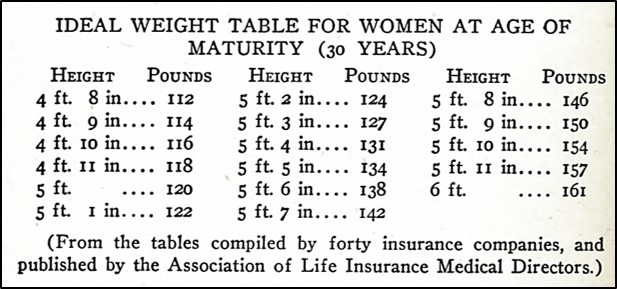
Some things haven’t changed much over the past hundred years. Similarly to now, people worried about their weight back then. A 1919 home economics textbook even contained a table that showed the “ideal weight” by height for a 30-year-old woman.
The book also offered advice for women about the importance of improving their eating habits:
Many women say, “Oh, I know I’m fat, but I feel all right anyway.” Nevertheless such women should practice those habits which will keep weight down automatically, no matter how well they feel, because (1) excess fat is unattractive from the appearance standpoint; (2) overweight after 35 years (according to the best insurance statistics) is closely associated with a high death rate; (3) an excess weight particularly handicaps efficiency in work or recreation.
Every homemaker, then, should closely estimate her own dietary. If she has servants and merely makes the beds or does light dusting, etc., then she needs only approximately 1,800-2,400 calories daily; but if she does most of her housework, including the heavier work of room cleaning, laundry work, etc., then she will need more nearly 2,500-2,800 calories.
Source – Household Engineering: Scientific Management in the Home by Mrs. Christine Frederick (1919)


