Types of Cheese Available in 1920

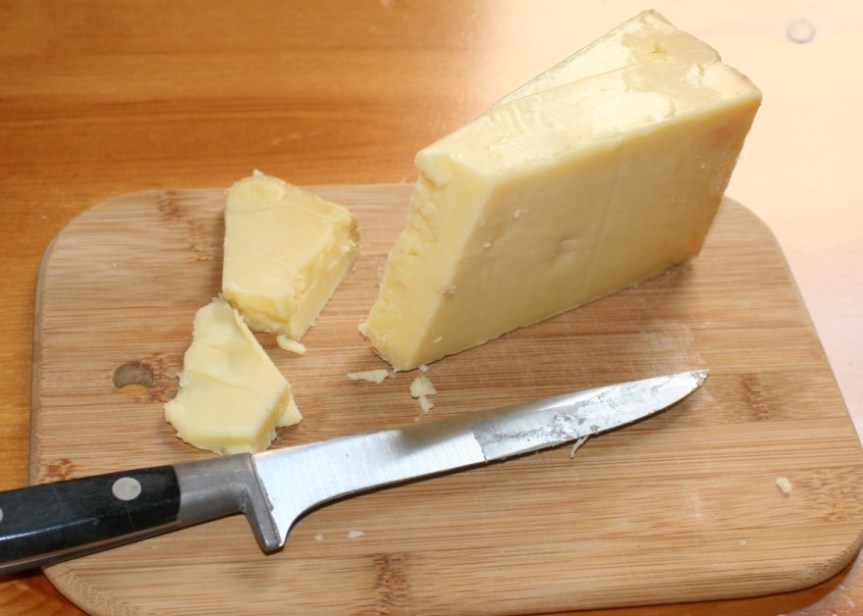
Cheddar Cheese and Knife on Cutting BoardToday there are a huge number of varieties of cheese. There were also lots of types of cheese a hundred years ago. Here’s what a 1920 magazine said:

Cheese

Cheese contains more than twice as much nourishment, pound for pound, as the best beefsteak.

There are over 500 varieties of cheese.

Cheddar, or the American dairy cheese, is characterized by its solid, close texture, delicate, mild aroma, and pleasing flavor.

A “green” or freshly made cheese lacks in flavor and is rubbery – more like the pressed curd from which it comes.

A “ripe” cheese is that which has aged and developed a full flavor and a rich, mellow consistency.

Those cheeses known as Pimiento, club, pineapple, and sage cheese, are of the Cheddar type and of distinctive shape or flavor.

Roquefort is cheese is made in Roquefort, France of goats’ milk, and is ripened by a secret “moldy bread process.”

Swiss cheese is of a somewhat different flavor, due doubtless to the presence of micro-organisms which are thought to be the cause of the numerous holes that perforate this food. It is claimed that an expert can tell the porousness of a Swiss cheese by the sound which it gives when it is tapped.

Edam and Parmesan cheeses are of a hard variety caused by pressing out all of the water. For this reason, they grate well and being of rich flavor, are desirable for seasoning.

Neufchatel cheese is made from thick, sour milk. It does not keep as the other cheeses do, and so one must be careful to purchase it fresh to have it at its best.

American Cookery (May, 1920)
1920 Advice for Preparing a Meal Tray for a Sick Person

Source: Household Arts for Home and School (Vol. 2) 1920 by Anna M. Cooley and Wilhelmina H. Spohr

Serving food on a tray is a nice way to show love and caring when a family member is sick.  A hundred-year-old home economics textbook had the following advice:

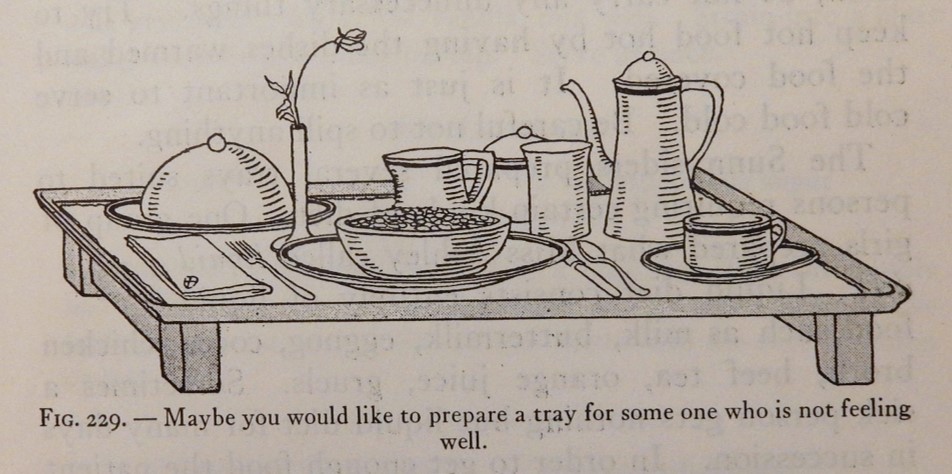
There is one thing that you can do and no doubt will enjoy doing, – preparing an attractive tray to carry to a person who is not well enough to come to the table. Of course, if the person is very ill, the doctor must tell you what to prepare, but there are many times when a person who does not “feel like eating” will be tempted to eat if some easily digested food, daintily prepared, is served. 

The tray should be made attractive with a clean cloth or doilies, and dishes that look well together. Nicked or cracked dishes should not be used if there are others to be had. Try to think of all of the utensils that are needed to eat what is served so that the person will not have to ask for anything. Butter, sugar, and salt should not be forgotten if they are to be used, and a glass of cold water is nearly always desired. On the other hand, do not carry any unnecessary things. Try to keep hot food hot by having dishes warmed and the food covered. It is just as important to serve cold food cold. Be careful not to spill anything. 

Household Arts for Home and School (Vol. 2) (1920) by Anna M. Cooley and Wilhelmina H. Spohr

1920 Lea & Perrins Sauce Advertisement

Advertisement for ea & Perrins Sauce
Source: Good Housekeeping (June, 1920)

I have a bottle of Lea & Perrins Worcestershire Sauce in my refrigerator. I use Worcestershire Sauce to give Sloppy Joes their tangy taste – but apparently I’ve never really appreciated its ability to make foods more gourmet. According to this 1920 advertisement for Lea & Perrins Sauce, it gives canned meat, soup, fish, and vegetables a real “chef” taste.

I wonder when the word “Worchestershire” was added to the name. Back in 1920, Lea & Perrins was just called a sauce.

Flower Arrangements for the Table

3 vases with flowers
Source: Household Arts for Home and School (Vol. 2) (1920)

Sometimes little things – like putting a vase with a few cut flowers on the table where I eat – energize me, and make an okay day seem like a great day. People a hundred years ago also appreciated cut flowers. According to a 1920 home economics cookbook, in a chapter titled Serving Luncheons:

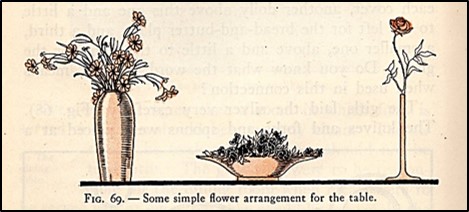
Fresh flowers give a lovely touch to the dining table, but they must not obstruct the view of persons sitting opposite each other (Fig. 69). Flowers may be kept fresh for several days if the water is changed daily. 

Household Arts for Home and School (Vol. 2) (1920) by Anna M. Cooley and Wilhelmina H. Spohr 

Hundred-Year-Old Advice About the Use of Candy in the Diet

pieces of Mint Chocolate Fudge on plateCandy is tasty, though it probably isn’t the healthiest food. Here’s what a 1920 home economics textbook said about candy:

The Use of Candy in Diet

Candy, is an energy-giving food, but unfortunately perhaps, it is not (at all times) a most desirable energy-giving food. Sugar exists in candy in concentrated form. Such sugar is irritating to the organs of digestion.

Sugar is contained in large quantity in some fruits, especially in dried fruits: figs, dates, prunes, etc. These fruits are a much better source of sweets for children than is candy, because they do not contain as much sugar, and have, in addition, valuable food materials in the form of ash. Note the large quantity of carbohydrates and ash in raisins.

Candy should never be used to excess or at the wrong time. A little eaten at the end of a meal is not harmful to the normal person. At that time the sugar is diluted because it is mixed with other foods. When diluted it does not irritate the digestive tract to the extent that it would if eaten between meals with no other foods. It is well to drink a generous quantity of water when eating candy or other sweets. Since molasses, honey, and maple syrup are not so concentrated as is sugar, they are desirable sweets for children – provided they are used moderately at the right time, and are mixed with other foods.

School and Home Cooking (1920) by Carlotta C. Greer

The old book mentions the role of “ash” in the diet. Today ash would be called minerals.

Hundred-year-old Food-related Math Problems

Basket with apples

Word math problems are a great way to engage students in learning how to apply the skills they have learned. Interesting problems encourage students to think creatively about how to solve problems that have applications in the real world.

Both in 2020 and 1920, there were many word problems that are based on food-related topics. However, there are major differences in the problems. Based on a quick scan of food-related problems on Pinterest, restaurant menu, food truck, pizza fraction, and food cost problems are currently popular. Food-related math problems in a 1920 home economics textbook also addressed cost, but with a slight twist. The focus of these hundred-year-old problems was on how to get a given number of calories for the least cost.

Problems

  1. A quart of milk gives 675 calories; a pound of lamb chops, 1600; a pound of eggs (eight or nine), according to size, 670 calories. With milk at 17 cents a quart, lamb chops at 48 cents a pound, and eggs at 60 cents a dozen, which food is the cheapest per 100-calorie portion?
  2. Cream of wheat has a fuel value of about 1600 calories and costs 15 cents a pound. Compare the cost of a 100-calorie portion of cereal with that of chops, milk, or eggs.
  3. Large oranges cost 60 cents per dozen. What is the cost of a standard portion?
  4. A good juicy apple yields about 100 calories. Dried apples give about 1320 calories per pound Find the difference in cost of 100-calorie portions, if fresh apples sell at the rate of 3 for 10 cents and dried apples cost 15 cents a pound.

Household Arts for Home and School (Vol. II) (1920) by Anna M. Cooley and Wilhelmina H. Spohr


1920 Tip: Use Paper Cups to Hold Picnic Salads

potato salad in a paper cupCooks have shared tips across the years. A hundred years ago Good Housekeeping magazine had a tips column called Discoveries. Readers could submit tips, and were paid one dollar for each tip that was used.

Here’s a tip for how to serve salads at a picnic:

Picnic Salad

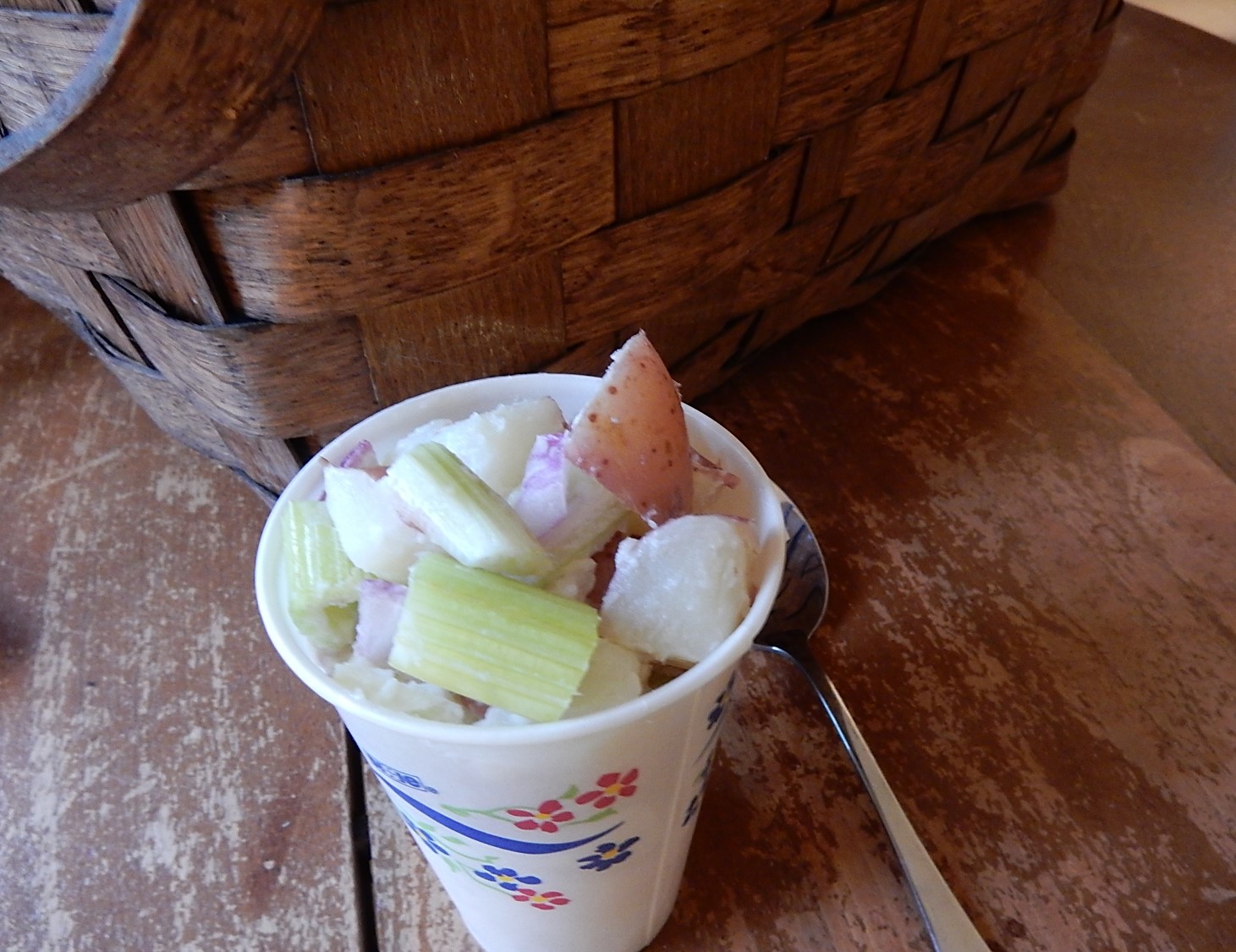
When going on little picnic suppers – especially in a machine, where one eats by the roadside or in the car seat – individual paper drinking cups are most satisfactory as containers for salads. The salad may be packed in the individual paper cups and garnished attractively with a sprig of parsley in one side. They always call forth favorable comments and are not messy to handle and each person has his own portion easily handed out.  – Mrs. R.H., D.C.

Good Housekeeping (June, 1920)