How Much do Americans Spend on Candy, 1920 and 2020?

gumdrops on plateOccasionally I see data in an old book that piques my curiosity – and next thing I know I’m searching for recent comparison data. This is one of those times.  According to a hundred-year-old home economics textbook:

We are told that American spend over $200,000,000 a year for factory-made candy. 

Household Arts for Home and School (Vol. II) (1920) by Anna M. Cooley and Wilhelmina H. Spohr

Which led me to wonder, how much did the average American spend on candy per year in 1920? According the 1920 U.S. Census, there were 106,000,000 people in the U.S. in 1920, so the average person spent $1.89 dollars per year on candy. According to Dave Manual’s Inflation Calculator, $1 in 1920 would be the equivalent to $12.50 today, so the average person in 1920 ate $23.65 worth of candy in today’s dollars over the course of a year.

This led to my next question, How much candy do American’s eat today? I found data for how much they spent on Halloween candy (but not for the entire year) -so the overall amount would be more. The data were for 2019, which I’m assuming is about the same as 2020.

According to the National Retail Federation’s annual survey conducted by Prosper Insights & Analytics, U.S. consumers are expected to spend $2.6 billion on candy or more than $25 on average.

How Much Candy Are You Buying for Halloween? This Survey Might Surprise You,” U.S.A. Today (October 5, 2019)

So the bottom line this at in Americans are spending more on candy today than they did a hundred years ago. In 1920, if the spending was adjusted for inflation, they spent an average of $23.65; today, just for Halloween, they spend more than $25.00 per year.

Save on Food Costs: 1920 Advice

squashFood is expensive today – and it was expensive a hundred years ago. Here is what someone a hundred years ago said about how they minimized their food costs:

We save on food costs. Twenty-five percent of the known incomes, allows $660 a year for food. I allow $540 or $45 a month, for a family of four. It means a very plain table. It means, too, that food costs are lessened by our flock of 12 to 15 chickens which returns 50% above its yearly cost, and by a garden from which I can vegetables and fruits. We pay in labor for part of our food – caring for the garden and the chickens.

From an article titled “Getting the Most Out of Your Dollar,” (Good Housekeeping; May, 1920)

A Thanksgiving Tale

slice of carrot pieHAPPY THANKSGIVING

Here’s a fun, old Thanksgiving poem that you might enjoy:

A Thanksgiving Tale

They sat on a shelf in the pantry-way cool.
Said Pumpkin to Mince Pie, “You crusty old fool.”
They squabbled and each of them thought himself best,
Till Pumpkin said, “Wait for Thanksgiving — the test.
I’ll bet you my pie plate that I’m eaten first;
While you, sir, uneaten with envy will burst.”

Thanksgiving Day came, and along with it, John,
Who ate everything his keen eyes fell upon. 
“A piece of each one,” Said this lad to the pies;
And, then I’ll determine which one wins the prize.”
But Johnny, alas! was unable to tell. 
For Johnny felt suddenly, — not at all well. 

Those wicked, old pies had continued their fight, 
Till Johnny’s poor tummy grew pained at the sight;
And Johnny said tartly, both pies were so bad,
No worse one than either could ever be had.
But I think to myself that young John was mistaken.
‘Twas mixing his pies so, gave Johnny that achin’.

Ellen M. Ramsay (American Cookery, November, 1919)

Mrs. Scott’s Seasonal Cook Books

Front page of Mrs. Scott's Seasonal Cook Books (Autumn, 1920)

EBay is a great source of hundred-year-old cookbooks. One “cookbook” that I purchased is a four-page newspaper supplement called Mrs. Scott’s Seasonal Cookbooks, Autumn 1920. When the supplement is folded, a quarter of the front page becomes the cookbook cover. It was originally published in a Philadelphia newspaper, The North American.

The cookbook contains 80 or so recipes that use seasonal ingredients. Recipes include Creamed Turnips (which I made earlier this week), Sweet Potato Puffs, and Christmas Sugar Cookies – as well a few recipes, such as Economy Fruit Cake, Smothered Guinea Fowl and Smothered Rabbit, that definitely seem like they are from another era.

The brittle yellowed newsprint pages somehow survived a hundred years. How could something so pedestrian have lasted so long? Somehow I just need to create a story for this little newspaper cookbook. . .

In my imagination, the original owner saved the newspaper supplement and tucked it away in a kitchen cabinet with the intension of making some of the recipes – but it was quickly forgotten. Years later her daugther was cleaning out the house, and came across the newspaper cookbook, and threw it into a box with many other things that needed sorting. She took the box to her own home, and set it in a corner of the living room for awhile. But somehow she never got around to sorting the items in the box, and as holidays approached, she decided to move the box to the attic, where it lay forgotten for another fifty years.

Then, another generation passed, and the son of the daughter of the original owner was cleaning out the attic and came across the box. When he opened it, he saw Mrs. Scott’s Seasonal Cookbooks, Autumn 1920, and thought, “Whew, this is old. I’d better keep it.” He took it to his home and put it in a file cabinet where it again was forgotten for years. Then, when dowsizing, he once again found the old  newspaper cookbook, and decided to sell it at a garage sale where it was purchased by a man who enjoys selling things on EBay. I then saw the cookbook on EBay, and bought it . . . and now it’s anyone’s guess what the next chapter might be for this cookbook, but I’m rooting that it will somehow, however improbably, survive another hundred years.

A Lunch Box Romance

Image of title of story
Source: American Cookery (April, 1920)

I love to read rich decriptions of food written by skilled food bloggers – even when it’s a bit over the top. Extravagant food descriptions aren’t new. Here are some excerpts from a fictional story that appeared in a 1920 magazine:

A Lunch Box Romance

From early youth Lucena Cottle had thirsted in secret for a romance and now she was face to face with her thirtieth birthday and none had come her way. Sidtracked by circumstances in the home of her widowed cousin-in-law, Mrs. Drusill Fifer, who took boarders for a livelihood.

However, as it chanced, the rank and file of Mrs. Fifer’s boarders- slangy young clerks, mostly whose brains ran to “swell” ties, “grand” movie shows and the like – made slight impression upon the fancy of Lucena. One, only one, was there whose stock stood high with her, and the, sad fact, was as helplessly shy as she, herself.

Dutton Filbert was not stylish, and his ties never bothered him. He was with an automobile company, and no doubt wore greasy overalls when at work, but he was always neat in the house, and Lucena liked his twinkling brown eyes.

The task of filling Mr. Filbert’s lunch basket daily was Lucena’s and one that she executed with zest. For, of all branches of cuisine duty, the preparing of sandwiches was one she especially loved and excelled in. No crude structures of slab-like bread and ragged gristly meat were those turned out by Lucena. Her’s – to see them was to taste them, and to taste them was to call for more. And no day-in-day-out sameness of construction dulled the appetite of the fortunate partaker thereof. One day, sliced cold, roast beef, thin, even, finely lean with narrow edging of delicate fat, nestled between the smooth, daintily battered slices of white bread and brown. Another day plentiful shavings of sweet, boiled ham, mustard-embellished, took the place of beef; or minced chicken, mingled with gravy, or scrambled egg, skillfully blended with chopped bacon of the alluring streak-of-fat-and-streak-of lean kind, serves as filling.

There were jelly tumblers of creamy rice pudding, and meringue custards, and marvelous mixtures of savory and spicy things baked in little brown casseroles; there were crisp, golden-brown turn-overs, fat and bulgy, merely hinting by a splash or two of candied red or orange-tinted juice, at the delights of their interiors, and cakes, never alike, two days in succession, but ranging widely from thin-edged wafers to wedges and triangles of loaf and layer cakes.

Mr. Filbert fully realized he was a lucky man.

One day Lucena got together a new gingercake that was a dream of joy – a sublimated thing, spice-breathing, raisin-spotted, of a spongy lightness and a delightsome dark red-brown hue. She placed two large blocks in Mr. Filbert’s lunch basket, and when next she overhauled the latter, she found not so much as an edge or a corner left. She did, however, find a bit of paper folded up in the napkins, which bore the following tribute:

Oh, gentle lady, who dost make
Such heart-enthralling gingercake,
Accept from me my thanks sincere
For treat the best I’ve had this year;
I’d like to ask you, if I may,
Please make another one someday.

—-

After that they took a walk and had a talk; and about the week next there’ll be a wedding.

Lucena laughed and said, “I don’t know what you call a courtship. It was all straightforward and right, and it came about through the medium of the lunch basket.”

American Cookery (April, 1920)

How Much Water Should I Drink? 1920 and 2020 Recommendations

glass of waterI recently came across advice in a 1920 home economics textbook about how much water we should drink each day – which led me to search for 2020 advice.
1920 Recommendations

When one rises in the morning, it is well to drink one or two glassfuls of water. From one to two quarts of water, either as plain water or in beverages, –should be taken each day. It used to be thought that water drinking during a meal was harmful. Scientific investigations have shown that this is a mistaken idea. Water may be drunk at mealtime. Indeed it has been found that it aids in the digestive processes, provided foods are not “rinsed down” with it, and provided very cold water is not used.

School and Home Cooking by Carlotta C. Greer (1920)

2020 Recommendations

The National Academies of Sciences, Engineering, and Medicine recommends that men drink 15.5 cups of water a day, and women drink 11.5 cups a day. But this is just a guideline.

How much water you need depends on a number of factors, such as what you eat and the way you move your body. Adequate hydration can even change based on climate and what the weather’s like on any given day.

Mayo Clinic

The 1920 advice recommends drinking 1-2 quarts of water a day. Since there are 8 cups in a quart, this would be 8 – 16 cups of water each day. The low end is less than the 2020 recommendation of 15.5 cups a day for men and 11.5 cups for women. A hundred years ago there was no differentiation in the amount needed by gender, whereas it is recognized today that men need more water than women.

The After-Church Dinner a Hundred Years Ago

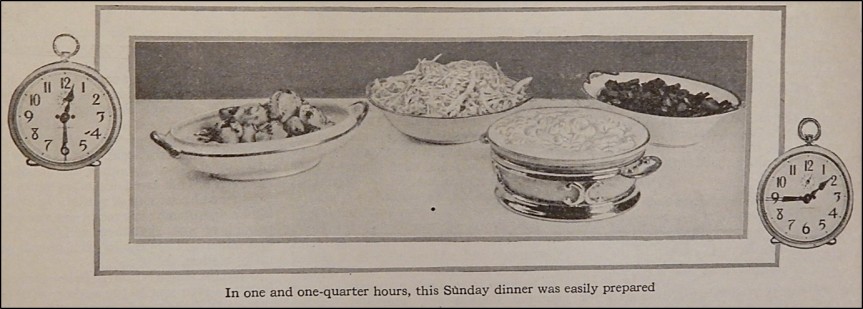
Foods for a Sunday Dinner
Source: Good Housekeeping (February, 1920)

Both in 1920 and in 2020, it can sometimes be challenging to get a meal prepared in a timely manner. Here are some excerpts from a hundred-year-old article in Good Housekeeping about successfully preparing a Sunday dinner:

The After-Church Dinner

Can I join my family at church on Sunday when there is a hearty dinner to prepare? 

“Yes,” answers Good Housekeeping Institute. “Let us show you the way. Go to church – then cook your dinner afterward, a dinner simple, yet hearty and tasty. Simplicity should be the keynote of the Sunday dinner.”

Save your more complicated meat, vegetable dishes, and desserts for the week-day meals, when time is not go great an item nor rest so essential. In their place serve broiled or baked chops, steaks, small roasts, or fish – meats which require little or no preparation and little time for cooking.

Simplify the vegetable courses by avoiding all scalloped or cream dishes which take so much time to prepare. Serve your potatoes baked in their jackets, boiled, or broiled, depending upon the various seasonings at hand to give variety to the vegetable. Serve carrots, turnips, celery, Brussels sprouts, and such vegetables in their simplest form, that is, either whole, sliced, or diced, according  to the vegetable; when properly cooked and delicately seasoned with salt, pepper, paprika, parsley, butter, etc., you will not long for the more elaborate dishes. Frequently serve from your store of home or commercially canned vegetables; these are cooked and require only reheating and proper seasoning to make them delicious. A salad course may or may not be included in your menu. 

At all times fruit is an acceptable dessert, particularly as a quick-time dessert. Many enjoy the fruit as it comes from the market; others prefer it cut up, slightly sweetened, and served plain or with cream. When fresh fruits are scarce, use your own canned fruit or that commercially canned. Such a dessert served with homemade cookies or cake cannot be surpassed. 

Good Housekeeping (February, 1920)