Chestnut Trees A Hundred Years Ago

16-year-old Helena Muffly wrote exactly 100 years ago today: 

Thursday, October 5, 1911: Besse was out a little while this afternoon. Brought some chestnuts. Didn’t have any before. Such an extraordinary occurrence. Ruth’s cow had twin calves. Both are white, rather good lookers. Ruth and I carried one down out of the field and out to the barn. Then we put him in the express wagon and he tumbled out.

Chestnuts (Source: Wikimedia)

Her middle-aged granddaughter’s comments 100 years later:

This entry befuddles me. I’m surprised that Grandma considered chestnuts a treat when her married sister Besse brought them, and that she’d never previously eaten any.

I would have guessed that chestnut trees were very common in central Pennsylvania in 1911—and my research supports that impression. Here’s what I found:

Chestnut trees were once more popular in the US than they are today—but many died due to a chestnut blight.

According t o Wikipedia, the blight was first identified on Long Island, New York  in 1904—and chestnut trees largely died out in the US over the next 40 years.  Wikipedia also says:

In some places, such as the Appalachian Mountains and others, one quarter of hardwoods were chestnuts. Mature trees often grew straight and branch-free for 50 feet (15 m), up to 100 feet, averaging up to 5 feet in diameter. For three centuries, most barns and homes east of the Mississippi River were made from it.

Bottom line—I still think that chestnut trees were common in 1911, so I’m still confused by this entry.

Twin Calves

It’s relatively rare for a cow to have twins. When I was growing up on a farm in the 1960’s we had a herd of 40 cows—and about one set of twins was born per year. I’m not sure how many cows the Muffly’s had, but it probably was in the range of 5 to 10 cows—so years probably went by between the birth of twins.

I can almost picture Grandma and her sister Ruth chatting and laughing as they collaboratively worked to bring one of the calves down to the barn.

For a discussion of how the Muffly children owned their own cows see the previous post on this topic.

Using Willpower to Improve Behavior

16-year-old Helena Muffly wrote exactly 100 years ago today: 

Wednesday, October 4, 1911: Had a clash with Ma this morning. I guess she thinks I am one terrible kid! I must bring about a reform if possible.

Her middle-aged granddaughter’s comments 100 years later:

I wonder what Grandma did.  This entry seems to indicate that Grandma believed that she was in the wrong—and that if she will had enough willpower that she might be able to “reform” herself.

In 1911 willpower was considered an important precursor of good behavior:

The Power of the Will or Inhibition

The conduct of mankind is chiefly governed by the emotions, instincts, and impulses.  . . .

“I am, I ought, I can, I will” are the only firm foundation-stones upon which we can base our attempts to climb into a higher sphere of existence. The first impulse a faculty of introspection, the second a moral judgment, the third a consciousness of the freedom to act, the fourth a determination to exercise that power.

Physical Hygiene and Physical Training for Women (1911) by Anna Galbraith

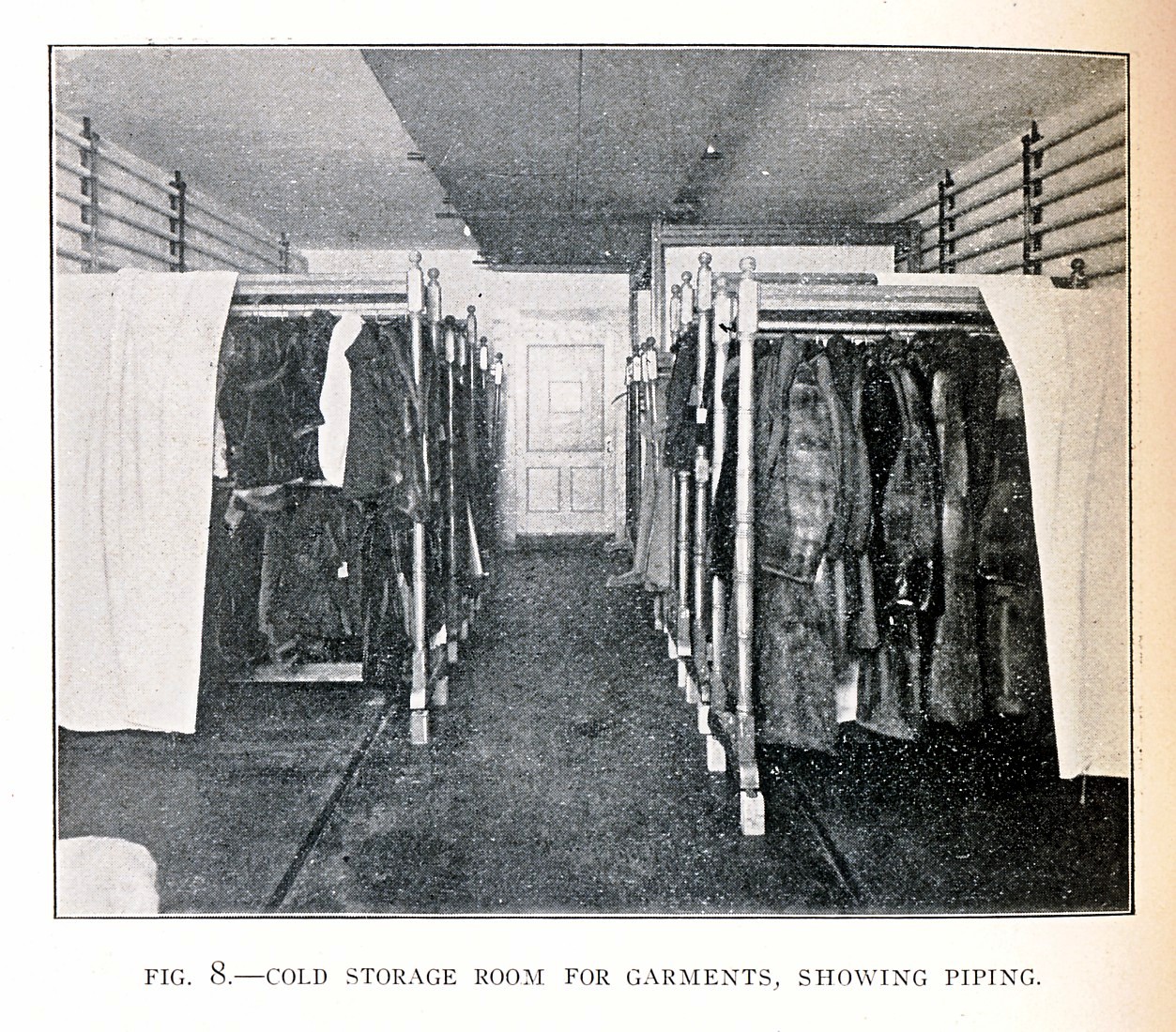
Cold Storage of Winter Clothes

16-year-old Helena Muffly wrote exactly 100 years ago today: 

Monday, October 2, 1911: It is beginning to get cold. Am thinking about my hat and coat, which are in the store as yet, but it doesn’t do very much good anyway.

Photo source: Practical Cold Storage (1905)

Her middle-aged granddaughter’s comments 100 years later:

A hundred years ago people sometimes took their winter coats, and other wool and fur garments, to a cold storage facility. This was done to help ensure that the clothes won’t be damaged by moths during the warm weather months.

I don’t understand exactly how cold storage rooms were kept cold, but the rooms probably were cooled by pipes filled with brine or ammonia. Compression machines may have been used.  There were a number of different methods described in a 1905 book, but a common method is described below:

In this system, the ammonia gas is driven off from aqua ammonia under pressure, by heating; the gas is liquefied by cooling, and the refrigerating effect obtained by expanding the liquid ammonia thus obtained though pipes surrounded by the medium to be cooled.

Practical Cold Storage by Madison Cooper

Definition of Outvie

16-year-old Helena Muffly wrote exactly 100 years ago today: 

Sunday, October 1, 1911:

Can the beauty of October be rivaled,

And the glories of summer outvie,

And the scenes of the Autumn forgotten,

Because they are doomed to die.

Oh you dreary days of autumn. It rained almost all afternoon. Papa and Ma went away visiting this morning. Took Jimmie along to be sure. Went to Sunday School this morning. Carrie was over this afternoon.

Her middle-aged granddaughter’s comments 100 years later:

On the first day in each month Grandma included a poem. This poem suggests that summer must be a better time of the year than October (autumn).

Today I learned a new vocabulary word. Outvie  means to be more of a rival than another.

Some words that were commonly used a hundred years ago are now seldom used or in some cases are even archaic.

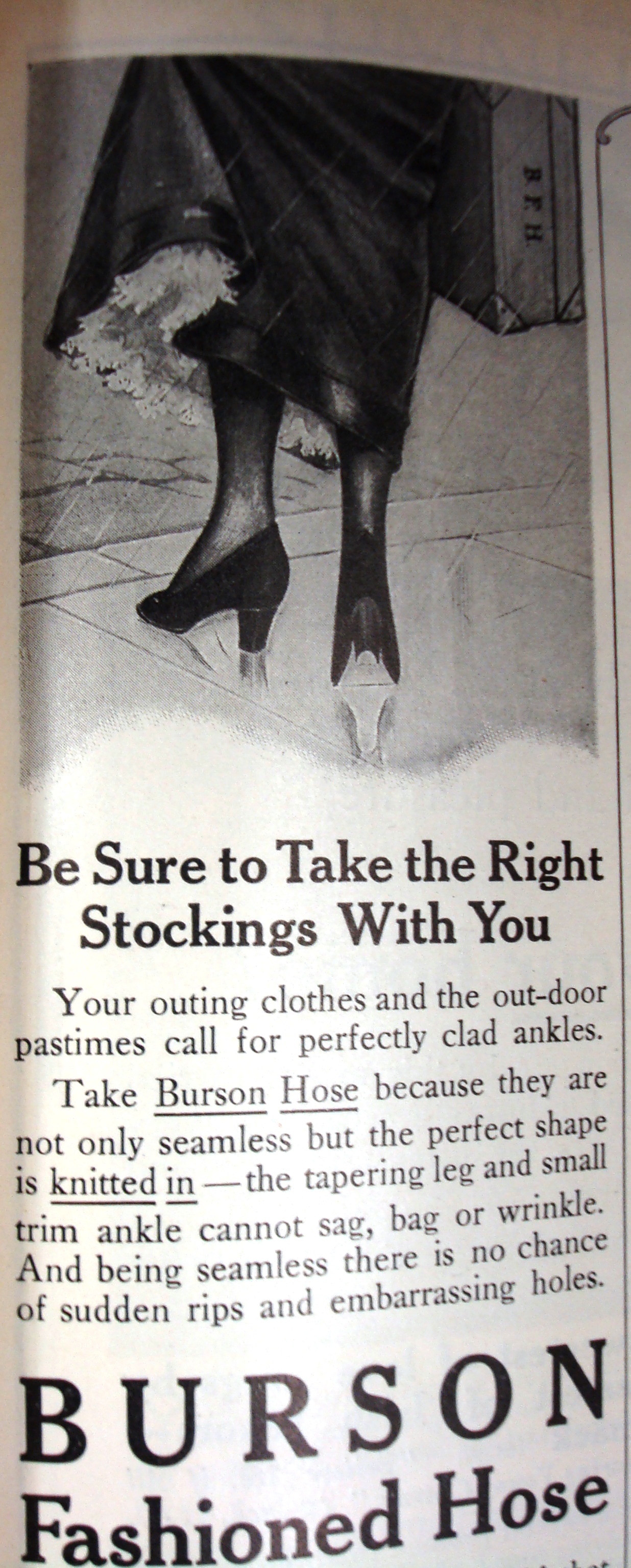
Went Shopping: Bought Toothbrush and Stockings

16-year-old Helena Muffly wrote exactly 100 years ago today: 

Saturday, September 30, 1911: Went to Watsontown this morning. Had to get a toothbrush and some stockings. Had to husk some corn this afternoon. It was my first attempt, so you see the piles of corn wouldn’t span out so rapidly. In addition to this I got stung by a bumble bee. How it did swell my thumb. Gee whiz!

Source: Ladies Home Journal (August 1911)

Her middle-aged granddaughter’s comments 100 years later:

A hundred years ago people in rural areas generally did not have electricity; many did not have telephones, and there were outhouses instead of bathrooms. Cars were a rarity; and it was a huge process to do laundry.

Yet, surprisingly—at least to me—you could go into a store and buy a toothbrush and stockings in 1911.  Until I read this entry, I never thought about whether people had toothbrushes a hundred years ago, but I don’t think that I would have guessed that these consumer goods were commercially available.

Miscellaneous Thoughts

It’s only late September. I’m surprised that the corn was dry enough to husk.

There must have been more insects a hundred years ago. This is the third time since June that Grandma has mentioned a bee sting (see June 21 and July 8).

Grandma’s Personality: Unbroken, Feisty . . .

16-year-old Helena Muffly wrote exactly 100 years ago today: 

Wednesday, September 27, 1911: All my fears, my doubts are over. Mollie and I are just in clover. She stands to perfection. She is entirely broken, hers indeed is a gentle nature, almost the opposite of her owner.

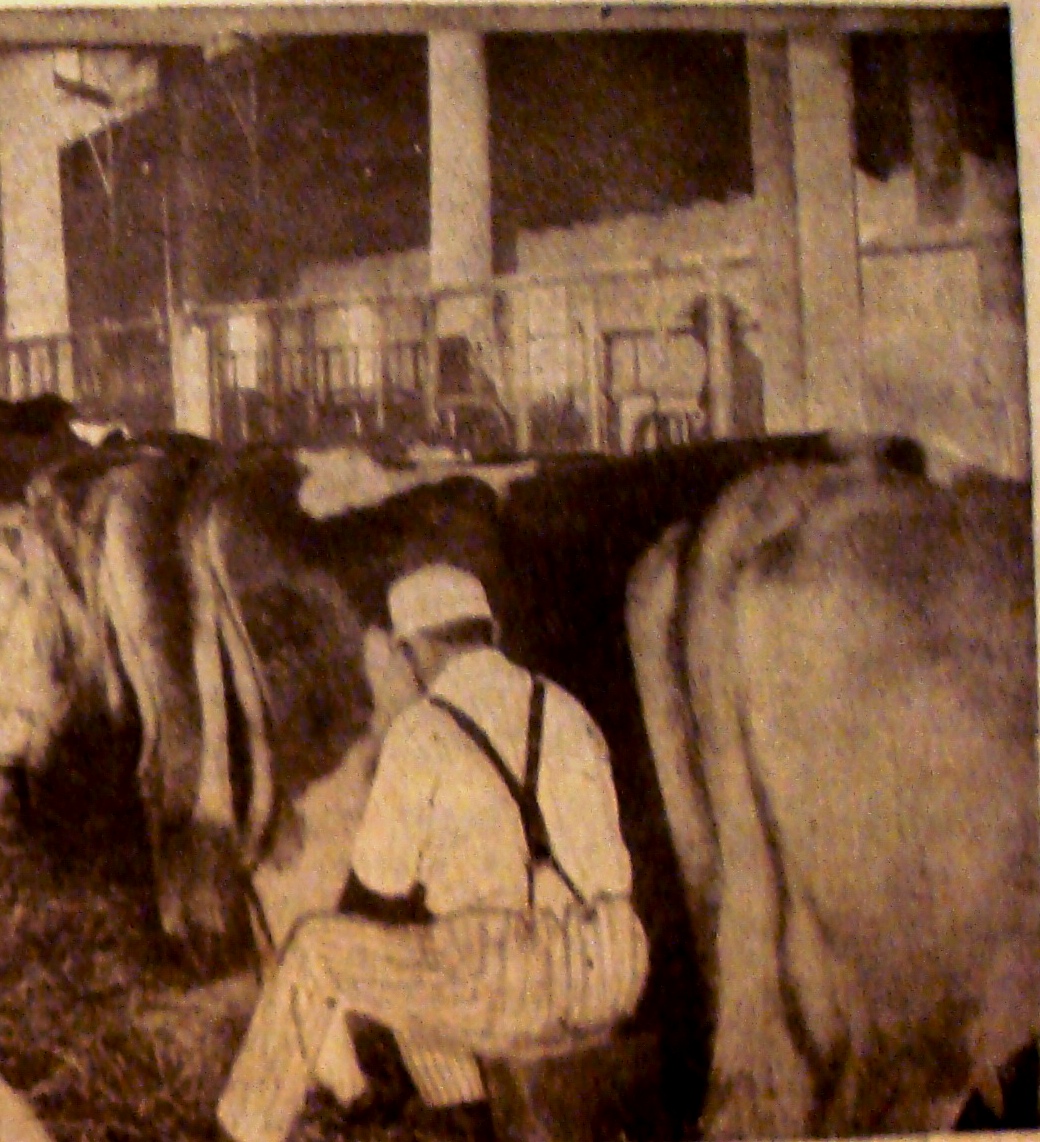
"Broken" cow standing still while being milked. (Photo source: Kimball's Diary Farmer Magazine, December 15, 1911)

Her middle-aged granddaughter’s comments 100 years later:

Mollie was Grandma’s cow. She had her first calf in August and it was sold two days prior to this diary entry. Grandma worried that the young cow would not take kindly to being milked—but Mollie apparently stood still and didn’t kick.

It’s interesting how Grandma compared herself to the cow. She said that the cow had been broken and had a gentle nature—but that she’s the opposite

This implies that Grandma considered herself to be feisty, energetic, a firebrand, a rabble-rouser.  . . .

I’d also argue that she was self-reflective.

I’m not sure whether Grandma saw these attributes as good or bad. Women a hundred years ago were generally encouraged to be obedient and to subsume personal desires. However, the suffragettes were active in urban areas —so maybe Grandma was able to see her spirited personality in a positive way.

But my gut feeling is that Grandma didn’t appreciate the value of these traits. Grandma was probably constantly told  by her parents and others that she was stubborn—and, reading between the lines– I sense that she was trying to change herself so that she was better behaved like the cow.

I know that I can’t change the past so I shouldn’t even go there, but I really, really hope that Grandma wasn’t too hard on herself.  A little feistiness is much better than a broken spirit.

Sometimes Little Brothers Get Even

16-year-old Helena Muffly wrote exactly 100 years ago today: 

Sunday, September 24, 1911: Went to Sunday School this afternoon. Only learned seven verses for today usually have twenty-seven. Was fooling with Jimmie tonight sprinkling him with water, but pretty soon he gave me a regular dunking (almost a whole tin cup full I judge) when I least expected it. Had to hang my dress up to dry.

Her middle-aged granddaughter’s comments 100 years later:

Jimmie was Grandma’s six-year-old brother. Sometimes when you tease little brothers they get even.

Memorizing Bible Verses

Whew, I can’t even imagine having a goal of memorizing 27 Bible verses a week. In fact, I can’t even imagine memorizing 7 Bible verses per week. Grandma was trying to memorize 700+ Bible verses for Sunday School so that she’d get a free Bible.  The diary entry from the previous Sunday said:

One reason for my regular attendance is that if you learn a number of verses from the Bible (over 700 it is) you will in the course of time receive a Bible.