17-year-old Helena Muffly wrote exactly 100 years ago today:
Friday, August 16, 1912:Was out in the field a while this forenoon. Didn’t fancy my job any too well. They had a lot of things to do today.
Early 20th century picture of harvesting potatoes. (The farm in the picture looks like it was much larger than the Muffly farm.) Photo source: Wikipedia.
Her middle-aged granddaughter’s comments 100 years later:
What was Grandma doing out in the field? . . . and why didn’t she like her job?
Maybe she was still leading horses that were pulling a roller over a recently plowed field.
. . . or maybe she was helping harvest the third cutting of hay.
. . . or maybe she was helping to dig and gather potatoes.
(I vote that she was helping harvest potatoes. It would have been dirty, backbreaking wok. It those days families raised lots of potatoes—both for eating and for selling — so the Muffly’s probably had an entire field of potatoes. I’m guessing that potato harvesting was not very mechanized in 1912, and that a lot of labor was needed to turn the soil over, sort through the dirt to find the potatoes, and then gather them .)
17-year-old Helena Muffly wrote exactly 100 years ago today:
Wednesday, August 14, 1912: Ruth and I went up to Oakes’ this evening. We were treated to the pleasure of hearing a Victor Victrola. I enjoyed it very much. It being the first time I had ever heard one play.
Source: Wikipedia
Her middle-aged granddaughter’s comments 100 years later:
The Oakes family lived on a farm near the Muffly’s. They had several children who were close in age to Grandma and her sister Ruth.
What a fun evening! I can almost picture 4 or 5 teen-agers and young adults gathered around the Victor Victrola machine listening to very scratchy music—while thinking that it was absolutely the most awesome thing ever.
The first Victor Victrola machine was produced in 1906—so the technology must have spread relatively rapidly if a farm family in rural Pennsylvania owned one by 1912.
Soon an extensive line of Victrolas was marketed, ranging from small tabletop models selling for $15, through many sizes and designs of cabinets intended to go with the decor of middle-class homes in the $100 to $250 range, up to $600 Chippendale and Queen Anne-style cabinets of fine wood with gold trim designed to look at home in elegant mansions.
Source: Wikipedia
One of the things that I’ve really enjoyed about Grandma’s diary is when Grandma mentions the first time she experiences various new technologies.
In May, 1912 Grandma rode in an automobile for the first time.
And, in 1911, Grandma used a telephone for the first time and also rode a ferris wheel for the first time;
17-year-old Helena Muffly wrote exactly 100 years ago today:
Tuesday, August 13, 1912: Yes sir,, and I did do the ironing this forenoon. All except two collars. Ruth went up to McEwensville this morning and was a long time coming home. I thought it wasn’t very nice.
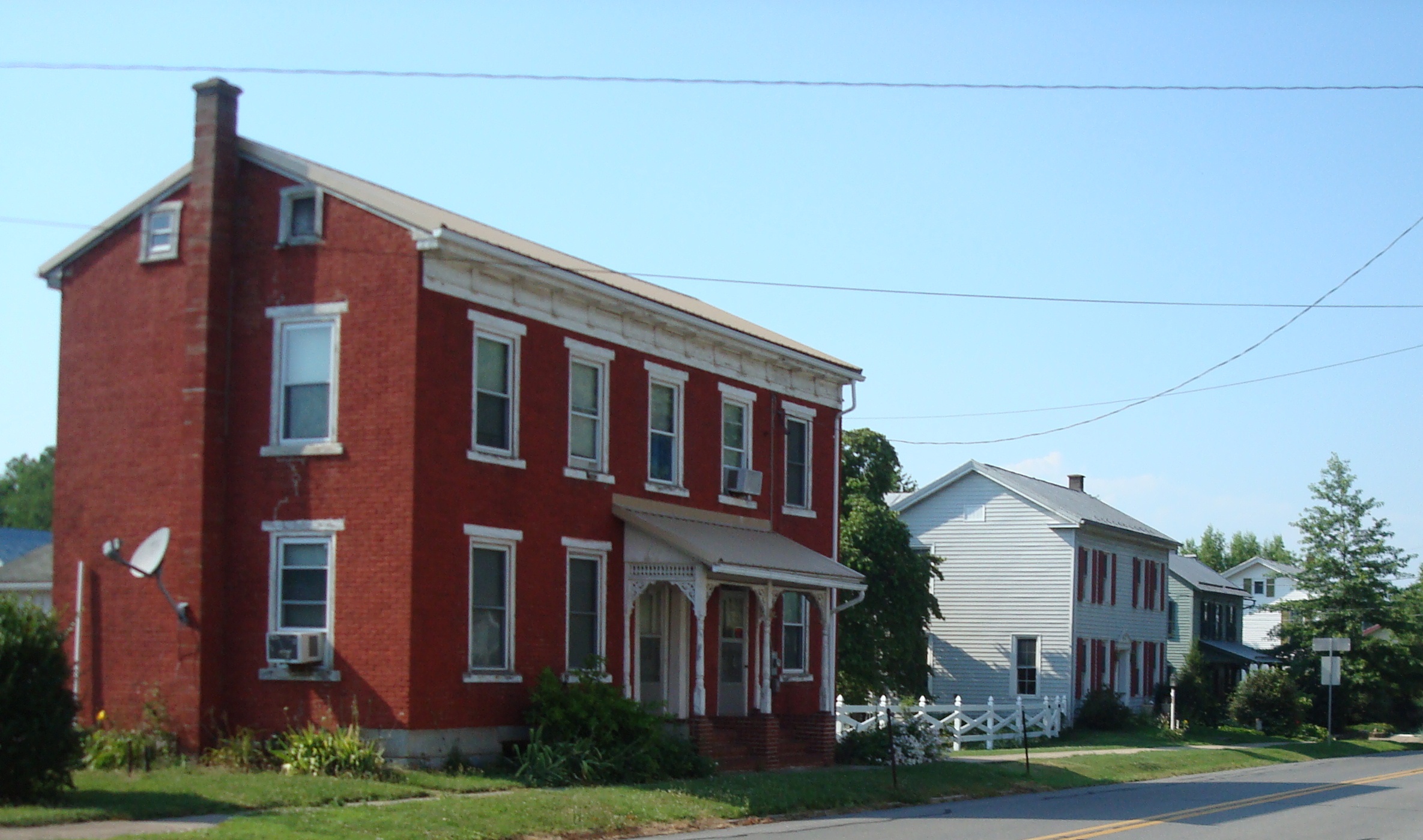
Recent photo of some houses in McEwensville
Her middle-aged granddaughter’s comments 100 years later:
Yes sir?? . . . Sounds like Grandma was mad at someone (her mother??).
Since Grandma’s sister Ruth didn’t get home in a timely manner, she apparently was ordered to do her sister’s chore (the ironing).
Why did Ruth go to McEwenville? Was it an errand? . . . to visit a friend?
17-year-old Helena Muffly wrote exactly 100 years ago today:
Monday, August 12, 1912: Went to Watsontown this afternoon to do some shopping, if such you may call it. Took my umbrella along, but it didn’t rain.
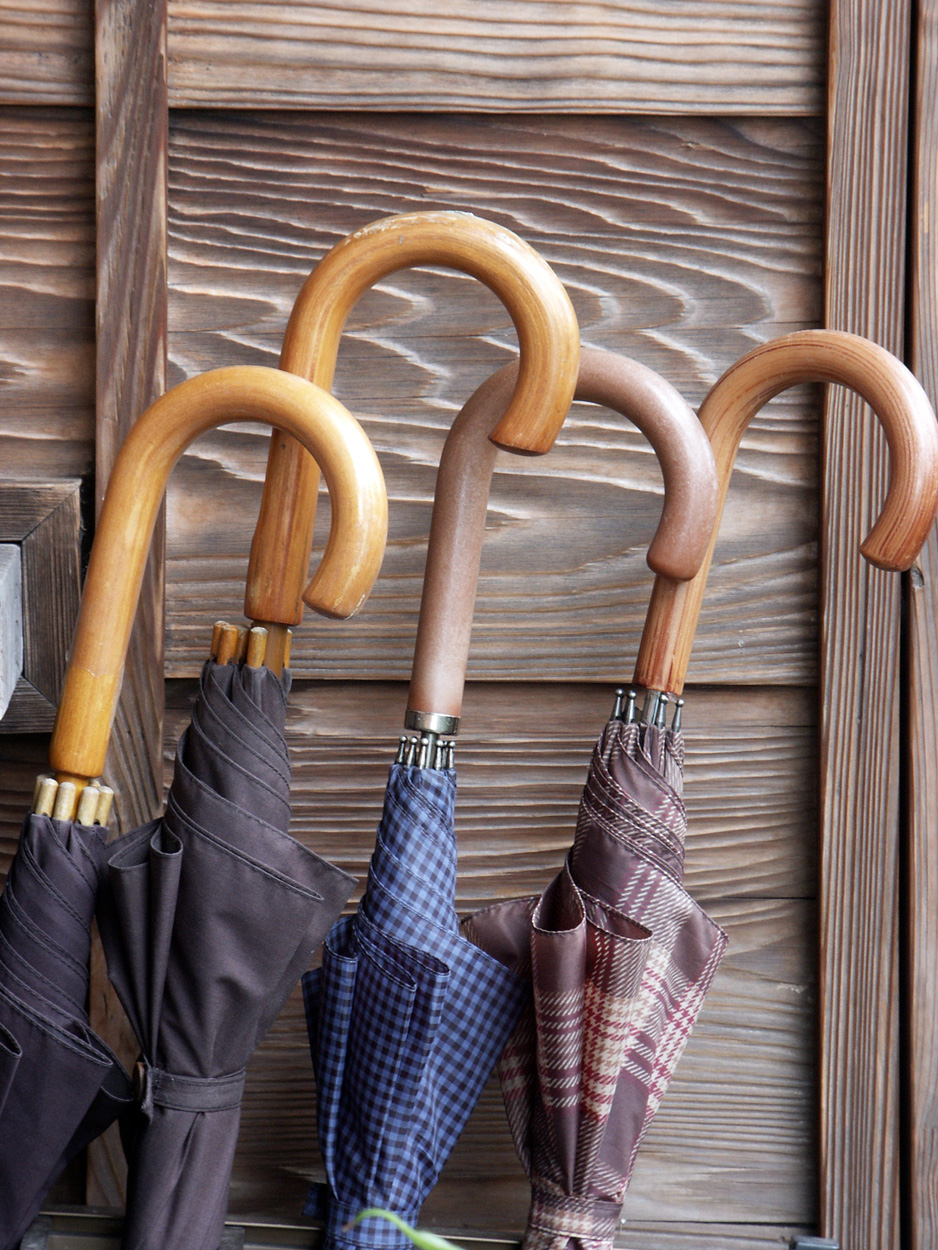
Photo source: Wikimedia Commons
Her middle-aged granddaughter’s comments 100 years later:
The previous day Grandma didn’t have her umbrella when she needed it:
. . . .got a dunking in the rain. Took an umbrella along part way, so it happened that I didn’t have it when I needed it the most.
And this day, she was prepared and carried an umbrella, but didn’t need it. Umbrellas didn’t fold as compactly back than as many do today. It probably was a real nuisance the entire time she was shopping.
Sometimes you just can’t win when guessing about the weather. . .
17-year-old Helena Muffly wrote exactly 100 years ago today:
Sunday, August 11, 1912:Went to Sunday School this afternoon. Went for some apples after I came home and got a dunking in the rain. Took an umbrella along part way, so it happened that I didn’t have it when I needed it the most.
Yellow Transparent Apples (Photo source: Wikipedia)
Her middle-aged granddaughter’s comments 100 years later:
I hope that Grandma was able to pick a few apples before it started raining. The first summer apples to ripen each year were special in those days.
Today we have apples year-round (sometimes from thousands of miles away), but in Grandma’s day the last of the apples from the previous year had probably been eaten in March or April—and after so many months in storage those last apples probably had been soft and mealy.
When I was a child, Yellow Transparent apples were the first to ripen each year. They made a wonderfully tart apple sauce. I haven’t seen a Yellow Transparent apple in years—there used to be so many apple varieties, each with a wonderfully unique taste and texture.
17-year-old Helena Muffly wrote exactly 100 years ago today:
Saturday, August 10, 1912: It didn’t rain this afternoon; it poured. Our front porch was a sight, sod covered it tonight. Ruth went up to Bryson’s on the train. Had to help her get ready. And now we’re here all alone, just we three. Seems so quiet and rather lonesome.
Her middle-aged granddaughter’s comments 100 years later:
With a drought over much of the country this year, rain sounds wonderful (even if Grandma was less than enthusiastic about it). Did the wind somehow blow grass or weeds up on the porch?
The tracks for the Susquehanna, Bloomsburg, and Berwick Railroad went along the edge of the Muffly farm. Ruth probably got on the train at a nearby feed mill. There was a whistle stop there.
It’s funny how Grandma gets so frustrated with Ruth—yet almost immediately misses her when she goes somewhere. I guess that’s just the way things go with sisters.
Why does the diary entry refer to three people being at home? It seems like there should have been four: Grandma, her mother, her father, and her little brother Jimmie.
17-year-old Helena Muffly wrote exactly 100 years ago today:
Friday, August 9, 1912:We had sort of s sewing bee here today. Besse was out and brought some of her stuff along.
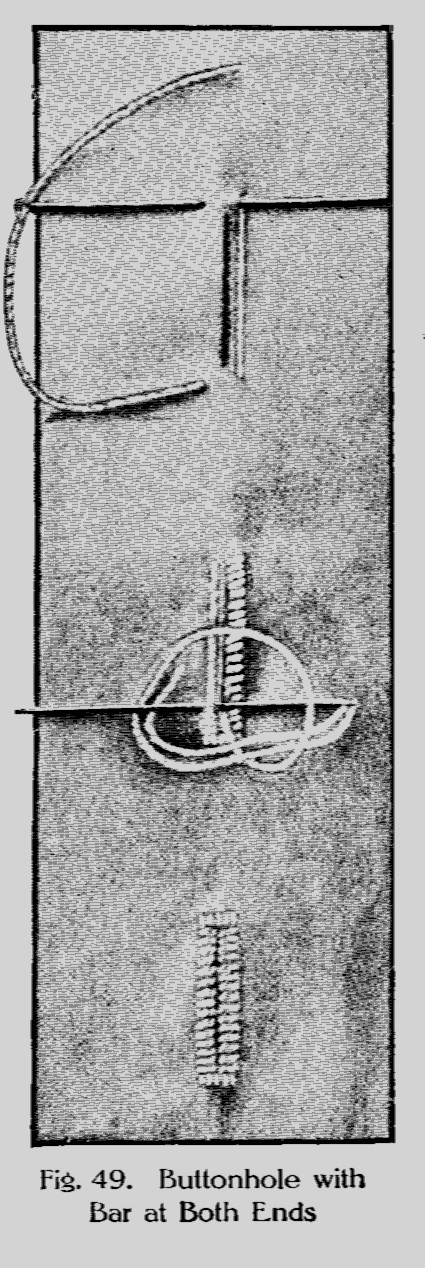
Source: The Dressmaker (1911)
Her middle-aged granddaughter’s comments 100 years later:
Besse was Grandma’s oldest sister. She was married and lived in nearby Watsontown. Was Grandma’s mother making buttonholes during the sewing bee?
Three days prior to this post, Grandma wrote that her mother was making her a dress for school, and I posted hundred-year-old drawings of dresses with lots of buttons.
Several readers commented that it would have been difficult to make a dress with that many buttonholes. One reader noted that people didn’t need to make buttonholes by hand a hundred years ago because treadle sewing machines had an attachment that made them.
But, in case, if you ever want to make them by hand, here are the directions from a hundred-year-old book:
A well-made garment that is otherwise perfect may be greatly injured in appearance by badly made buttonholes. They should always be properly spaced and marked before they are cut.
Mark the points for the top and bottom buttonholes, and divide the distance between these two points into the desired number of spaces. The slit must be cut on the thread of the goods, if possible, and must be large enough to allow the button to slip through easily.
With the buttonhole scissors carefully test the length of the slit and make a clean cut with one movement of the scissors.
Barred buttonholes are used for underwear, waists and shirts. To make the buttonhole bring the needle up at one end of the buttonhole, and, allowing the thread to lie along the edge of the cut on the right side of the material, stick down at the opposite end.
Do the same on the other side of the cut and stick down opposite the first stitch, with a stitch across the end to fasten the thread. If the material is inclined to fray, the edges may be overcast before working the button holes.
To make the stitch, place the buttonhole over the forefinger of the left hand, holding it in position with the thumb and second finger as shown in Fig. 48.
Begin to work the buttonhole close to the corner or starting-point. Insert the needle, and while it is pointing toward you, bring the double thread as it hangs from the eye of the needle around to the left under the needle. Draw the needle through the loop, letting the tread form a purl exactly on the edge of the slit.
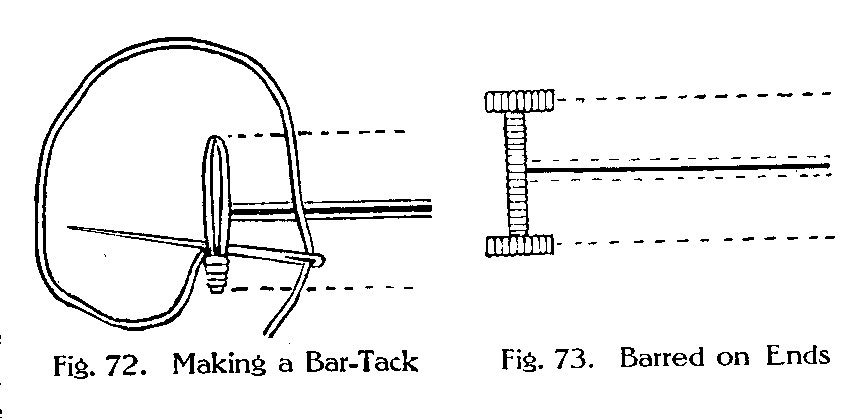
Continue these stitches to the opposite end, being careful to make them the same depth and close together. Now pass the needle up and down through the goods until two or three threads cross the end of the slit quite close to the button hole stitches, thus forming a bar tack.
At the end, turn the work around so that the bar end is toward you and make several buttonhole stitches over the bar tack and through the material. Work the other side of the button hole and the second bar.
The Dressmaker (1911) by The Butterick Publishing Company