17-year-old Helena Muffly wrote exactly 100 years ago today:
Monday, October 21, 1912: Some good kind of mortal ought to tell me what to write, for I am beginning to get at the end of my string, as you surely can see by the tone of this entry.
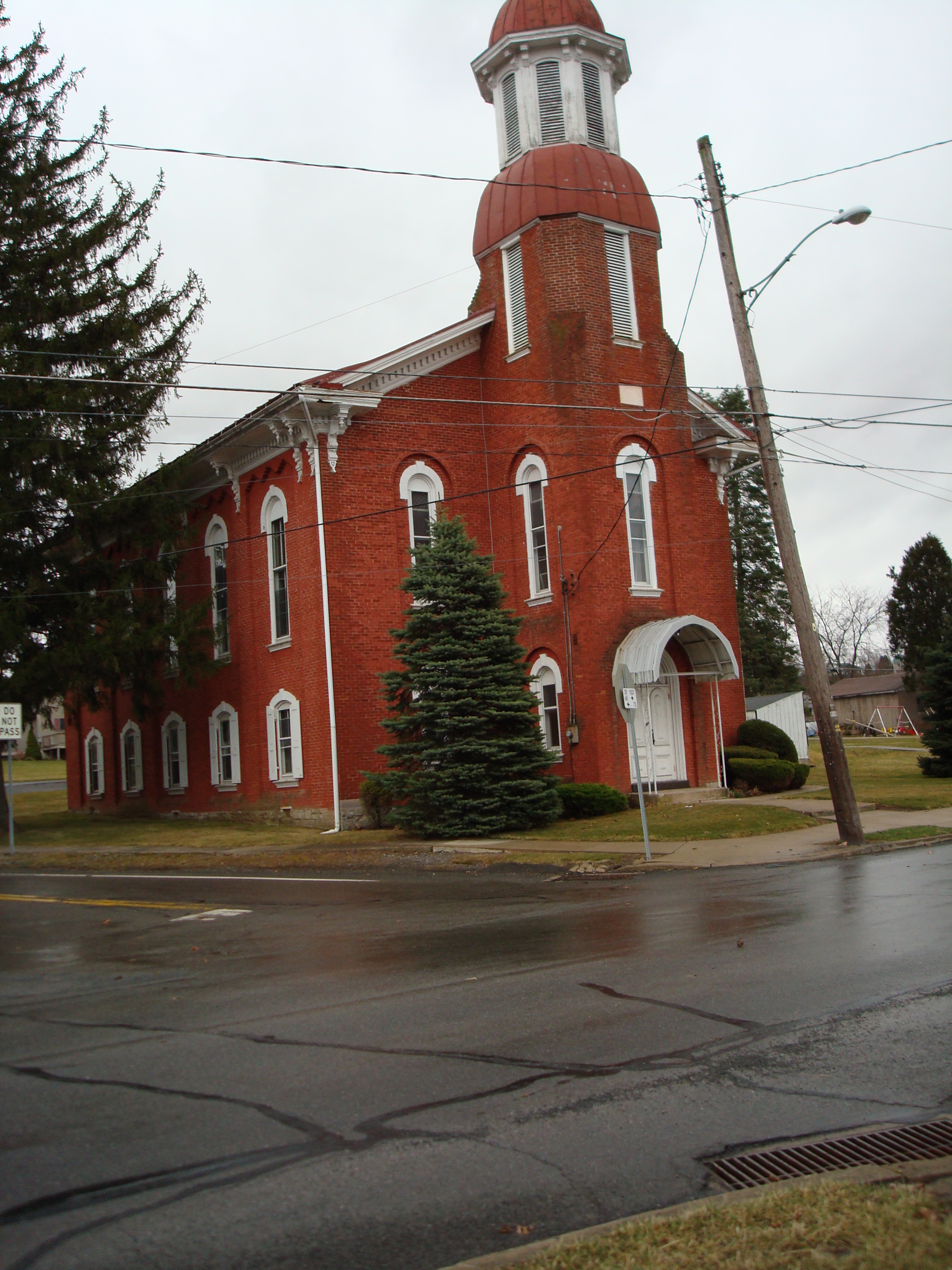
I wish that Grandma had described what downtown McEwensville was like back then. I think that some of these homes were stores back then.
Her middle-aged granddaughter’s comments 100 years later:
It’s interesting how Grandma seemed annoyed with herself when she couldn’t think of anything to write. Since she was keeping the diary for herself, it seems like she might have just some skipped days. But, Grandma seemed very disciplined about writing something every day. She must have been very firm with herself.
17-year-old Helena Muffly wrote exactly 100 years ago today:
Sunday, October 20, 1912: Went to Sunday School this afternoon. Mrs. Besse was here when I came home, but didn’t seem to make a very long stay of it.
The four Muffly siblings. Left to right: Helena (seated), Besse, Jimmie, Ruth (circa 1912)
Her middle-aged granddaughter’s comments 100 years later:
Mrs. Besse refers to Grandma’s oldest sister. Besse was married to Curt Hester and lived just outside of Watsontown—less than two miles from the Muffly farm.
This entry made me realize that Besse hasn’t been mentioned much in the diary recently.
I believe that she was most recently mentioned almost two months prior to this entry on August 9:
. . . Went to Sunday School this afternoon. Besse and Curt were here today.
Earlier in 1912, Besse had a baby that died shortly after birth. On April 9 Grandma wrote:
I was an aunt for one brief half a day yesterday, but didn’t know it until this morning. I was so disappointed when I heard it was dead. My little nephew was buried this afternoon. The baby I never saw. I feel like crying, when I think I am an aunt no longer.
My sense is that Besse was having a rough year—though you’d think she’d be spending more time with her mother and sisters rather than less.
17-year-old Helena Muffly wrote exactly 100 years ago today:
Saturday, October 19, 1912: Had to pick taters this afternoon. Thought perhaps I’d get out of it because it rained last night, but didn’t get out of it any way.
Harvesting potatoes in the German Democratic Republic in 1945. The country isn’t right–and the year isn’t right to illustrate this entry. But the picture does provide a sense of how much work it is to gather potatoes. (Source: Wikimedia Commons)
Her middle-aged granddaughter’s comments 100 years later:
It’s always dirty, difficult, back-breaking work to gather potatoes—and it must have been especially unpleasant if the field was muddy.
These potatoes probably were a long-season variety stored well.
I’m surprised that Grandma’s parents wanted to harvest potatoes if the ground was wet—it seems like the potatoes would have been a muddy mess.
17-year-old Helena Muffly wrote exactly 100 years ago today:
Friday, October 18, 1912: These days are beginning to be so much agreeable.
Source: Wikimedia Commons
Her middle-aged granddaughter’s comments 100 years later:
What makes a day an agreeable day? . . . warm, sunny weather?. . . a good day at school or work? . . . a visit with a friend? . . .good health?
Grandma must be feeling better. The previous day, she’d complained about a cold that she’d had for almost a week. It’s amazing how our health can affect our mood.
17-year-old Helena Muffly wrote exactly 100 years ago today:
Sunday, October 13, 1912: Went to Sunday School this morning. Had to amuse myself this afternoon because no one came to see me and most of the family had gone away.
Source: Wikimedia Commons
Her middle-aged granddaughter’s comments 100 years later:
What might Grandma have done to amuse herself on a boring Sunday afternoon?
17-year-old Helena Muffly wrote exactly 100 years ago today:
Saturday, October 12, 1912: Was busy hulling walnuts today. I estimated them to have amounted to about half a bushel. My work in that is not finished yet.
Black walnuts that fell on a country road
Her middle-aged granddaughter’s comments 100 years later:
A half- bushel of walnuts is a lot to hull (remove the outer layer)—though it’s going to be a lot bigger job to crack them after they dry.
I also gathered and hulled walnuts this fall—though I only gathered a couple pounds.
This year I wore plastic gloves when I hulled them. Last year I stained my hands while hulling them—and it took at least a week to get rid of the ugly brown stains.
17-year-old Helena Muffly wrote exactly 100 years ago today:
Friday, October 11, 1912: I’ve fully awakened to the startling fact that I’m getting another cold. It’s on its way. Had an exam in Caesar.
Maybe cough cream would help cure Grandma’s cold. Was this about the same thing as Vicks Vapor-rub? (Do they still make that?) Ad in November 1912 issues of Good Housekeeping magazine.
Her middle-aged granddaughter’s comments 100 years later:
This is the second cold that Grandma had during Fall, 1912. On September 1, 1912 she wrote:
I have one cracker jack of a cold. . . . .
I wonder if lower air quality due to the use of a wood or coal stove for heating might have contributed to the current cold. This is what the October, 1912 issue of Ladies Home Journal had to say:
When “Colds” Begin
No sooner do we light our winter fires than we begin to have “colds” and we blame it on the colder weather. Doctors know, however, that it is not the lower temperature that brings on “colds.”
If cold weather produces “colds,” why is it that they do not have such diseases in the Arctic regions, where today they are absolutely unknown? Why is it that Peary and his men never had a single “cold” until they came back to American shores—and our dry-heated homes?
God never created the oxygen in the air to make us sick, but to keep us well. If the fresh air can do so much to heal the lungs attacked by tuberculosis or pneumonia how much more can it do for the healthy lung? If fresh air can heal a diseased lung can it not likewise keep well a healthy lung? It is the dust and the dry heat inside our homes that produce our “cold”: never the fresh air. . .