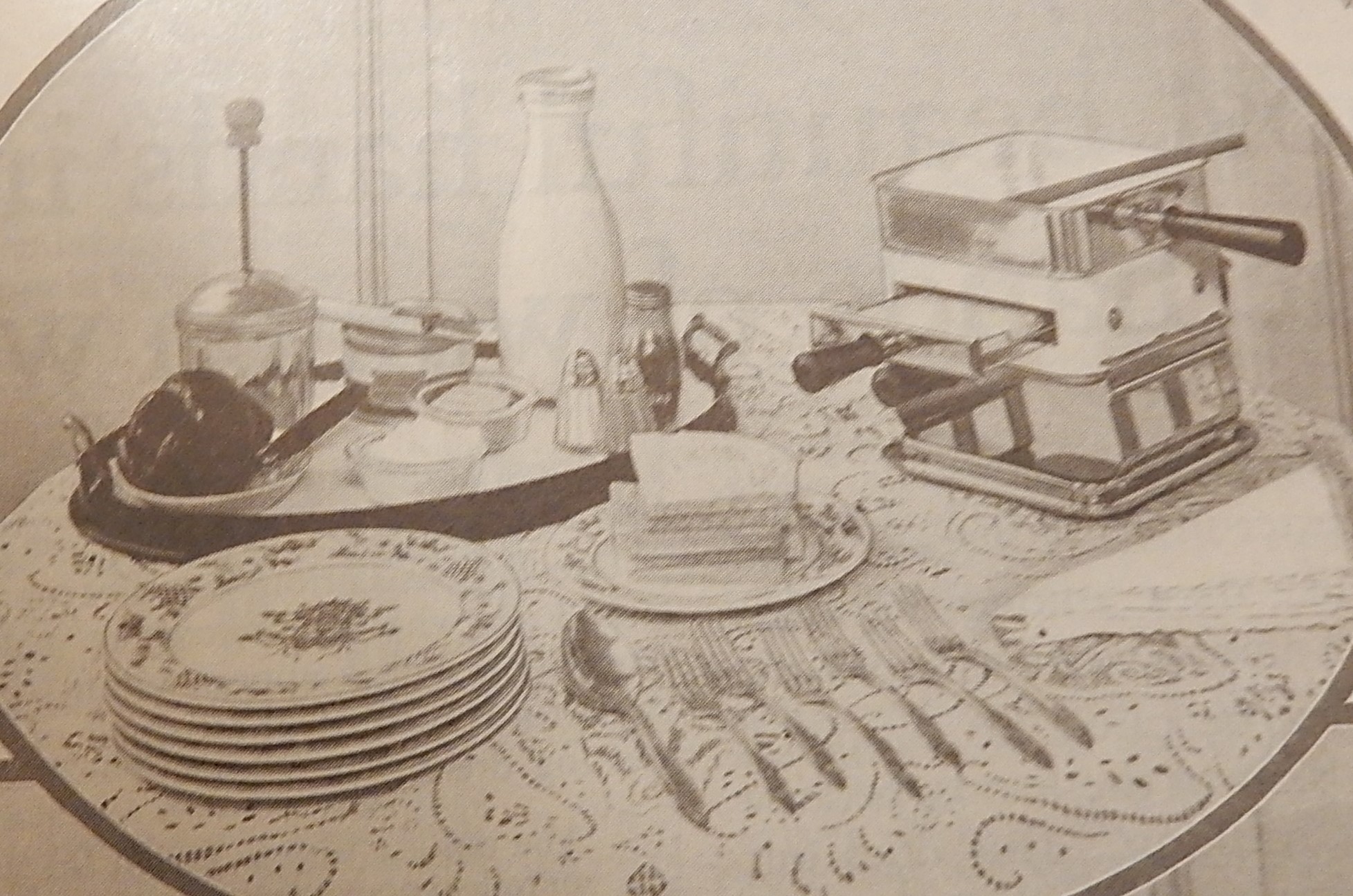
1924 Place Setting Diagram for a Formal Dinner

Place setting diagram
Source: Modern Priscilla Cook Book: One Thousand Home Tested Recipes (1924)

Does anyone host formal dinners anymore? I don’t. They seem like something from the past – though apparently formal dinners were on their way out even a hundred years ago. Here’s what it said in a 1924 cookbook:

A formal dinner is an expensive and elaborate affair not to be undertaken unless one has at her command plenty of help and plenty of money. Very few really formal dinners are given nowadays except in those circles of society where the rigors of etiquette are punctiliously observed. We live in an informal age, and yet through all our informality we observe, generally, more rules of correct usage than the average family has ever done before. That is, there are more of us trying to follow the rules of good manners and consideration (upon which quality all good manner are built) than was the case when one element of society lived and moved by rule, and the rest of it went as it pleased.

The Modern Priscilla Cook Book: One Thousand Home Tested Recipes (1924)

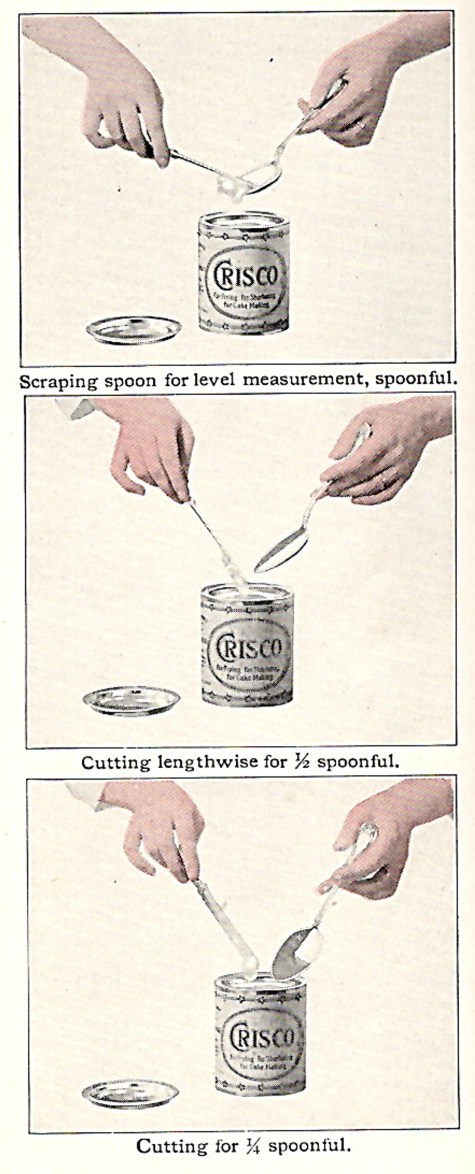
Hundred-Year-Old Directions for Measuring a Spoonful of Shortening

Drawings of how to measure shortening
Source: The Whys of Cooking by Janet McKenzie Hill (1924)

A hundred-year-old promotional cookbook for Crisco shortening had drawings showing how to measure a spoonful (or a half- or quarter-spoonful) of shortening. I knew that the spoon should be scaped to accurately measure a spoonful of shortening. I never would have thought of cutting lengthwise for 1/2 spoonful.

It was expensive to print color pages in a book in 1924. Apparently the cookbook publisher thought that directions for measuring a spoonful of shortening was a high-interest topic. Who would have guessed?

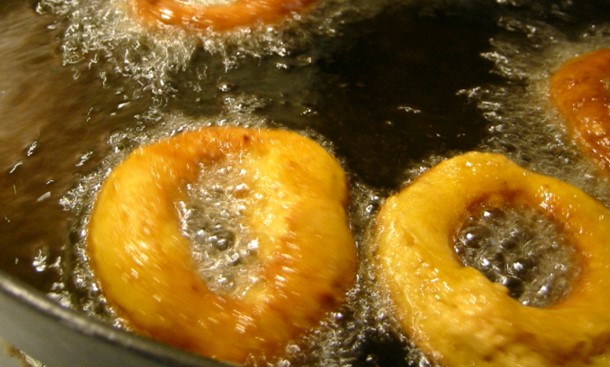
Hundred-Year-Old Tips for Frying Crullers, Doughnuts, and Fritters

Frying Doughnuts

Time to make doughnuts. It will be Fasnacht Day next week. Here’s what I wrote back in 2022:

When I was a child growing up in Pennsylvania, Fasnacht Day (the day before Ash Wednesday) was always a day when we ate doughnuts. Fasnacht Day was supposed to be a day to eat indulgent foods before the beginning of Lent – and doughnuts with their sugar and fat were considered the ultimate in indulgent foods. It is also known as Fat Tuesday or Shrove Tuesday.

A Hundred Years Ago, February 27, 2022

Sometimes it’s tricky to make good doughnuts. Here are a few tips in a hundred-year-old cookbook for frying crullers, doughnuts, and fritters:

CRULLERS, DOUGHNUTS, AND FRITTERS

Facts to Remember

The products of deep fat frying have a reputation for indigestibility which is deserved only when there is something wrong with the procedure. One difficulty is that under certain conditions food absorb more fat in frying than can be easily taken care of by the digestion, and another, that at a certain temperature, differing with each kind of fat, a change takes place which develops an indigestible product called acreolin. This is recognizable by its acrid odor. Fat should never if used after it has reach this point.

The temperature of the fat is of upmost importance in frying. If it is not hot enough the food absorbs fat; if too hot the outside browns before the inner part is thoroughly cooked. A thermometer is essential for the inexperienced cook in controlling the temperature, and it is advisable in any case.

Next to the frying temperature, experience in handling the dough is the most important part of doughnut making.

Dough which has been chilled can be more easily handled and absorbs less fat than the same dough at room temperature. In putting doughnuts into the fat, have the part which has been next to the moulding board uppermost.

Only a few doughnuts or fritters should be fried at one time, because the cold dough cools the fat rapidly.

Fried foods should be drained on absorbent paper.

There is no marked difference in the amount of absorption power for the various fats and oils in common use.

Modern Priscilla Cook Book: One Thousand Home Tested Recipes (1924)

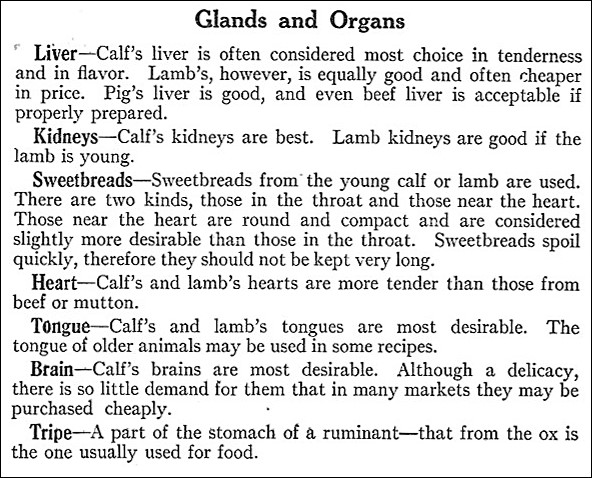
1924 Perspectives on Gluten

bread
Source: The Whys of Cooking by Janet McKenzie Hill (1924)

Today we tend to think of gluten in a negative way. But here is what it said about gluten in a 1924 cookbook:

BREADS

. . . The protein in flour is in the form of gluten, and while elasticity is a property of all proteins, the gluten of wheat possesses this property in marked degree. This strong elastic gluten makes a good framework to retain the air and carbon dioxide, and renders wheat the ideal grain for bread making. The protein in oats and corn are deficient in this property and when used in bread making are combined with wheat.

Wheat and flour vary greatly in the quantity of gluten present; even the same variety of wheat will vary from season to season. Also, in connection with the kind of wheat, the time of planting affects the quantity and quality of the gluten. Spring wheat sown in the spring and harvested the same season contains more protein and, consequently, more gluten than winter wheat sown in the fall and harvested in the early part of the summer. Flour from spring wheat, rich in gluten, is well adapted to bread making and is known as bread flour. It is creamy in color, granular to the touch and passes through a sieve easily; a slight jar sends it through. Flour from winter wheat is whiter in color and soft to the touch; if a quantity be crushed in the hand it will retain the impress of the lines in the hand. It tastes sweet. It is adapted to the making of starch. It is adapted to the making of cake and pastry articles; foods in which delicacy rather than strength is sought. Such flour is known as pastry flour.

Source: The Whys of Cooking by Janet McKenzie Hill (1924)

Why Does Yolk of Egg Keep White From Beating Stiff?

egg white with a little yolk mixed in

I know that if there is even a bit of yolk in egg whites that they won’t beat well, and that it is impossible to get stiff peaks. Over the years, I’ve often broken a yolk when separating the whites from the yolks and ended up discarding the egg white (or the whites from multiple eggs if I was being cavalier and had assumed that I wouldn’t have problems and directly separated eggs into a bowl that already had whites from other eggs). But I never knew why until I read a short article in a hundred-year-old magazine. (It’s amazing how many new things I’ve learned over the years from old books and magazines.)

 Why Does Yolk of Egg Keep White from Beating Stiff? 

If even a small portion of the yolk of the egg gets mixed with the white, this will keep the white from beating to the same kind of stiff froth that the white alone will beat into, because there is enough oil present, in the little portions of yolk, to keep down the froth. You know you cannot beat olive oil, for instances, into a froth. You know that “pouring oil on troubled waters” is a very real, rather than poetical expression of the smoothing-down effect of oil on a rough sea and angry breakers. Yet if only a very little of the yolk gets mixed with the white, and if you beat long and hard, you will get a fluffed up mass, though not of the same texture attainable by beating of the white alone.

American Cookery (December, 1924)

Okay, I guess this makes sense – but I’m still a little confused. Why can heavy cream (with lots of fat) be whipped into stiff peaks, while skim milk (with no fat) doesn’t whip at all?