Children’s Dining Sets a Hundred Years Ago

Children's table and chairs
Source: American Cookery (December, 1926)

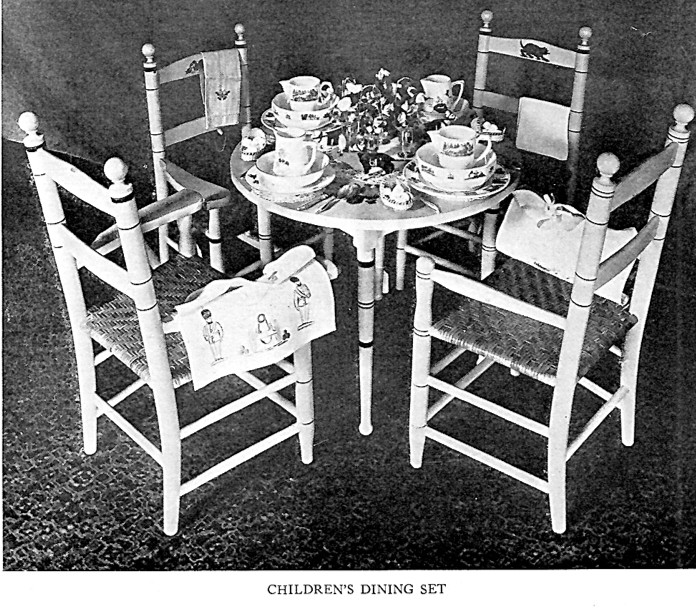
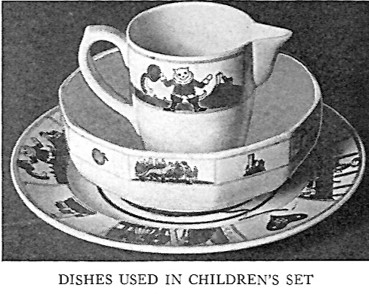
My grandson has lots of play dishes, pots and pans, and foods. He loves to make and serve “pizza,” “fruits,”  and other foods. A hundred years ago, children also enjoyed play dining sets. Both then and now, children like to role-play and use their imaginations.

Children's dining set
Source: American Cookery (December, 1926)

A 1926 issue of American Cookery had an article titled, “Treat the Nursery from an Educational Point of View” that encouraged parents to provide their children with toys that “excite his little mind.”

(I was pleasantly surprised that the old magazine referred to “his mind.” Some argue that toys today are too gendered. In 2026, I think that tea sets and many cooking-related toys are sometimes considered “girl” toys. It’s nice that the author in 1926 thought boys – and I assume girls – both would enjoy playing with children’s dining sets.)

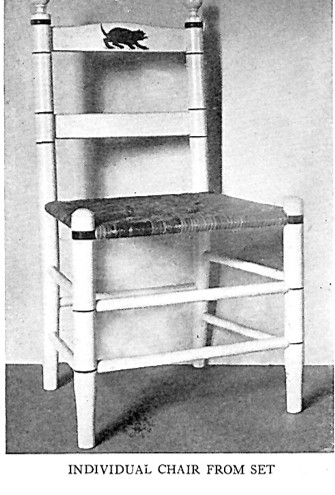
Child's chair

Source: American Cookery (December, 1926)

Have Grandma’s Recipes Been Ghosted?

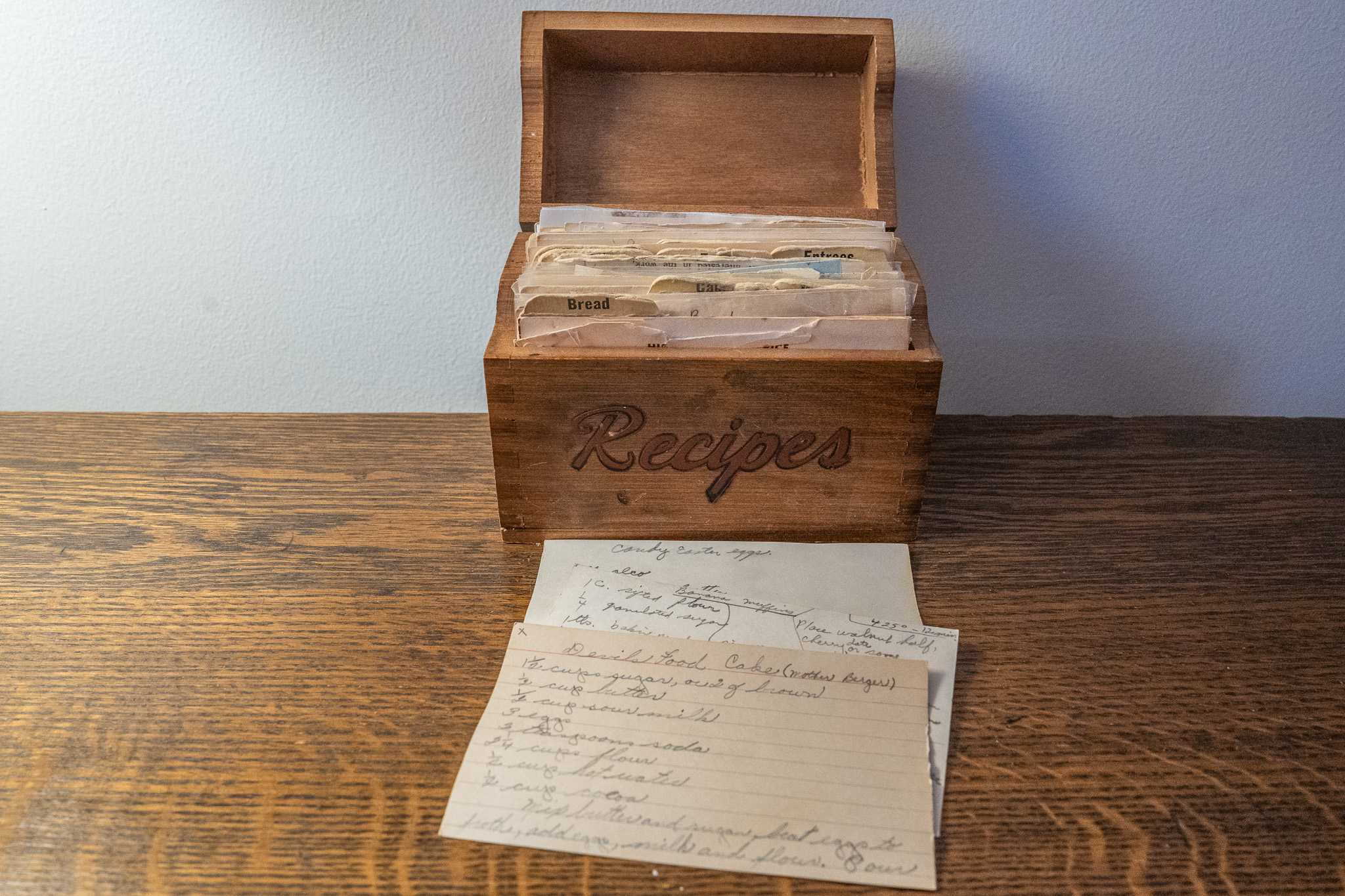
Recipe box and cardsMany dishes on the holiday dinner menu are the same year after year, and there can be complaints if a dish vanishes or is “different” from how Grandma used to make it. So, I was surprised when a friend said, “Grandma’s recipes have been ghosted.”

My first reaction was “No way. ”

I know from comments I get on this blog that many people are looking for old-recipes that they have vague memories of ancestors making years ago. I regularly get comments like, “Thanks! I’ve been looking for this recipe for years. It is almost exactly like the recipe my grandmother made when I was a child.”

But, the more I thought about whether old family recipes are being ignored, the more I think that my friend was right. Grandma’s recipes are frequently ghosted.

My own efforts to create a cookbook to preserve family recipes ended up resulting in the beginnings of A Hundred Years Ago. In 2009, I compiled a  family cookbook. I included some family photos in the book. One of them was a photo of a surprised-looking me walking through a doorway at my bridal shower. Sitting on the couch in the photo’s foreground was my 82-year-old paternal grandmother.elderly woman sitting in room with younger woman in background
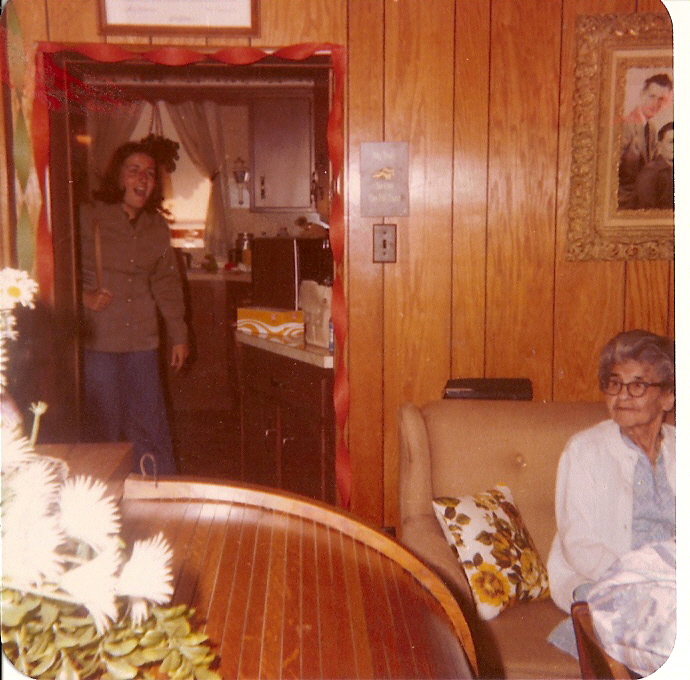
A much younger me arriving at my bridal shower with my grandmother sitting near the doorway.

When I gave the cookbook to my children, my daughter asked, ” Who’s that old lady.”

I told her that it was her great-grandmother. But her question jogged my memory about a copy of an old diary of my grandmother’s that I had. I dug it out of a cupboard and discovered that Grandma kept the diary from 1911 – 1914. She was a teen-ager at the time.

I realized that it would be exactly one hundred years since Grandma wrote the first diary entries very soon. I decided to post Grandma’s diary entries a hundred years to the day after she wrote them on a blog I called A Hundred Years Ago. I originally did it for family, but soon others were also enjoying the diary entries. However, after four years the diary ended. I briefly quit blogging, then re-invented A Hundred Years Ago as a cooking blog.

Over the many years that I’ve done this blog, I’ve learned a lot from my readers about the value of preserving family recipes as well as the challenges. Here is a summary of what I’ve learned.

Understanding the Challenges

Cursive Writing is Difficult to Read. Old recipe cards often were written in cursive and are extremely difficult to read. Younger cooks never learned to read or write cursive text, and older people often don’t interact much with cursive anymore and now find it hard to read.

I recently spoke with a graphic designer who said that she advises clients to avoid the use of script-style fonts when laying out promotional materials or an advertisement. She said, “People just can’t read it.” This suggests that if people struggle to even read typed script fonts that old handwritten recipe cards are almost impossible for them to decipher.

Old Recipes Lack Directions. Another challenge for modern cooks is that old recipes often have few, or confusing, directions. Many cooks just throw up their hands and give up on a recipe when it says things like “add enough flour so that the dough can easily be rolled” or “bake in a quick oven.”

Dirty, Worn Recipe Cards and Cookbooks Are a Nonstarter. Cooks today often find the old recipe cards and books that their Grandma once used to be unappealing. Old cookbook pages are yellowed, often there are loose pages, and the book spine may be torn. Many of the pages may have food stains, which can be considered badges of honor that indicate which pages contained Grandma’s favorite recipes; but, more often, just seem like dirty (and perhaps germy) pages.

It’s Hard to Know What a Dish Will Look Like When There is No Photo. Cooks today regularly use online recipe sources (as well as modern cookbooks) that show vibrant recipe photos that help them decide which foods to make, while old recipe boxes and cookbook pages are crammed with recipes, but contain few or no pictures. This can make it difficult for a cook to envision what the dish would look like.

Sharing Family Memories

Dishes that once were common foods may now be considered old-fashioned, not appealing, or not very healthy; however, they become part of family lore and traditions. I want to think that old family recipes pull families together at holiday gatherings by becoming the basis for stories and memories. But, I also know that they can create challenges.

When a family sticks rigidly to the traditional menu for a holiday gathering, family members who do not eat animal products, have food allergies, or have environmental concerns about certain foods can feel frustrated or hurt that their needs are not met.

Yet, who can’t smile when a family matriarch remembers a great aunt who has been gone for forty years, and tells the story (for the 39th year) about the time Great Aunt Emma’s molded, canned fruit gelatin collapsed into a mushy mess when she was unmolding it right before dinner.

Discussing Grandma’s Recipes

Family members can have different opinions regarding how much (or if) their grandmother’s recipes can be adapted or modified without changing them so much that they are no longer her recipe. There probably would be general agreement that it is okay to cook a stew in a crock pot rather than in a pan on the stove as described in an old recipe.

However, if an old recipe for apple pie called for using shortening when making the pie shell and Northern Spy apples for the filling, some family members may think that it is okay to substitute butter for the shortening for the crust and to use another apple variety in the filling, while others might say that the pie no longer tastes like Grandma’s. Still others might chime in that it would be nice if Grandma’s old recipe was updated so it was gluten-free and vegan so that everyone could enjoy it.

Some might worry that “Grandma won’t approve of us changing her apple pie recipe,” while others might note that Grandma herself may have “modernized” the recipe when she updated her grandmother’s recipe so that it used shortening instead of lard. This could lead to a discussion about whether the recipe should be converted back to using lard for the pie pastry now that research suggests some possible health issues related to the use of shortening.

Preserving Grandma’s Recipes

Everyone seems stressed this year, and worried that discussions at the holiday dinner table may go sideways with one disagreement or another. Maybe it would be a good time, when everyone is there, to discuss how to preserve their Grandma’s recipes and make them more accessible.

What it means to save Grandma’s recipes will differ from family to family. In some cases, it might mean developing a plan for typing them up and creating a family hard-bound or electronic cookbook. In other families, it might mean making videos that show how to prepare favorite recipes; while, still others might have discussions about how to update the recipes to make them more user friendly, or how much a recipe can be updated without destroying it.

Let’s not ghost old family recipes, but rather use them as connectors that bring families together. Those old recipes can be a powerful tool that engages family members across generations.

1925 Practical Christmas Gift Suggestions

1925 gift ideas
Source: Ladies Home Journal (December, 1925)

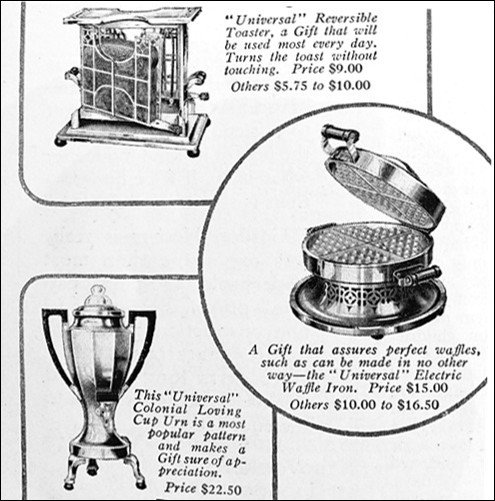
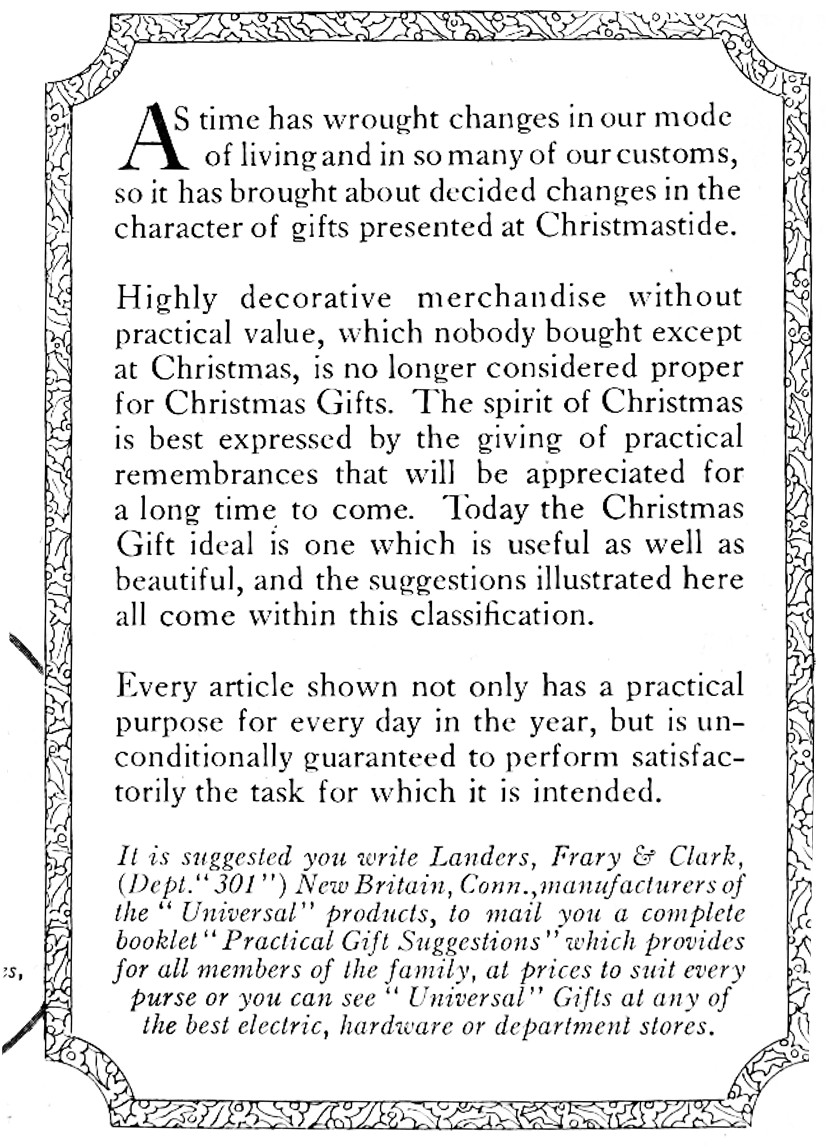
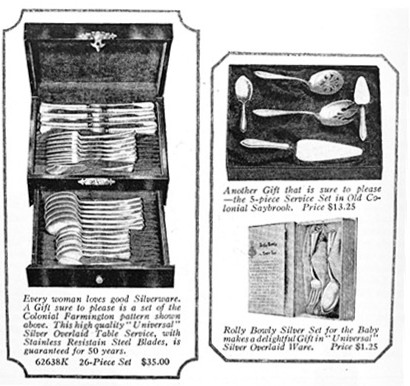
Social media and online retailers offer lots of Christmas gift suggestions. Similarly, a hundred years ago people turned to magazines when looking for gift suggestions. The December, 1925 issue of Ladies Home Journal included an infographic advertisement that contained “practical Christmas gift suggestions.” for “Universal” products from Landers, Frary, and Clark.

Text about Christmas gift suggestions
Source: Ladies Home Journal (December, 1925)
1925 Christmas gift ideas
Source: Ladies Home Journal (December, 1925)

1925 New York City Milk Bar

glass of milkWhy isn’t milk a popular drink option in restaurants, at sports events, and at other places where beverages are served? Coffee bars and shops are ubiquitous, and juice bars exist for those seeking healthier options. Beer, wine, and other alcoholic beverages (as well as mocktails) can be enjoyed at restaurants and bars. but a cold glass of milk is seldom featured as a drink option. “Milk mustache” ads once promoted drinking milk, but I haven’t seen one in years.

A hundred years ago, the U.S. was in the middle of the prohibition era, and people were looking for other drink options. According to a short article in the September, 1925 issue of Farm Journal, there was a “milk bar” in New York City’s Grand Central Station:

Article about NYC Milk Bar
Source: Farm Journal (September, 1925)

Did commuters in their business suits and dresses grab a quick glass of milk on their way to and from work? Maybe families visiting the city’s museums had some milk before catching the train home. And, maybe stylish people downtown for a day of shopping balanced a glass of milk while toting bags filled with the latest fashions.

Grand Central Station
Source: Pennell, J. (1919) Concourse, Grand Central. New York, 1919. Retrieved from Library of Congress public domain photo collection, https://www.loc.gov/item/2003673554

In order to learn more about this counter selling milk in Grand Central Station, I searched for additional information, but had little luck – though I discovered that there now is a chain of bakeries called Milk Bar (including the company’s flagship bakery in New York City) that are not known for their milk, but rather for “compost cookies” and other sweets.

I want to believe that the original milk bar in Grand Central Station was a huge success, but the fact that I can find nothing to corroborate the Farm Journal article makes me think that it may not have lasted long.

Still, in our current era, when poor nutrition is endemic, maybe there is a need to once again have actual milk bars where milk is promoted as a popular drink of choice.

1925 Thanksgiving Menu

Thanksgiving Menu
Source: Ladies Home Journal (November, 1925)

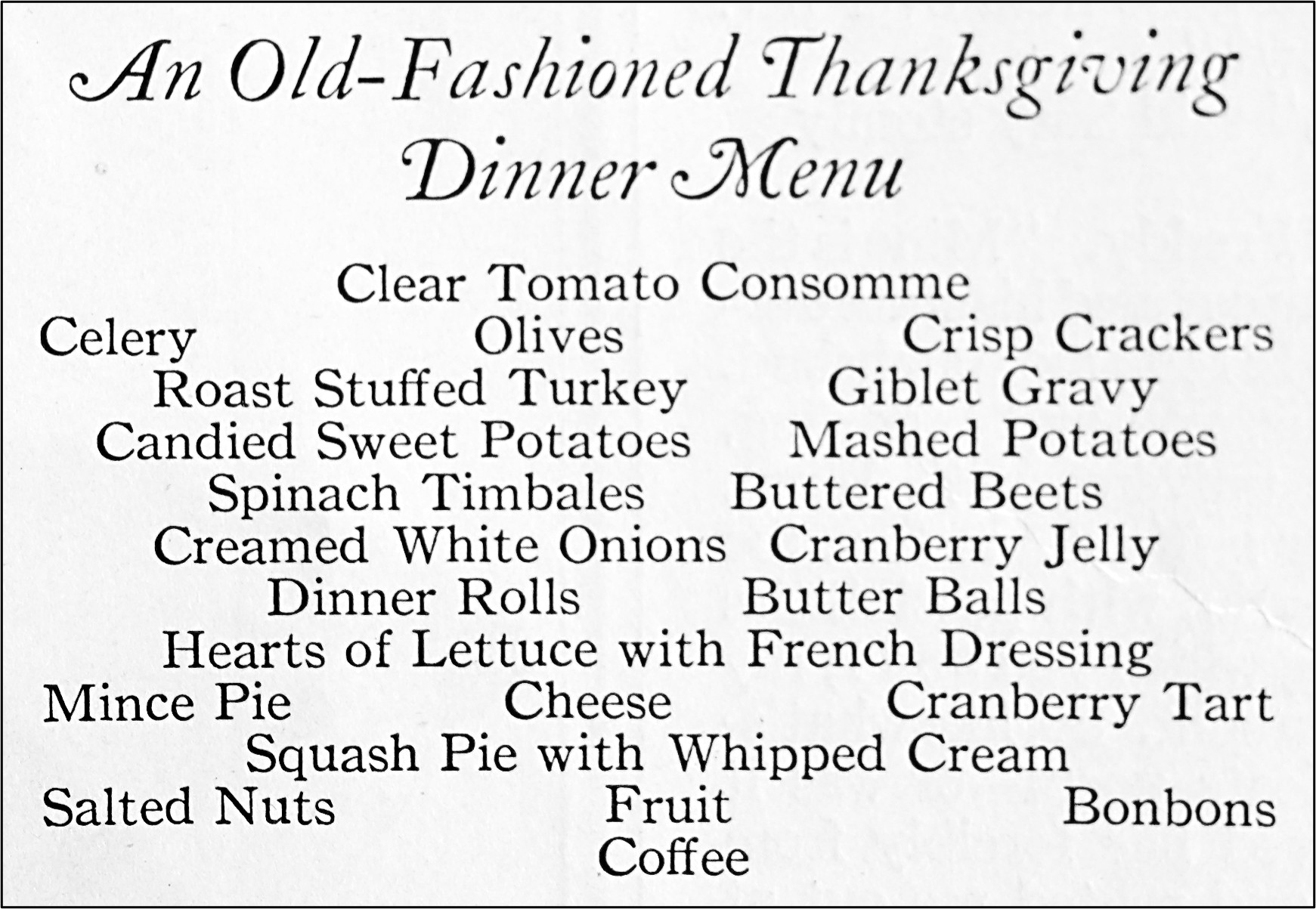
The foods we eat have changed over the past hundred years; but, for many, the Thanksgiving dinner menu remains very similar to what it was a hundred years ago. Actually, the traditional turkey meal was already considered “old-fashioned” in 1925. A Thanksgiving menu that appeared in the November, 1925 issue of Ladies Home Journal was labeled “old-fashioned.” It included many of the same foods we commonly eat on Thanksgiving today, as well as some, such as Spinach Timbales, that are seldom eaten now.

When I looked at the old menu, I was surprised how many of the foods on the menu I have made over the past several years:

Cranberry Sauce (Cranberry Jelly)

Cranberry Tarts

Spinach Timbales  

Squash Pie

Over the years, I also posted various hundred-year-old Thanksgiving menus. Some were more complicated (or more “modern”) than this 1925 one. It’s always been a delicate balancing act to get the right balance between serving traditional foods that family members have enjoyed for generations, and providing foods that are currently popular and may better meet the dietary needs and preferences of attendees. Here are the links to the other Thanksgiving  menus I’ve posted:

1917 Thanksgiving Menus

1921 Thanksgiving Menus 

1924 Thanksgiving Menus

Celebrating Halloween a Hundred Years Ago

Halloween parties are the best – and they have been lots of fun for many years ago. Like now, a hundred years ago, people made jack-o-lanterns and decorated their home for Halloween. Back then, the decorations were often homemade rather than the typical purchased decorations used today.

The October, 1925 issue of Good Housekeeping magazine provided party suggestions -and included an image of a centerpiece with a Gingerbread Witch House surrounded by black cats, small jack-o-lanterns, and other spooky figures.

In the early 1900’s, the “trick” part of “trick or treat” was still in play, and people often played tricks on others – and sometimes even did pranks, including “soaping windows” by taking a bar of soap and rubbing it on windows.

More than 14 years ago, I started this blog as a place to post my grandmother’s diary entries exactly one hundred years to the day after she wrote them. She was a teen-ager living on a farm in central Pennsylvania when she wrote the entries. Her diary ended after four years, and I then converted this blog to its current food blog format. Here is what Grandma wrote in her diary about a Halloween party:

At last this old house sees a party. It was fun to see the guests arrive. They were gowned in many crazy ways. One fellow wore a skirt with hoops and looked too silly for anything. We also had a clown, a ghost, and a witch. The rest were dressed in any old way. As for the false faces, they were about as ugly as could be. There were twenty-one in all and made quite a merry company.

As it was Halloween, one of the guests caught it. Someone unhitched his buggy and carted it away, but it was found at last.

Helena Muffly, October 31, 1913

Here are a few posts I’ve done over the years about Halloween foods, decorations, and crafts:

1924 Halloween Dinner Menu

Old-Fashioned Witches’ Layer Cake

Hundred-Year-Old Shrunken Apple Head Witch Craft

Hundred-Year-Old Halloween Bogeyman Craft

Halloween Place Cards

Hundred-Year-Old Halloween Party Invitations

Hundred-Year-Old Halloween Costumes

Ice Cream Served in Orange Jack-o’-Lantern Shells

Old-Fashioned Homemade Crackerjack Candy (Popcorn)

The leaves are turning vibrant shades of red and yellow, the days are getting shorter, Halloween will be here soon, and I’m enjoying autumn comfort foods.  Popcorn is the perfect fall snack food – and popcorn coated with a molasses-flavored caramel coating brings back memories of Halloween gatherings in days gone by. I found a hundred-year-old recipe for Crackerjack Candy, which is popcorn coated with a molasses mixture, and decided to give it a try. It is somewhat similar to the Cracker Jack popcorn snack sold in stores, but does not contain any peanuts.

According to Wikipedia, commercially- packaged Cracker Jack has been around since the late 1800s. And, for almost as many years, there have been recipes for making a similar molasses-flavored popcorn. One such recipe appeared in the December, 1925 issue of Farm Journal. The recipe in the magazine spelled Cracker Jack as one word – Crackerjack, and called the coated popcorn a candy.

The homemade Crackerjack was tasty, and had a rich caramel flavor. Similar modern recipes often call for using corn syrup instead of molasses. The molasses is healthier and more nutritious than corn syrup, but it is also more challenging to use. The key to successfully making this snack is to just lightly coat the popcorn with the molasses mixture. If the coating is thick, the crunchy, chewy texture of the coating can become a bit overwhelming.

Here’s the original recipe:

Recipe for Crackerjack Candy
Source: Farm Journal (December, 1925)

The recipe says that the syrup should be boiled until “it will harden when dropped in cold water.” I interpreted this to mean that it should be cooked until it reaches the hard ball stage (260° F.)

Here’s the recipe updated for modern cooks:

Crackerjack Candy

  • Servings: 8 - 10
  • Difficulty: moderate
  • Print

12 – 15 cups popped popcorn

salt, optional

1 cup molasses

1 cup brown sugar

butter

Put the 12 cups of popped corn in a large bowl and set aside. Be sure to remove any un-popped kernels. If desired, lightly salt the popped corn. (Reserve remainder of the popped corn in case it is needed when combining the syrup with the popcorn.)

Using butter, generously grease a baking sheet or other large pan. Set aside.

Put molasses and brown sugar in a pan; stir to combine, then using medium heat bring to a boil. Reduce heat and gently boil until the syrup reaches 260° F. degrees). This will take approximately 15 to 20 minutes. Remove from heat and immediately pour over the  popped corn in the bowl and stir with the large spoon to coat the popped corn. The coating on the popped corn should just lightly coat it. If the coating is too thick, stir in additional popcorn. Work quickly because the mixture quickly begins to cool.

Spread the coated popped corn on the buttered baking sheet or other large pan. After the coated popcorn cools, break (don’t cut) into small pieces. If  it will not be used immediately, store in a tightly covered container.

http://www.ahundredyearsago.com