Old-fashioned Raised Doughnuts

Doughnuts on plate

When I was a child growing up in Pennsylvania, Fasnacht Day (the day before Ash Wednesday) was always a day when we ate doughnuts. Fasnacht Day was supposed to be a day to eat indulgent foods before the beginning of Lent – and doughnuts with their sugar and fat were considered the ultimate in indulgent foods. It is also known as Fat Tuesday or Shrove Tuesday.

Some churches in Pennsylvania made doughnuts on Fasnacht Day as a fundraiser, and students at my school who attended those churches took orders for the doughnuts, and then brought the them to school on Fasnacht Day.  I always looked forward to buying (and eating) those incredible doughnuts.

Now, every year as Lent approaches, I remember those sweet, flavorful, light, yet slightly chewy, doughnuts of my childhood (they are nothing like modern cake-like doughnuts), and think that I should try making doughnuts, but I never actually did  – until this year. I came across a hundred-year-old recipe for Raised Doughnuts and decided it was time to give doughnut-making a try.

It took me about six hours from start to finish to make the doughnuts since I had to let the dough rise three times – but it was worth it. The doughnuts were just like I’d remembered (and my husband kept saying, “These are a lot better than store-bought doughnuts”).

Recipe for Raised Doughnuts
Source: Mrs. DeGraf’s Cook Book (1922)

And, here’s the coffee cake foundation recipe:
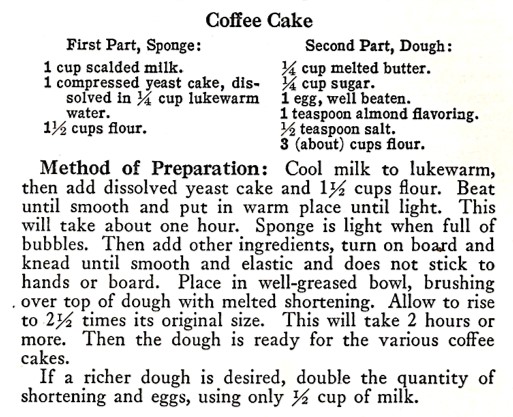
Recipe for Coffee Cake
Source: Mrs. DeGraf’s Cook Book (1922)

Here’s the recipe updated for modern cooks:

Raised Doughnuts

  • Servings: approximately 20 doughnuts
  • Difficulty: difficult
  • Print

1 cup milk

1 packet (0.25 ounce) active dry yeast

1/4 cup lukewarm (110 – 115° F.) water

1 1/2 cups flour + approximately 3 cups flour

1/4 cup butter melted + a small amount of additonal melted butter to brush on top of dough

1/4 cup sugar

1 egg, beaten

1 teaspoon almond extract

1/2 teaspoon salt

fat or cooking oil (I used shortening.)

powdered sugar

Put the milk in a saucepan, and scald (180-185° F.) using medium heat. Remove from heat and cool until lukewarm (110-115° F.). In the meantime, dissolve the yeast in the lukewarm water.

Put the 1 1/2 cups flour, lukewarm scalded milk, and dissolved yeast in a mixing bowl, and beat until smooth. Cover and put in a warm spot until the mixture is light and spongy (about 1 hour). Add the melted butter, sugar, egg, almond extract and salt. Gradually add approximately 3 cups flour until the dough reaches a consistency where it can be handled.  Turn onto a floured surface and knead until the dough is smooth and elastic (about 10 minutes). Put in a large greased bowl, brush top with melted butter, cover and place in a warm spot until the dough is about 2 1/2 times its original  size (about 2 hours).

Put dough on a lightly floured surface and roll dough to 1/4 inch thick, and cut doughnuts with a doughnut cutter. (If thicker doughnuts are desired, don’t roll quite so thin.) Put the cut doughnuts on a baking sheet, and let rise until light and doubled in size (about 45 minutes).

Heat  3 – 4 inches of fat or cooking oil in a deep fat fryer or kettle to 350 – 375° F. Drop doughnuts (a few at a time) into the hot fat or oil. Turn as they rise to the surface. Gently turn and fry 2-3 minutes or until golden brown. Remove from fat and drain on paper towels.

Put powdered sugar in a bag. (I used a brown paper lunch bag.) While the doughnuts are still warm, put one doughnut at a time in the bag and gently shake to coat with the sugar.

 

http://www.ahundredyearsago.com

Old-fashioned Salmon Croquettes

Salmon Croquettes on Plate

I seldom buy canned salmon, yet when  I recently  flipped through a hundred-year-old cookbook, a recipe for Salmon Croquettes caught my eye. It brought back warm memories of eating various canned salmon dishes when I was a child. Long story short, I bought a can of salmon the next time I went to the store, and soon was making Salmon Coquettes. The crispy croquettes only took a few minutes to make and were a tasty comfort food.

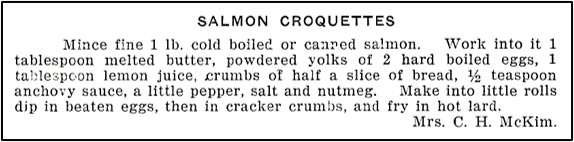
recipe for Salmon Crocuqettes
Source: Cement City Cook Book (1922, compiled by First Baptist Church, Alpena, Michigan)

Here’s the recipe updated for modern cooks:

Salmon Croquettes

  • Servings: 4 - 6
  • Difficulty: moderate
  • Print

1 can salmon (14.75 oz.), flaked

1 tablespoon, butter, melted

2 hard-boiled egg yolks, mashed

1 tablespoon lemon juice

1/2 slice bread, torn into small pieces to make crumbs

1/2 teaspoon anchovy sauce

dashes of salt, pepper, and nutmeg

1 egg, beaten

approximately 3/4 cup cracker crumbs (I put saltine crackers in a Ziplock bag and rolled with a rolling pin to make crumbs.)

lard, shortening, or cooking oil

Put salmon into a mixing bowl. Add melted butter, mashed hard-boiled egg yolks, lemon juice, bread crumbs, anchovy sauce, salt, pepper, and nutmeg. Shape into small balls about 1 1/2 inches in diameter. (If the mixture is too juicy to make balls, add additional bread crumbs.)

Put the beaten egg in a bowl. In another bowl put the cracker crumbs. Roll the salmon balls in the egg and then in the cracker crumbs.

Put  lard, shortening, or cooking oil in skillet and heat until hot using medium heat.  (It should be about 1/2 inch deep.) Add salmon balls. When the bottom of the balls have lightly browned (about 1 1/2 – 2 minutes), gently roll to brown the other sides.  Remove from skillet and drain on paper towels, then serve.

http://www.ahundredyearsago.com

Old-fashioned Grated Cheese Canapes

grated cheese canapes on plate

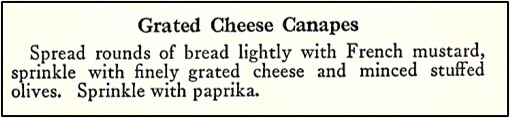
Canapes made using bread as the base were a popular appetizer a hundred years ago. I was intrigued by a recipe for Grated Cheese Canapes in a 1922 cookbook. Rounds of thin-sliced bread were spread with mustard then topped with grated cheese and chopped olives. The tangy mustard combined nicely with the slight saltiness of the cheese and olives to make a lovely  hors d’oeuvre.

Here’s the original recipe:

Recipe for Grate Cheese Canapes
Source: Mrs. De Graf’s Cook Book (1922)

A hundred years ago did  the term “French mustard” refer to a yellow mustard or a dijon-style mustard? I googled it discovered that French’s Mustard was introduced at the 1904 St. Louis World’s Fair – but that is a brand and not exactly a type of mustard. In the end, I decided to use a dijon-style mustard, but am not sure that was commonly available in the United States in 1922.

Here’s the updated recipe for modern cooks:

Grated Cheese Canapes

  • Servings: 12 canapes
  • Difficulty: easy
  • Print

6 slices of thinly sliced bread (assumes 2 rounds per slice) (I used white bread.)

approximately 2 tablespoons French mustard (I used a Dijon mustard.)

approximately 3/4 cup finely grated cheese (I used cheddar cheese.)

approximately 1/2 cup stuffed olives, finely chopped

paprika

Cut the bread into rounds that are 2 – 2 1/2 inches in diameter. Thinly spread French mustard on the rounds. Top with grated cheese and chopped olives; sprinkle with paprika.

http://www.ahundredyearsago.com

Old-fashioned Cabbage with Caraway Seeds

I recently found a hundred-year-old recipe for Cabbage with Caraway Seeds. It has an old-fashioned goodness, and makes a lovely side dish.

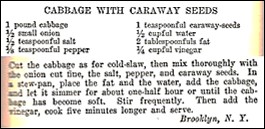
Here’s the original recipe:

recipe for Cabbage with Caraway Seeds
Source; Good Housekeeping’s Book of Menus, Recipes, and Household Discoveries (1922)

Here’s the recipe updated for modern cooks:

  • Servings: 4 - 5
  • Difficulty: moderate
  • Print

1 pound cabbage (about 1/2 of a medium cabbage), shredded

1/2 small onion, finely chopped

1/2 teaspoon salt

1/8 teaspoon pepper

1 teaspoon caraway seeds

1/2 cup water

2 tablespoons fat (I used butter.)

1/4 cup vinegar

Put cabbage, onion, salt, pepper, caraway seeds, butter and water in a large saucepan. Bring to a boil using medium heat, then reduce heat and simmer until the cabbage is tender; stir frequently. If needed, add additional water. After the cabbage is soft (about 30 minutes), add the vinegar and cook an additional 5 minutes.

http://www.ahundredyearsago.com

Old-fashioned Cream of Mushroom Soup

Cream of Rushroom Soup

I am so fortunate to have such wonderful readers, and am humbled  by their kindness and thoughtfulness. Recently one reader, Judy L., gave me a special hundred-year-old cookbook out of her collection. The book is called For Luncheon and Supper Guests by Alice Bradley. Judy  is not sure, but the cookbook may have belonged to her grandmother. The small book has 10 menus and more than 100 recipes that are:

Suitable for company luncheons, Sunday night suppers, afternoon parties, automobile picnics, evening spreads, and for the tea room, lunch room, coffee shops, and motor inns.

The book’s author dedicated it to:

The thousands of women who like to entertain their friends and prepare for them something new and delicious to eat.

The book is a joy to browse through, and I can picture cooks a hundred years ago using it to plan lovely events. Judy, thank you!

The first recipe I made out of the book was the recipe for Cream of Mushroom Soup. I tend to associate Cream of Mushroom Soup with the condensed canned soup and think of it as more of a recipe ingredient than something to eat on its own. Yet the old cookbook recommended it as a special dish to serve guests, so I decided to give it a try.

This recipe is for a delicate, velvety smooth mushrooms soup that was perfect on a cold winter day – and that would be delightful for a light lunch with friends.

Here’s the original recipe:

Recipe for Cream of Mushroom Soup
Source: For Luncheon and Supper Guests (1922) by Alice Bradley

When I made this recipe I bought an 8-ounce box of whole button mushrooms – and chopped the entire mushrooms rather than buying more mushrooms and only using the stems and skins. (By the way, what is a mushroom skin?)

The old recipe says to serve the soup in bouillon cups which made me think about presentation. How would a hostess in days gone by serve  this soup to her lunch guests? I then remembered some vintage luncheon plates way in the back of the top shelf of my kitchen cabinets. They have an indentation for a  small matching bowl. I pulled my step stool over, climbed up and got one of the plates and bowls out. I then made a sandwich to go with my soup. And, suddenly, with just a little imagination, my boring Saturday lunch was transformed into a beautifully presented luncheon in a different time and place.

Cream of Mushroom Soup

  • Servings: 4 - 6
  • Difficulty: moderate
  • Print

Here’s the recipe updated for modern cooks:

2 cups milk

1/2 pound (8 oz.) mushrooms, chopped

1/4 cup onion, chopped

3 cups chicken broth

4 tablespoons butter

4 tablespoons flour

1 1/2 teaspoons salt (Use less if the chicken broth contains salt.)

1/4 teaspoon  pepper

Put milk in a saucepan, and using medium heat, heat until it is scalded (just begins to boil); stir occasionally. Remove from heat and set aside.

Put the mushrooms,  onions, and chicken broth in another saucepan, and bring to a boil using high heat. Reduce heat and simmer for 20 minutes. Remove from heat, and strain; keeping the liquid. (The vegetables can be discarded or served separately.

In the meantime, melt the butter in a large saucepan. Stir in the flour, salt, and pepper, then gradually add the mushroom broth while stirring constantly, Using medium heat bring to a boil while continuing to stir occasionally;  then stir in the scalded milk and reheat until hot and steamy.

Note: This recipe is for a silky smooth mushroom soup, but if desired, the cooked chopped mushrooms and onions that were strained out when making the mushroom broth, can be stirred back into the soup for a more robust chunky soup.

http://www.ahundredyearsago.com

Old-fashioned Grapefruit Pie

Grapefruit Pie

I was intrigued by a hundred-year-old recipe for Grapefruit Pie, and decided to give it a try. The pie was bursting with a sunny grapefruit flavor. It reminded me of lemon meringue pie, but was a little less tart.

Here’s the original recipe:

Grapefruit Pie

Recipe for Grapefruit Pie

Source: American Cookery (March, 1922)

Rather than squeezing a grapefruit to get juice to make the pie, I purchsed a bottle of grapefruit juice. A typical grapefruit contains about 3/4 cup of juice.. When I made this recipe, the pie filling was a little juicy, so when I updated the recipe I added an additional egg yolk, (The original recipe called for 2 yolks and 3 egg whites. Using an additional yolk eliminates the need to figure out what to do with an extra yolk.). I also added an additional 1/2 tablespoon of cornstarch when I updated the recipe to further thicken the filling.

Here’s the recipe updated for modern cooks:

Grapefruit Pie

  • Servings: 6 - 8
  • Difficulty: moderate
  • Print

Pie

1 cup sugar

1 cup water

3 1/2 tablespoons cornstarch

1/8 teaspoon salt

3/4 cup grapefruit juice

3 egg yolks, beaten

1 9-inch pie shell, baked

Meringue

3 egg whites

6 tablespoons sugar

2 teaspoons grapefruit juice

Place water, sugar, cornstarch, salt, and grapefruit juice in a saucepan, stir until thoroughly mixed and smooth. Using medium heat, bring to a boil while stirring occasionally. Reduce heat and simmer for 5 minutes. Add a small amount of the hot mixture to the beaten egg yolks, while stirring constantly, and then slowly add to the contents in the saucepan while stirring constamtly. Remove from heat. If not smooth, stain the mixture. Allow the mixture to cool.

In the meantime, preheat oven to 400 ° F. and  make the meringue. Place egg whites in a bowl, and beat the egg whites until they form stiff peaks. Gradually add 6 tablespoons sugar while continuing to beat; add the 2 teaspoons of grapefruit juice and beat.  Then spoon on top of the pie and swirl. Place pie  in the oven and bake for  8 – 10  minutes or until the meringue is lightly browned.

http://www.ahundredyearsago.com

Several Hundred-Year-Old French Dressing Recipes

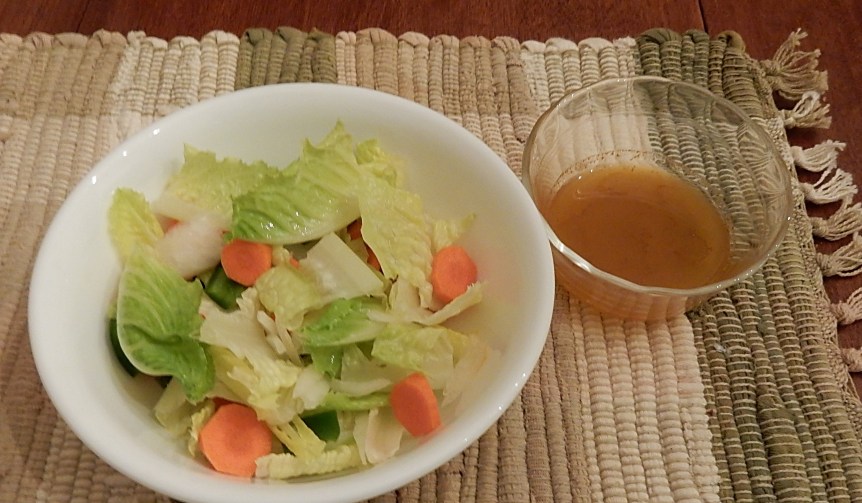
Salad and Salad DressingSome recipes don’t change across the years; others do.  As tastes and preferences change, recipes are updated. In other cases, lack of availability of an ingredient might lead to tweaking of an old recipe. Also, for commercially-prepared foods, government regulations can affect their composition.  Last week I was amazed to discover that the government regulated French Dressing for many years.
On January 13,  the Wall Street Journal had an article titled “The U.S. Federal Government Deregulates French Dressing.”  The government established the standard for French Dressing 72 years ago, and “according to the original 1950 standard, a French dressing should include vegetable oil, and a vinegar and/or lemon or lime juice, and could be seasoned with ingredients such as salt, sugar, tomato paste or puree, and spices such as mustard are paprika.”

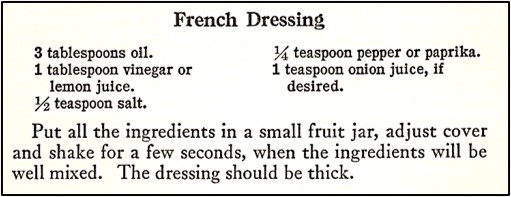
This article made me remember the many French Dressing recipes that I’ve seen in hundred-year-old cookbooks over the years, and how those recipes differed from today’s seemingly ubiquitous creamy orange dressing. Back then the dressing was often more of a vinaigrette. Here are two French Dressing recipes from 1922 cookbooks:

French Dressing Recipe
Source: Mrs. DeGraf’s Cook Book (1922)

French Dressing RecipeSource: Good Housekeeping’s Book of Menus, Recipes, and Household Discoveries (1922)

I made the French Dressing in the photo using the first recipe.

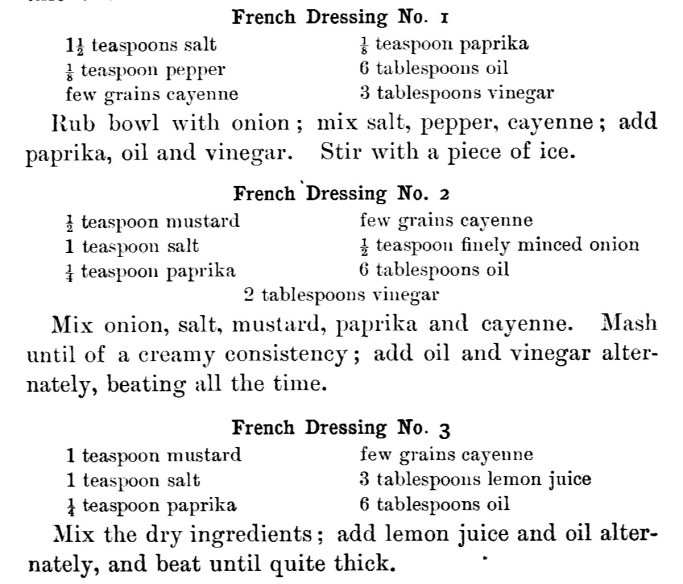
Several years ago, I did a post with a recipe for Endive Salad with Homemade French Dressing that contained three 1912 French Dressing Recipes. Here are those recipes:

3 French Dressing Recipes
Source: Lowney’s Cook Book (1912)

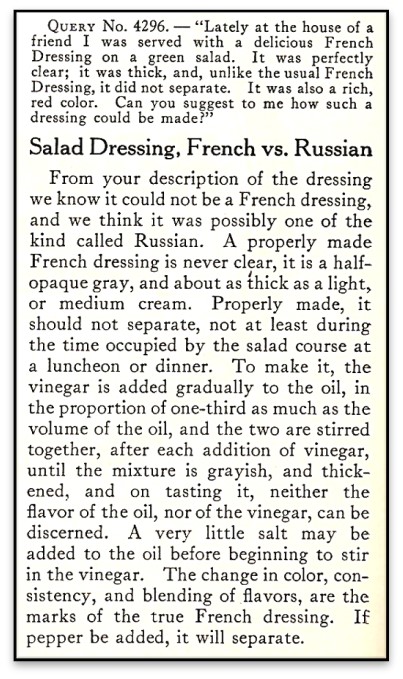
And, here is a 1922 magazine article that responds to a reader’s question about French Dressing. The response differentiates between French Dressing and Russian Dressing -though it is mostly focused on French Dressing:

magazine article
Source: American Cookery (June/July, 1922)

Whew, my head is spinning. Who would have guessed that for a least a hundred years people have been giving lots of thought to exactly what comprises French Dressing?