Old-Fashioned Cherry Toast

Cherry Toast

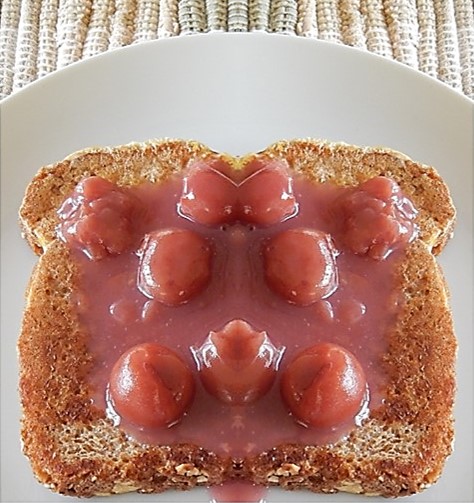
I’m always looking for interesting breakfast foods, so was intrigued by a hundred-year-old recipe for Cherry Toast.  This is basically is French Toast topped with a cherry sauce. The recipe turned out well – though the sauce seemed different from modern French Toast toppings. The sauce soaks into the toast for old-fashioned goodness and texture.

Here’s the original recipe:

Recipe for Cherry Toast
Source: Modern Priscilla Cook Book: One Thousand Home Tested Recipes (1924)

Something is off with the number of slices of bread in this recipe. It calls for 16 slices of bread, but 1 egg plus 1/2 cup of milk is not nearly enough liquid to dip that many slices of bread into. When I made this recipe, it was enough liquid for 4 slices of bread. The recipe as written makes an appropriate amount of sauce for 4 slices.

I decided to use tart canned cherries (like the ones I use to make a pie) rather than sweet ones. The can I bought contained cherries canned in water, so I added 1/4 cup sugar to the sauce to make it a little sweeter.

When I made the sauce, I approached the process similarly to how I make white sauce, which is a slightly different process than described in the original recipe. I melted the butter in a saucepan, then stirred in the flour. I gradually added the cherry juice while stirring constantly, then stirred in the cherries.

Here’s the recipe updated for modern cooks:

Cherry Toast

  • Servings: 2-4
  • Difficulty: moderate
  • Print

1 egg

1/2 cup milk

4 slices bread

1 can (approximately 14.5 ounce) tart cherries including both cherries and juice

1 tablespoon butter

2 tablespoons flour

approximately 1/4 cup sugar (optional)

Beat the egg, then add the milk; beat until mixed together. Dip the slices of bread in the egg and milk mixture, then brown both sides on a hot griddle.

In the meantime, melt the butter in a saucepan. Stir in the flour, then gradually add the cherry juice while stirring constantly. Stir in the cherries. Continue heating and stirring until the mixture boils. If the cherries were canned in water (rather than a sugar syrup), add  sugar to taste. Remove from heat.

To serve, spoon the cherry sauce over the browned bread slices.

http://www.ahundredyearsago.com

Lemon Citron Cake

Lemon Citron Cake

This week I decided to make a hundred-year-old recipe for Lemon Citron Cake. I can already sense your questions. Why make this cake in February? Isn’t citron a holiday fruitcake ingredient that is usually only available in stores in December?

Well . . . let me explain.

Do you ever have ingredients left over after completing holiday baking, and don’t know how you’ll ever use them? Well, that’s how I felt about some citron that was still lingering in one of my kitchen cabinets. I thought that I might have to throw it out; but, then I happened across a recipe for Lemon Citron Cake in a hundred-year-old cookbook and decided to give it a try.

The cake was delightful. It had a lovely, light texture and a sunny citrus flavor. The original recipe didn’t indicate whether the cake should be iced. I decided to put a light lemon glaze on it, which worked well with the citron. Citron is too tasty to be relegated to just the winter holidays. Assuming you can find the citron, this cake would be lovely during any season.

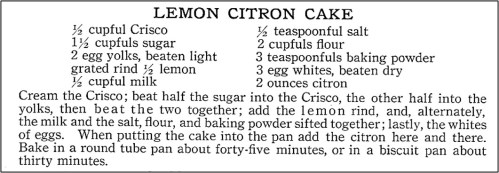
Here’s the original recipe:

Recipe for Lemon Citron Cake
Source: The Whys of Cooking by Janet Mckenzie Hill (1924)

It seemed unusual that this recipe called for two egg yolks and three egg whites, so I decided that maybe there was a typo and used three egg yolks. It worked fine. I’m also not sure why the recipe called for creaming some of the sugar with the Crisco shortening and the remainder with the egg yolks, and then combining. I just put them all in the mixing bowl.

Any shortening will work for this recipe so I didn’t specify a brand. Additionally, I gently stirred the citron into the cake batter after all the other ingredients had been combined rather then adding pieces of citron “here and there” as the batter was being poured into the pan.

Here’s the recipe updated for modern cooks:

Lemon Citron Cake

  • Servings: 8 - 10
  • Difficulty: moderate
  • Print

3 eggs, separated

1/2 cup shortening

1 1/2 cups sugar

1/2 cup milk

2 cups flour

1/2 teaspoon salt

3 teaspoons baking powder

grated rind, 1/2 lemon

2 ounces citron (about 1/4 cup)

Preheat oven to 350° F. Put egg whites in a medium mixing bowl and beat until stiff. Set aside.

Put the shortening, egg yolks, and sugar in a mixing bowl; beat until smooth. Add milk, flour, baking powder, and salt; beat to combine. Gently fold in the egg whites, then gently stir in the grated lemon rind and citron. Spoon the batter into an ungreased tube pan with removable bottom (angel food cake pan). Bake for 45 minutes or until the cake is lightly browned and the top springs back when lightly touched.

If desired, glaze with a thin icing made with melted butter, confectioners sugar, and lemon juice.

http://www.ahundredyearsago.com

Old-Fashioned Creamed Rutabaga

Creamed Rutabaga

I love to browse when I’m in the produce section of the supermarket. There are so many interesting vegetables and fruits. But after looking at them, I typically select the same old, same old – lettuce, potatoes, bananas, apples, and other items that I buy almost every week. One vegetable I almost never purchase is rutabaga. But when I saw a recipe for Creamed Rutabaga in a hundred-year-old cookbook, I decided it was time to give it a try.

The Creamed Rutabaga was lovely. The rutabaga tasted like a cross between turnips and carrots.

The cookbook that I got the recipe out of is called Low Cost Cooking. The author noted that rutabagas cost about 4 cents per pound. The one I bought weighed about 2 pounds and cost $1.99 per pound – which isn’t cheap, but I guess that it is a reasonable price for a fresh vegetable. I only used about half of it when making this recipe, so I’ll need to either find another rutabaga recipe or, more likely, I’ll make this dish again.

Here’s the original recipe:

Recipe for Creamed Rutabaga
Source: Low Cost Cooking by Florence Nesbitt (1924)

The recipe says that the cooked rutabaga chunks could be put into a white sauce which would be made using butter and milk, or that that the sauce could be made using water and milk (and skipping the butter). This reminds me that the cookbook is all about how to prepare inexpensive meals, and this probably was seen as a cost saver.

This recipe calls for a whole rutabaga, as well as for three cups of white sauce. Rutabagas are large- and this would be a lot, so I used half a rutabaga and made about of 1 cup of white sauce. (I decided not to go with the low cost water and milk option for the sauce.)

Here’s the recipe updated for modern cooks:

Creamed Rutabaga

  • Servings: 2 - 3
  • Difficulty: moderate
  • Print

2 cups chunks of rutabaga (about 1/2 of a medium rutabaga; chunks should be about 1/4 inch thick, 1/4 inch wide, and 1/2 inch long)

1 teaspoon salt +1/4 teaspoon salt

2 tablespoons butter

1 tablespoon flour

dash pepper

1  cup milk

Put rutabaga chunks in a saucepan and cover with water. Add 1 teaspoon salt. Bring to a boil using high heat, then reduce heat and simmer until the rutabaga is tender (about 30-40 minutes). Remove from heat and drain.

In the meantime, in another pan, using medium heat, melt  butter, then stir in the flour, 1/4 teaspoon salt, and pepper. Gradually, add the milk while stirring constantly. Continue stirring until the white sauce begins to thicken. Add the cooked rutabaga chunks and stir gently. Remove from heat and serve.

http://www.ahundredyearsago.com

Boston Roast Recipe

Boston Roast

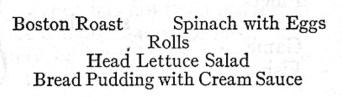
A week or so I did a post on 1924 meatless menus that included menus for five meals. One of those menus included a dish called Boston Roast.

Menu with Boston Roast
Source: The New Butterick Cook Book (1924)

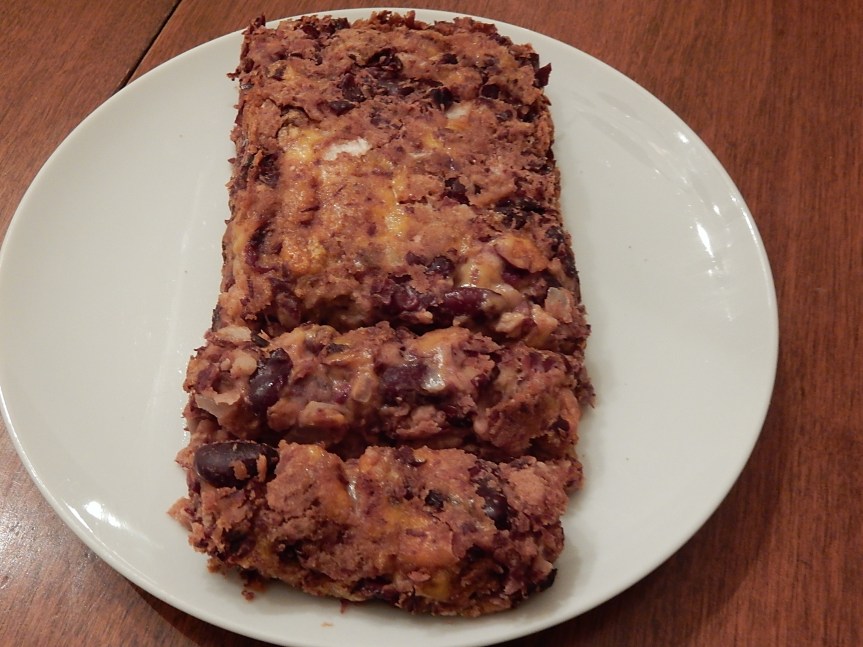
Several readers made comments about Boston Roast. A couple wondered what it was; another did an online search and found a recipe for Boston Roast and discovered that it was made using kidney beans, and still another noted that Boston is sometimes called “Bean Town” so it was made sense that the dish was called “Boston Roast.”

I’d found the meatless menus in a hundred-year-old cookbook. After getting all the comments about Boston Roast, I looked at the book’s table of contents and found the recipe for Boston Roast. The recipe called for kidney beans, grated cheese, onions, bread crumbs (cubes), chopped onions, and milk.  The recipe also noted that “this is a good meat substitute.”

The recipe turned out well – though it had a slight tendency to fall apart when I sliced it. The kidney beans were the predominant flavor.

Here’s the original recipe:

Recipe for Boston Roast
Source: The New Butterick Cook Book (1924)

I used canned kidney beans rather than dried ones. The recipe calls for 1 1/2 cups of dried kidney beans which is the equivalent of 3 1-pound cans of kidney beans.  I didn’t use the 3 tablespoons of salt since I didn’t cook dried beans in salted water. Instead I just used 1 teaspoon of salt which I mixed in the with other ingredients.

Here’s the recipe updated for modern cooks:

Boston Roast

  • Servings: 6 - 8
  • Difficulty: moderate
  • Print

3 1-pound cans kidney beans

1 1/2 cups grated cheese (I used cheddar cheese.)

2 tablespoons onions, chopped

1 cup bread cubes (coarse bread crumbs)

1/2 cup milk

1 teaspoon salt

melted butter

hot water

Preheat oven to 375° F. Drain kidney beans and then chop. (A food processor or blender can be used to chop the kidney beans.) Put the chopped beans in a mixing bowl and add the cheese, onions, bread cubes, milk, and salt. Stir until thoroughly combined. Shape into a loaf (or put into a loaf pan) and put in the oven. Bake for 40 minutes. If the top seems dry while baking, baste with melted butter and water.

http://www.ahundredyearsago.com

Old-Fashioned Canned Peach Pudding

Canned Peach Pudding

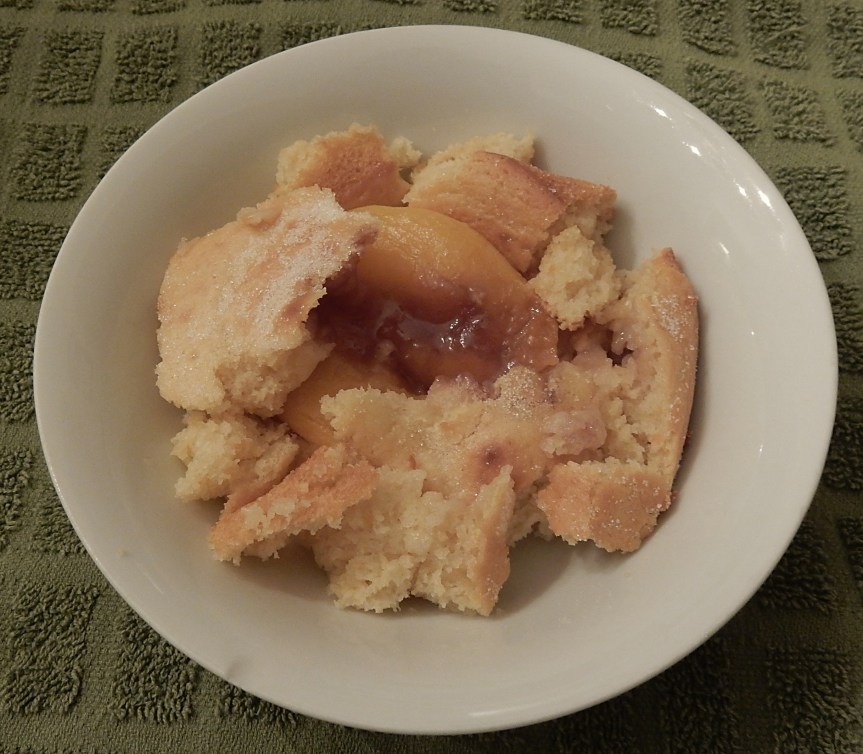
I was recently browsing through a hundred-year-old magazine, and came across a recipe for Canned Peach Pudding. Back then fresh fruit was scarce during the winter and early spring, so canned fruit was very popular. At the time, canned fruit (either home or commercially canned) was considered a modern option.

The Canned Peach Pudding was delightful. The pudding batter included pureed peaches, and whole peach halves (filled with a red jelly or strawberry jam) are placed in the batter and then additional batter is poured on top.

Here’s the original recipe:

Recipe for Canned Peach Pudding
Source: American Cookery (April, 1924)

When I put the baked pudding with the sugar on top under the broiler, the sugar did not brown, but the top of the pudding did begin to brown.

Here’s the recipe updated for modern cooks:

Canned Peach Pudding

  • Servings: 6
  • Difficulty: moderate
  • Print

12 canned peach halves (approximately 1 29 oz. can + 1 15 oz. can or 1 quart home canned peaches)

1 egg

1/2 cup milk

1/2 cup sugar

1 1/2 cups flour

3 teaspoons baking powder

1/4 teaspoons salt

2 tablespoons butter, melted

6 teaspoons red jelly or strawberry jam (I used current jelly.)

granulated sugar

Preheat oven to 350° F. Puree 6 of the peach halves. In a mixing bowl combine the peach puree, milk, sugar, flour, baking powder, salt, and melted butter. Put half of the batter into an 8″ X 8″ baking dish. Arrange 6 peach halves, hollow side up, on top of the batter. Fill the center of each peach half with 1 teaspoon of red jelly or strawberry jam. Pour the remaining better on top. Bake for 40-50 minutes or until a wooden pick inserted into the center comes out clean. Remove from oven and lightly sprinkle with granulated sugar. Put under the broiler until the top of the baked pudding is lightly browned. Remove from oven.

http://www.ahundredyearsago.com

Old-Fashioned Chocolate Waffles

Chocolate Waffles

Week-end mornings are the perfect time to make breakfast foods that are just a little special, so when I saw a recipe for Chocolate Waffles in a hundred-year-old cookbook, I decided to give them a try.

The Chocolate Waffles were crispy on the outside and tender in the middle. They contained just the right amount of chocolate. The waffles were not very sweet, but when syrup or other sweet topping is added it was just right.

Here’s the original recipe:

Recipe for Chocolate Waffles
Source: Modern Priscilla Cook Book: One Thousand Home Tested Recipes (1924)

I gradually added the hot water to the cocoa, and stirred until smooth. This resulted in a very thick paste. I could not figure out why the old recipe called for then heating this thick cocoa and water mixture to boiling, so I skipped that step.

Chocolate Waffles probably are lovely when served with chocolate sauce, marshmallow cream, or vanilla ice cream, but I just served them with maple syrup and they were delightful.

Here’s the recipe updated for modern cooks:

Chocolate Waffles

  • Servings: 4-6
  • Difficulty: moderate
  • Print

1/2 cup cocoa

1/2 cup water

1 cup milk

2 eggs

2 cups flour

4 teaspoons baking powder

1/2 teaspoon salt

1/4 cup sugar

2 tablespoons shortening, melted

1/2 teaspoon vanilla

Put the cocoa in a mixing bowl, and gradually add the hot water while stirring constantly. Stir until smooth. Add remaining ingredients. Beat until smooth. Ladle batter onto a hot waffle iron and cook, following the waffle iron directions.

http://www.ahundredyearsago.com

Old-Fashioned Potato Biscuits

Potato Biscuits

I recently came across a hundred-year-old recipe for Potato Biscuits, and decided to give it a try. The biscuits were soft and tender. This recipe is a great way to use up leftover mashed potatoes.

Here’s the original recipe:

Recipe for Potato Biscuits
Source: The Whys of Cooking by Janet McKenzie Hill (1924)

This recipe calls for using the Crisco brand of shortening. That’s because the recipe was published in a 1924 promotional cookbook for Crisco.  When I updated the recipe, I changed it to just “shortening” since any brand would work. I used all-purpose flour rather than pastry flour when I made this recipe, and it worked fine.

Here’s the recipe updated for modern cooks:

Potato Biscuits

  • Servings: approximately 10 biscuits
  • Difficulty: moderate
  • Print

1 1/2 cups all-purpose flour

3 teaspoons baking powder

1/2 teaspoon salt

1 cup mashed potatoes

1/4 cup  shortening

approximately 1/3 cup milk, as needed

Preheat oven to 450° F. Mix the flour, baking powder, and salt together; stir in the mashed potatoes. Then cut (work) in the shortening and butter using fingers, pastry blender, or food processor.  Gradually add the milk while mixing with a knife or spoon.  Continue adding liquid until there is a soft dough. The amount of milk needed varies depending upon the type of flour. On a floured board, pat or roll the dough until 1/2 -inch thick. Cut with a round biscuit cutter. (I used a drinking glass as the cutter.) Place on a baking sheet, and bake for 15 – 20 minutes, or until lightly browned. Serve warm.

http://www.ahundredyearsago.com