
Bijou Dream Theatre

16-year-old Helena Muffly wrote exactly 100 years ago today: 

Saturday, May 6, 1911: Ruth and I went to Milton this afternoon. I wanted to get my teeth filled but as the dentist was absent I was forced to wait until another day. While there we went into the theatre on Broadway.
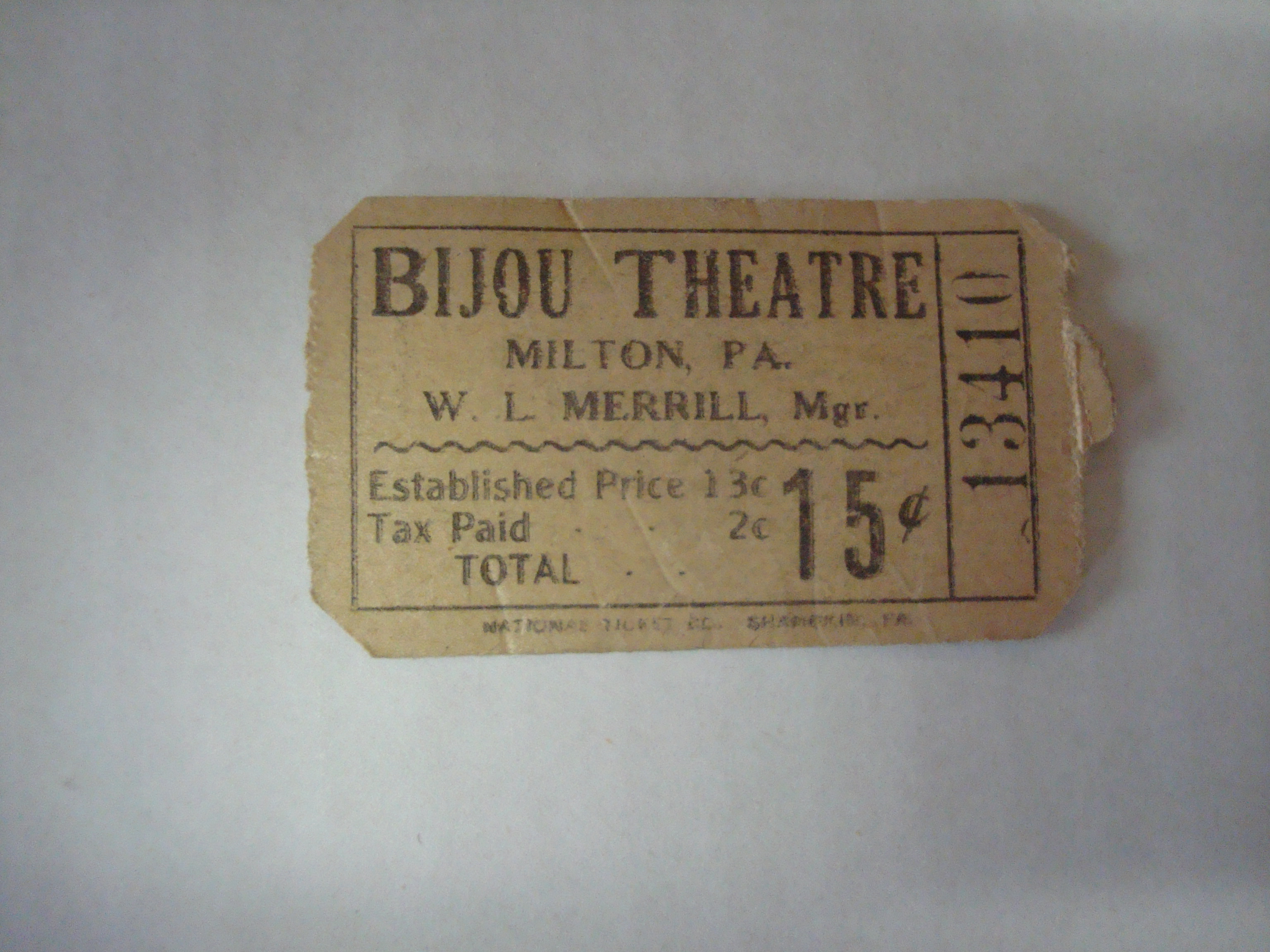
Bijou Dream Theatre Ticket (Source: Milton Historical Society)

Her middle-aged granddaughter’s comments 100 years later:

I get caught up in the story of Grandma’s life—and have worried that she has had a toothache since April 11 (and again mentions the pain on April 15 and 18), but has not treated it.

I feel relieved that Grandma finally tried to visit the dentist—and disappointed that he wasn’t there. (I guess this was the era before appointments.) Hopefully she’ll goon get the tooth fixed.

The Movies

In 1911 Milton had a movie theater on Broadway called the Bijou Dream that showed silent movies.
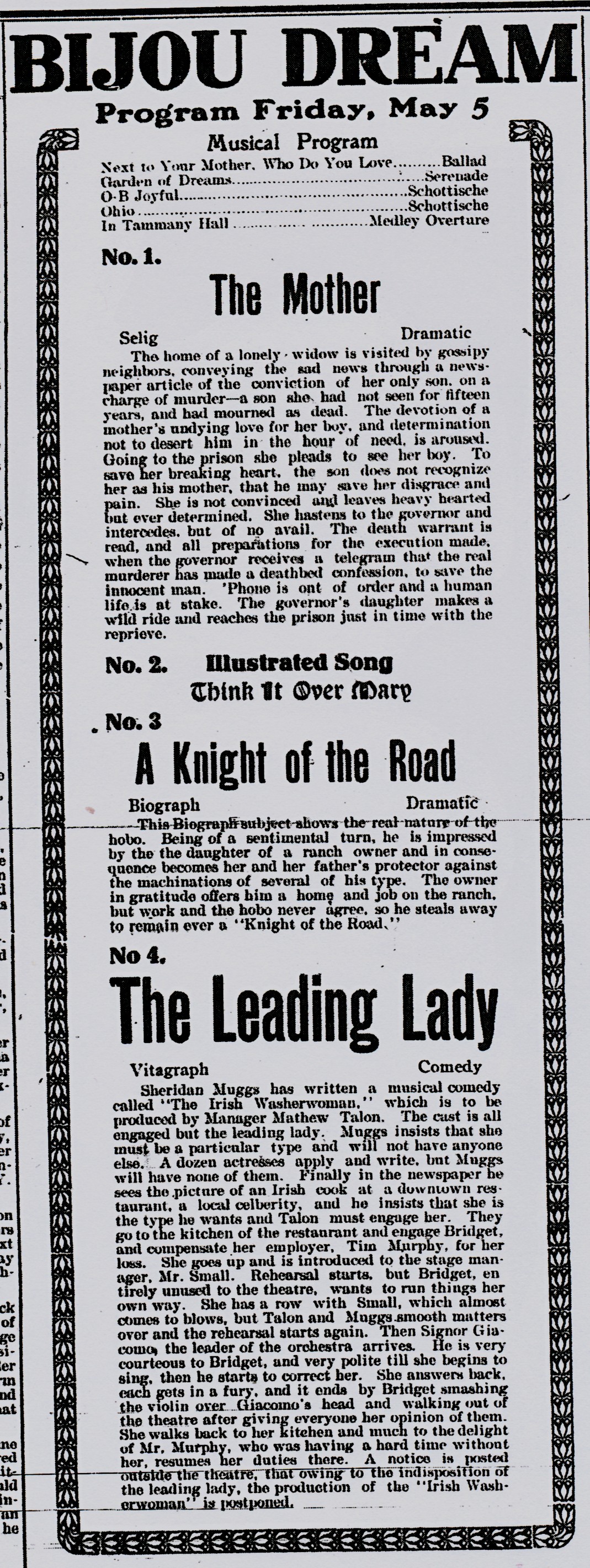
Advertisement in Milton Evening Standard, May 5, 1911

It looks like four short films were being shown in May 1911. In case it’s difficult to read the description of the movies in the photo above, I’ll reprint the description for  the first movie.

 No. 1. The Mother—

The home of a lonely widow is visited by gossipy neighbors, conveying the sad news of the conviction of her only son on a charge of murder—a son she had not seen for fifteen years, and had mourned as dead. The devotion of a mother’s undying love for her boy, and determination not to desert him in the hour of need, is aroused. Going to the prison she pleads to see her boy. To save her breaking heart, the son does not recognize her as his mother, that he may save her disgrace and pain. She is not convinced and leaves heavy hearted, but ever determined. She hastens to the governor and intercedes, but of no avail. The death warrant is read, and all preparation for the execution made, when the governor receives a telegram that the real murderer has made a deathbed confession to save the innocent man. Phone is out of order and a human life is at stake. The governor’s daughter makes a wild ride and reaches the prison just in time with the reprieve.

Whew, what melodrama in the old silent films. I can almost hear dramatic music (played by a live pianist) reaching a crescendo as the governor’s daughter makes the wild ride trying to reach the prison before the execution.
Ironing Collars with a Flatiron

16-year-old Helena Muffly wrote exactly 100 years ago today: 

Wednesday, May 3, 1911:  I did most of the ironing this morning. Ironed my Ma’s fancy collar, but somehow I didn’t iron it right, then I got a lecture for my pains. Sewed this afternoon.

Her middle-aged granddaughter’s comments 100 years later:

A hundred years ago, when it was much more difficult to launder and iron clothes than it is today, women’s dresses sometimes had detachable collars.

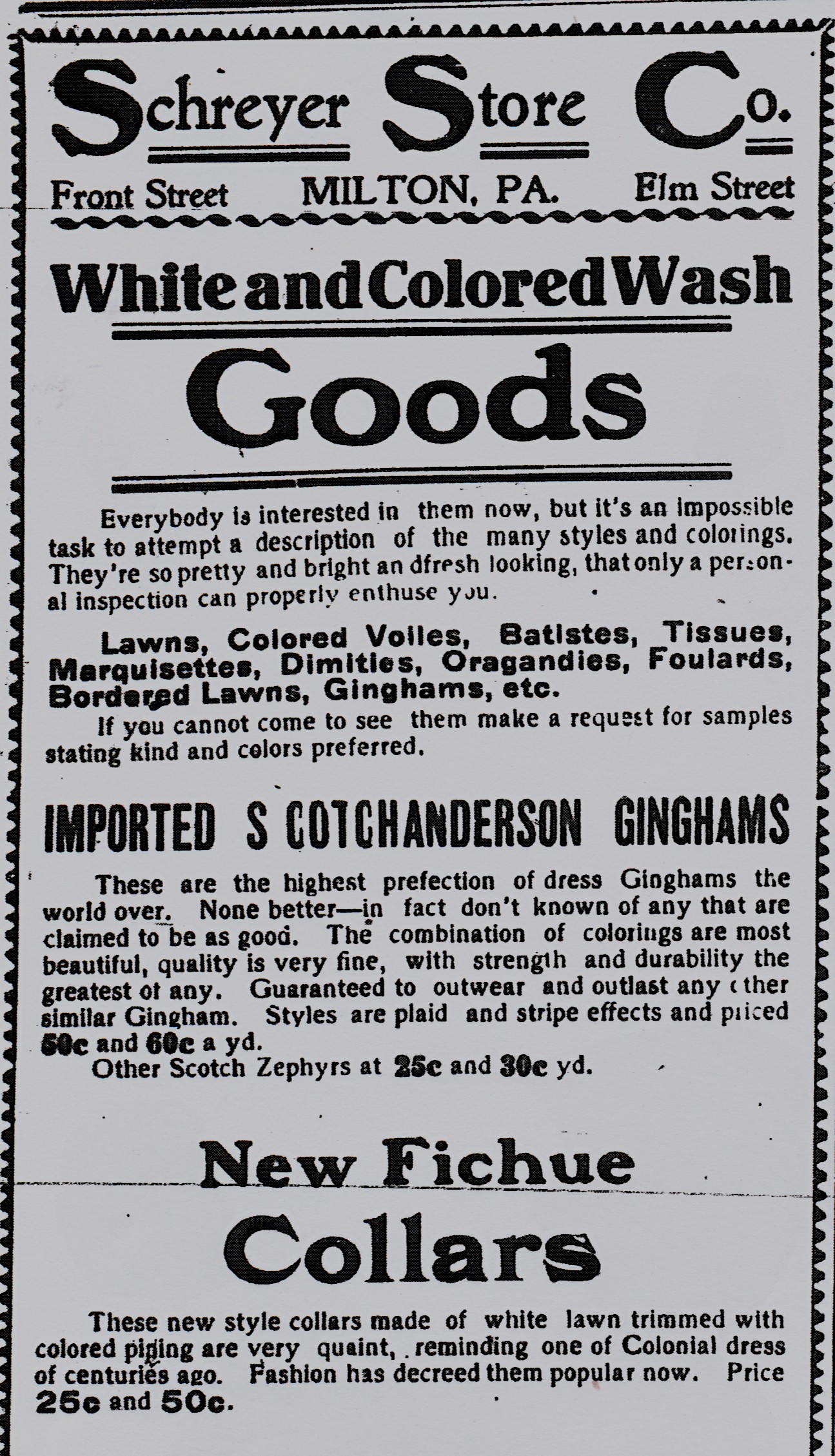
Also, detachable collars came in different styles which enabled people to vary the look of one dress by changing the collar.  If you’d like to see what they looked like, costumes.org has some vintage detachable collar patterns.

Advertisement for collars, Milton Evening Standard, May 8, 1911

Even with modern irons, it can be difficult to iron clothes correctly.  A hundred years ago ironing was even more complicated.

During the laundering process prior to ironing, the fancy collar probably needed to be starched to stiffen it to just the right degree of crispness. If the starch was inadvertently made too thin or too thick there was the potential for disaster.

And, when it was time to iron, the collar needed to be damp—but not too damp.  Grandma probably was using a flatiron that was heated by placing it on the wood stove. It needed to be hot enough to get the wrinkles out—but not so hot that it would scorch the collar.

A book published in 1909 by Juniata Shepperd called Laundry Work: For Use in Schools and Homes had lots of tips for ironing difficulties:

  • Make starch as directed for stiff starching, and use a clean, bare, unpainted table to work on. Things for stiff starching should be thoroughly dried before starching. . . Rub between the hands until the cloth is thoroughly saturated with starch. . . When well wiped, smooth out all wrinkles with the fingers, and hang to dry.
  • To dampen collars and cuffs dip a clean white towel in hot water and wring moderately dry. Lay a collar straight on the towel and turn one thickness over it. Put on another collar, and turn the towel over it and so continue until all are in. Keep straight, and, when ready to iron, take out just one at a time. Starched things should not be damp enough to stick to the ironing board. If they blister when ironed, it indicates that they are too wet and the dampening cloth should be wrung a little drier next time.
  • When set before a wood fire, irons heat well, but require frequent cleaning on account of the dust and ashes which are constantly coming in contact with them. They heat very well on the top of the kitchen range, but it must be made perfectly clean and free from polish where the irons set.
  • Put a goodly pressure on the iron, and do not raise it from the cloth, but move it quickly and evenly over the surface to be smoothed. When a wrinkle is made in ironing, dampen it again in that place with a wet cloth and smooth out.
  • Ironing should be done rapidly, otherwise much time is spent in changing the irons.
  • To remove scorch stains lay the article in the window where the hot sunshine may act upon it for several hours. If the stain is but slight it may be removed by placing a folded white cloth under it and rubbing it gently with a damp cloth. An obstinate stain may be removed by dampening, soaping well and bleaching in the dew and sunshine.

Milton A Hundred Years Ago

16-year-old Helena Muffly wrote exactly 100 years ago today: 

Tuesday, May 2, 1911: Ruth and I went to Milton this morning. Her highness got a dress and a pair of pumps. Don’t know when I will get mine, perhaps next winter.

Postcard showing Marsh Shoe Store in Milton a hundred years ago (postally used December, 1910).
Advertisement in Milton Evening Standard, May 4, 1911

Her middle-aged granddaughter’s comments 100 years later:

We’re five months into the diary–and even though Milton is probably only about 5 miles from the Muffly farm–this is the first time that it is mentioned in the diary. The only towns previously mentioned were McEwensville, Watsontown, and Turbotville. Whew, by today’s standards, Grandma never got very far from her home.

A trip to Milton probably felt like a trip to the big city.

A hundred years ago Milton had a humming downtown with lots of wonderful stores. Back then there were trolley tracks that ran between Watsontown and Milton, so Grandma and her sister Ruth probably walked to Watsontown and then took the trolley to Milton.

Milton Postcard, circa 1911 (Source: Milton Historical Society)

The trolley system was dismantled a few years after the diary was written:

 With the automobile came on the scene in the early years of the twentieth century, the trolley business began to slack. After a sharp decline in business, the L.M. & W. trolley company changed to gasoline buses in 1922. Even the buses couldn’t complete with the automobile and service ended in the early 1930s.

George Venios in Chronicles and Legends of Milton (2002)

An aside: I had a wonderful visit with George Venios, Deb Owens, and Joan Nunn at the Milton Historical Society yesterday. I enjoyed learning more about Milton, and they shared many wonderful artifacts with me including the early postcard in today’s posting. Additional Milton pictures from the historical society will illustrate future posts. Thank you!

I’d also like to thank the Milton Public Library and the Montgomery House Library for their awesome assistance with finding and navigating my way through old issues of the Milton Evening Standard and the Watsontown Record and Star. I’ll be periodically sharing materials from those newspapers.

Tips from 1911 on Raising Chickens

16-year-old Helena Muffly wrote exactly 100 years ago today: 

Saturday, April 29, 1911:  Ma kept me busy a chasing the chickens out of the garden this afternoon. I get so mad at them. Carrie Stout came over this evening. Wanted me to go along with her up to McEwensville. She is afraid of the dark. Of course I went, although I looked like a witch.

Her middle-aged granddaughter’s comments 100 years later:

I wonder what Grandma and her friend Carrie were doing in McEwensville on a Saturday night. Today, I think that Saturday nights in McEwensville are generally pretty quiet—maybe it was hopping a hundred years ago.

Chickens 

The chickens probably enjoyed eating the small emerging plants in the garden. It sounds like the family needed a fence to keep them out.

In the old days women often were able to earn a little “pin money” by raising chickens and selling their eggs. A hundred years ago women’s magazines—as well as farm magazines—had lots of poultry advice.

Paul Orr in the June 1911 issue of National Food Magazine  in an article titled “Are Old Methods Best? Two Thousand Years Have Seen Little Progress in Poultry Raising”  argued that the old ways of raising chickens were best—and that incubators and other “fancy” equipment were not needed. Poultry tips in that issue of the magazine included:

  •  Beginners in poultry raising often owe their failure to the deluge of new-fangled suggestions by men who make things to sell. There are a hundred trinkets and devices on the market that are useless, and the beginner is the legitimate prey not only of egg sellers but of breeders and makers of all ilks of useless contrivances. The fact is that the old methods of poultry raising are often the best.

    Advertisement in April, 1911 issue of Farm Journal
  •  Two hundred heads are sufficient for employing the whole care and time of one person, provided that either a diligent old woman or a boy be appointed to keep watch over them, so they will not stray away or fall a prey to marauders. (Comment by Sheryl: Or I guess—at least in the case of the Muffly family—a diligent teen-aged daughter might be asked to chase after the chickens.)
  •  They must not be allowed wander far from the coop when very young.
  •  Let the custom be observed here, as with other cattle; pick out the best for breeding and sell the less good.
  •  Also dispose of all hens over three years old, and those hatched after the solstice (June 21), as they will not attain their full growth.
  • Avoid the white kind, as they are not very hardy, and because of their conspicuous white color they fall an easy prey to hawks and eagles. Those of a reddish color, with black pinions, should be chosen.

    Cartoon in April, 1911 issue of Good Housekeeping. Photo caption: “I insisted that he should see the Black Minorea”.
  •  It is not expedient to keep a cock except he is exceedingly strong and vigorous of the same color as the hens and with the same number of toes . . . Such a male should be provided with five females.
  •  When the breeding season begins. . the keeper must take care that the laying places are strawed with clean straw, and free from vermin; and the eggs are gathered every day and marked, so he may know that the freshest are put under the hens when they become broody. The freshest eggs are the most proper for hatching; yet such as they are stale may be set, provided they are not over ten days old.
  • The old hens are best suited for hatching, as they are more reliable than the young.

Old Ice Cream Freezer Advertisement

15-year-old Helena wrote a hundred years ago today:

Sunday, January 22, 1911. Went to Sunday school and church this morning. Made ice cream. That is my sister made it and I assisted. I got the ice. Besse and Curt came out this evening. Just when Ruth and I were having a little spat all to ourselves.

Advertisement in the July 1910 issue of National Food Magazine.

 Her middle-aged grand-daughter’s comments 100 years later:

Grandma’s oldest sister Besse was married to Curt Hester, a butcher in Watsontown. My father can remember Curt and Besse working in the butcher shop

Today we think of ice cream as a warm weather food—but I guess in the days before refrigeration that maybe it was a cold weather food. It would have been easier to get the ice needed to make ice cream during the winter months.

I wonder what Grandma and her sister Ruth had a ‘spat’ was about.  Maybe Grandma wanted to make the ice cream rather than assist .

Where did Grandma get the ice?  Warrior Run Creek flows near the house, so maybe she gathered frozen chunks that were near the creek bank. .  . or maybe there was ice on the cattle watering troughs . . . or maybe had they set pans and buckets filled with water out to freeze the previous day . . .