17-year-old Helena Muffly wrote exactly 100 years ago today:
Thursday, May 30, 1912: Memorial Day: Carrie and I went up to McEwensville this morning. This afternoon we went over to Watsontown accompanied by another girl friend. We had the pleasure of getting an automobile ride. It was the first time I was ever in one and consequently never had experienced a ride. We had a good time.
F.O.B. Detroit, including equipment of windshield, gas lamps and generator, oil lamps, tools, and horn. Three speeds forward and reverse; sliding gears. Four cylinder motor, 3 ¼-inch bore and 5 ½ inch stroke. Bosch magnets, 106-inch wheel base, 32 x 3 ½ inch tires. Color, Standard Hupmobile Blue, Roadster, $900.
Two cars whose name is your guarantee
We refer to the two leading Hupmobiles—the Long-Stroke “32” Touring Car, and the Standard 20 H.P. Runabout.
Both the product of the same engineering skill and the same shop organization that originated the Hupmobile.
Both incorporating elements of value not found elsewhere at the price or near it.
Each the sign and symbol of the highest and best construction of its particular type.
The Long-Stroke “32,” with its cylinders cast in one piece, its three bearing crank shaft, its enclosed valves—a motor of extraordinary pulling power and sturdiness and absolute silences, perfectly dust-and oil-tight.
Multiple disc clutch, 13 inches in diameter.
Three-speed transmission, large enough for a 40 H.P. car.
Each a feature for the equal of which you must go beyond Hupmobile price.
And a full floating rear axle of especially strong construction.
Fifteen thousand owners, the world over, testify to the worth and serviceability, the staunchness and durability, of the Runabout.
It, too, has a unit power plant; multiple disc clutch; and sliding gear transmission.
All the power you will ever need or want and to spare.
If you are in the market for a touring car around $900, or a two passenger car, around $750, get in touch with the Hupmobile dealer.
He will show you the actual value of these cars, the value that sets them above other cars of their prices.
Write for a complete catalog.
Standard 20 H.P. Hupmobile, $750
F.O.B. Detroit, with same power plant that took the world touring car around the world—four cylinders, 20 H.P., sliding gears, Bosch magnets, Equipped with top, windshield, gas lights and generator, oil lamps, tools, and horn. Roadster with 110-inch wheel base and highly finished steel box mounted on rear deck, $850.
Hup Motor Car Company, 1201 Jefferson Ave., Detroit Mich.
Her middle-aged granddaughter’s comments 100 years later:
Wow, it’s awesome that Grandma had her first ride in an automobile. I wonder who gave Grandma and her friend Carrie Stout the ride.
The previous year, on May 8, 1911, Grandma used a telephone for the first time.
Technology was rapidly coming to Central Pennsyvlania!
Memorial Day
A hundred years ago Memorial Day was always on May 30—instead of on the last Monday in May like it is now.
17-year-old Helena Muffly wrote exactly 100 years ago today:
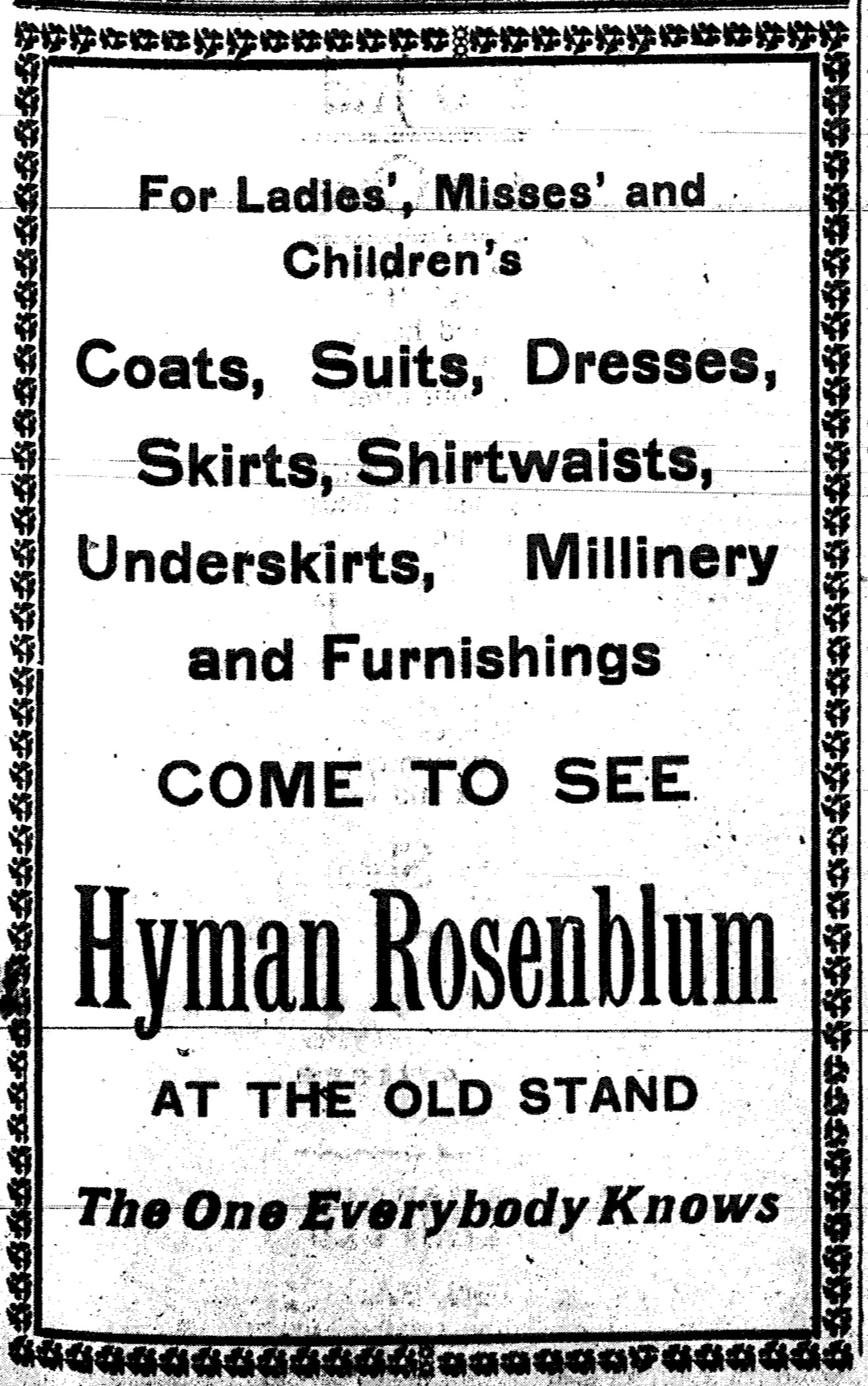
Tuesday, April 30, 1912:Took my dress uptown to get made. Wonder when it will be done. Hope it will be satisfactory. I have a sore fore-finger, but can’t account for the cause.
Her middle-aged granddaughter’s comments 100 years later:
Hmm. . . I’m not sure what Grandma meant when she said that she took her dress uptown to get it made.
Three days earlier, she’d written that she and her mother went shopping in Milton and purchased a hat, several other items, and a white dress:
. . . I got a white dress . . .
Diary entry, April 27, 1912
Advertisement in Milton Evening Standard
Sometime a diary entry raises more questions than it answers.
— Had they really purchased cloth and a pattern, instead of a dress?
— Or did they buy a dress, but it needed alternations?
–Where was uptown? . . . somewhere in McEwensville? . . . in Watsontown? . . . (Uptown sounds like such a classy word to describe any section of the little towns near Grandma’s home.)
–And a lingering question—Do I worry too much about the details? In the bigger picture of Grandma’s story, does it really matter whether she bought a dress or had someone make it for her?
16-year-old Helena Muffly wrote exactly 100 years ago today:
Friday, December 22, 1911: Strung some pop corn for on the Christmas tree. Jimmie got a sled today after a lot of ding-donging for it. He had to go along with Pa to see that he got the kind he wanted. Ruthie came home with them, well supplied with lots of news. I only hope she got me the Xmas present I wanted. She got Jimmie a horn. With two horns he ought to makes things buzz for several days at least.
Her middle-aged granddaughter’s comments 100 years later:
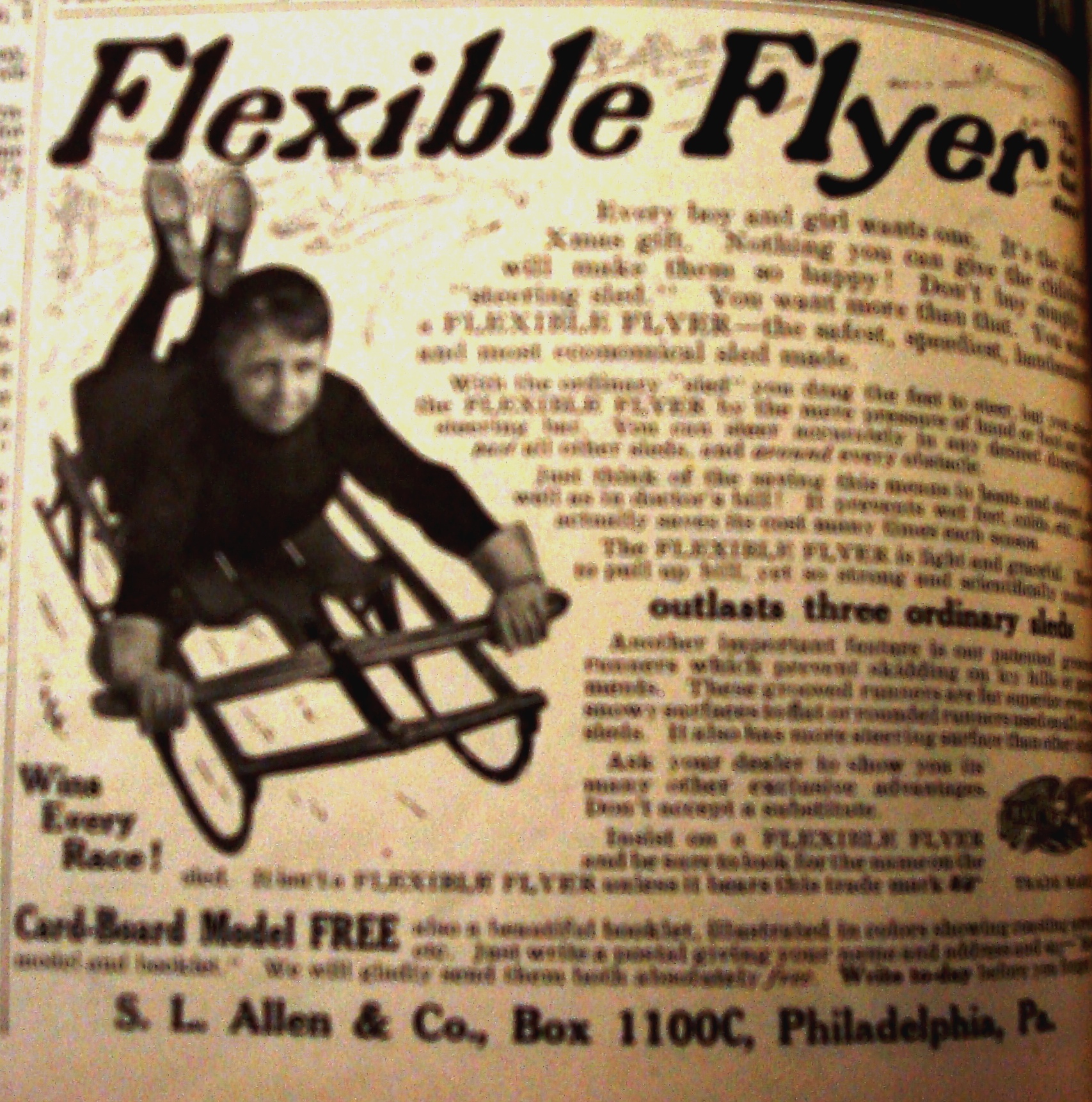
I wonder if Grandma’s six-year-old brother Jimmie got a Flexible Flyer sled.
Source: The Youth’s Companion (December 7, 1911)
Flexible Flyer—“The sled that steers”
Every boy and girl wants one. It’s the ideal Xmas gift. Nothing you can give the children will make them so happy! Don’t buy simply a “steering sled.” You want more than that. You want a FLEXIBLE FLYER—the safest, speediest, handsomest, and most economical sled made.
With the ordinary “sled” you drag the feet to steer, but you steer the FLEXIBLE FLYER by the mere pressure of hand or foot on the steering bar. You can steer accurately in any desired direction past all other sleds, and around every obstacle.
Just think of the saving this means in boots and shoes, as well as in doctor’s bills! It prevents wet feet, colds, etc., and actually saves its cost many times each season.
The FLEXIBLE FLYER is light and graceful. Easy to pull up hill, yet so strong and scientifically made it
outlasts three ordinary sleds
Another important feature is our patented grooved runners which prevent skidding on icy hills or pavements. These grooved runners are far superior even on snowy surfaces to flat or rounded runners used on all other sleds. It also has more steering surface than other sleds.
Ask your dealer to show you its many other exclusive advantages. Don’t accept a substitute.
Insist on a FLEXIBLE FLYER and be sure to look for the name on the sled. It isn’t a FLEXIBLE FLYER unless it bears this trade mark.
Win every race!
Card-Board Model FREE, also a beautiful booklet, illustrated in colors showing coasting scenes, etc. Just write a postal giving your name and address and say—“Send model and booklet.” We will gladly send them both absolutely free. Write to-day before you forget it.
16-year-old Helena Muffly wrote exactly 100 years ago today:
Monday, December 18, 1911: Got up about five o’clock this morning. I milked this morning in entire darkness, but I guess I’ll wait until it gets lighter after this. Ruth left about half past six this morning intending to take the early train. Don’t know what I’ll do without her. Am beginning to miss her already. I consoled myself by going to Watsontown and buying Xmas presents. I got Mater a half doz. tumblers. Ruth a pair of gold collar pins. Besse a gold hat pin and Jimmie a horn to make some noise with. After going over my list of things I bought I found that one of the clerks had cheated herself out of fifteen cents.
Her middle-aged granddaughter’s comments 100 years later:
Whew, Grandma had a long day. It doesn’t sound like fun to get up at 5 a.m. to milk cows on one of the shortest days of the year.
And, it’s kind of cool that Grandma missed her sister Ruth so quickly after she left–or at least wished that her sister was there to help with the work. In so many diary entries, Grandma seemed annoyed or frustrated with her sister; and refers to her as Rufus, her highness, etc. It’s been fun to try to decipher the complex relationship between the sisters.
At least Grandma had a fun shopping. I love the line about the clerk cheating herself out of 15 cents. Grandma would have noticed that type of mistake even when she was elderly. She strongly believed that if you watched your pennies that the dollars would take care of themselves. (Actually she probably also worried about the dollars.)
Even when Grandma was very old, if she saw a penny lying on a sidewalk, she would bend down to pick up.
I also always pick up stray pennies whenever I see any—and remember that I learned the importance of every single penny from Grandma. I tell my children that I’m still young because I can still bend and pick pennies up. My children retort that I must be old if I think that a penny still has enough value to make it worthwhile picking up.
16-year-old Helena Muffly wrote exactly 100 years ago today:
Friday, December 15, 1911:Our entertainment is over at last. That dialogue went off alright. I didn’t forget any of my part although I was rather doubtful about it. As I rather expected before hand, we all received a Christmas present from Jake. It was a post card with his picture on it. Last year he gave girls little china dishes with Japanese on them and the boys match holders containing matches.
Maybe the boys got a China Bald Head Match Holder or a China Scratch Me Match Holder the previous year. Ugh–Somehow giving match holders just don’t work for me.
Her middle-aged granddaughter’s comments 100 years later:
A hundred years ago today was the last day of School for Grandma before the Christmas break. Winter breaks apparently were longer back then than they are now.
It sounds like the students had fun doing the dialogue—Grandma had been working at learning her part since the 5th.
I can’t imagine a teacher giving students match holders today. I wonder why the boys needed them—to light stoves or candles? . . . or perhaps some of them smoked.
16-year-old Helena Muffly wrote exactly 100 years ago today:
Thursday, December 14, 1911: Oh dear! I do wish it would snow. I’m getting tired of tramping through the mud all the time. Get provoked at a problem in Arith. It looked so easy, but I couldn’t get it. I’ll try tomorrow again and perhaps I’ll succeed.
Men probably wore boots like this when tramping around the farm through the mud. Grandma probably had galoshes that she pulled over her shoes. (Source: Kimball’s Dairy Farmer Magazine, September 15, 1911)
FARM COMFORT
Sloshing around in wet and mud is no fun, but a pair of good, stout rubber boots, which you always depend on, makes it a lot easier.
Get the easy, comfortable, long-wearing kind—the
Woonsocket
ELEPHANT HEAD
Rubber Boots
We have been making rubber boots for 45 years, often as many as 10,000 pairs a day—in the only exclusive rubber boot mill in the U.S.
We make boots for men, women, and children: hip boots, knee boots, short boots—all kinds. One man who bought a pair 28 years ago wrote us that they were still good.
All Dealers.
WOONSOCKET RUBBER Co.
Woonsocket, R.I.
[An aside–I can’t even imagine a company today advertising that a pair of boots might last 28 years. I guess that some things were just made better a hundred years ago!]
Her middle-aged granddaughter’s comments 100 years later:
Yuck—the mud sounds awful. This is the third time that Grandma’s mentioned mud in her December diary entries . . . and the eleventh time that she’s mentioned it since she began the diary in January 1911.
(If you would like to read her previous entries on this topic—type the word mud into the search box near the top of this page.)
Mud was a huge problem a hundred years ago. There would have muddy areas between the house and barn on the farm. And, the roads, both in McEwensville and the surrounding rural areas, were not yet paved in 1911.