1919 Heinz Vinegars Advertisement

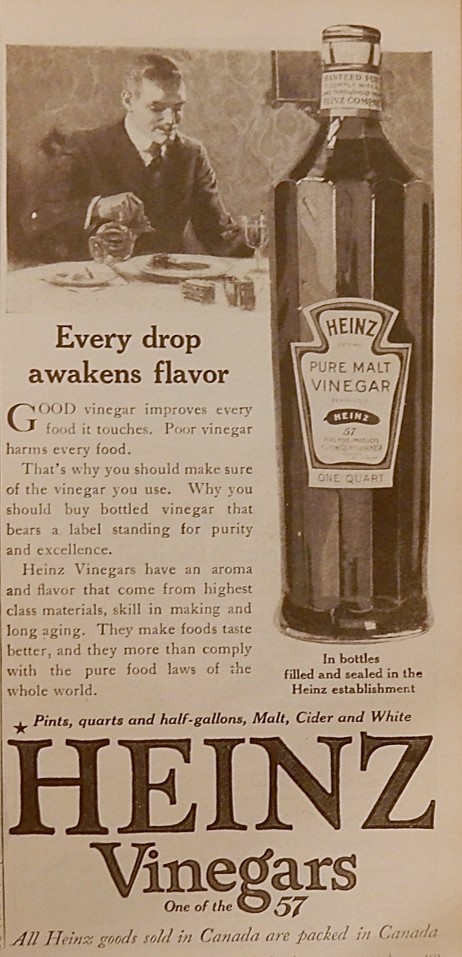
Advertisement for Heinz Vinegar
Source: Good Housekeeping (April, 1919)

Some things haven’t changed much over the past hundred years. For example, in both 1919 and 2019, Heinz emphasized that the company offered several varieties of vinegar.

The 1919 Heinz Vinegars advertisement said that “Malt, Apple, and White” varieties were available, and that they were “one of the 57” Heinz products.

The current Heinz brand tagline is “A Vinegar for Every Need.”

Is it grammatically correct to pluralize “vinegar” or is “vinegars” an archaic term?

1919 Tayler Oven Thermometer Advertisement

Source: American Cookery (February, 1919)

I was surprised to see an advertisement for a oven thermometer in the February, 1919 issue of American Cookery magazine. Cooks had a bit more information about oven temperatures than I’d previously realized.

Cooking with wood and coal stoves a century ago could be challenging. Hundred-year-old recipes never indicated the exact temperature that should be used when baking food in the oven. Instead the recipes said things like use a “high temperature” or a “medium temperature.” And, the cook was left to her (it was generally a woman in those days) own devices to figure out how to regulate the temperature. For example, more wood or coal might be thrown on the fire to get increase the temperature.

1919 Jell-o Advertisement

Source: American Cookery (January, 1919)

A 1919 Jello advertisement treats measles as a common ailment, and suggests that children who are sick with the measles might enjoy eating Jell-o while they recuperate. The first measles vaccines were introduced during the 1960s, and the Measles, Mumps, and Rubella (MRR) vaccine was introduced in 1973.

1918 Quaker Oats Advertisement

Source: Ladies Home Journal (May, 1918)

Food is expensive – both a hundred years ago and now. It’s interesting to see how a 1918 advertisement for Quaker Oats framed the cost of meals around calories. Back then, apparently getting more calories per amount spent was considered a good thing.  Today, are people willing to spend more to get fewer calories?