
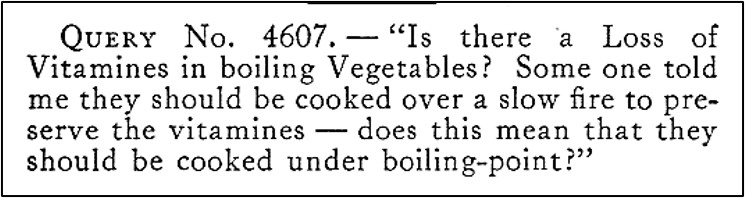
A hundred years ago, American Cookery magazine had a Queries and Answers column. I looked at least four or five times at the header, and kept thinking that it should say “Questions and Answers,” but it actually says, “Queries and Answers.” What a formal way of saying “Q&A.”
One query was about the loss of vitamins when vegetables are cooked. It seems really strange that “vitamins” was spelled, “vitamines” in the query. Maybe that’s an archaic spelling. Here’s the answer in the old magazine:
Loss of Vitamines in Cooking Vegetables
In all cooking of food there is more or less loss of vitamines involved, but the lower the temperature the less will be the loss, so we think your friend probably meant “low temperature” when she said “slow fire.”
Authorities on the subject tell us that the temperatures used in the ordinary methods of home cooking involve no very serious loss of vitamines. but when vegetables or other foods are cooked in water, there is a serious loss of the vitamines that are soluble in water. In our own experience, this rather than the high temperature, is the thing to be dreaded and deplored.
When the water used in cooking is drained off down the sink there is a waste of valuable substances which should be regarded as nothing short of criminal. In some of the classic experiments on these substances, pigeons which had been fed on vitamine-free foods until they were at the point of death were quickly resuscitated and made a complete recovery when the water used in boiling vegetables was administered to them.
We, therefore, pray you, boil your vegetables if you wish (though we’d prefer you to steam them), but save every drop of the water from either process. Use it as a basis for soup, for gravy, for mashing potatoes, for breadmaking – for anything you please, only use it.
American Cookery (December, 1926)
Whew – the author of the answer has a strong opinion! I’m apparently acting in a criminal manner. This answer makes me feel guilty, and I hate to admit it, but when I boil or steam vegetables, I throw the water out. Maybe I should stick with roasting vegetables.
I also am a bit alarmed by the pigeon experiments, but things were different back then. Some things have definitely changed over the years.

I’m mostly a water-tosser too, although I never boil any veggie (apart from occasional potatoes). Steaming is my method of choice. I will save veggie water if I have soup-making coming up, since I was told early and often to do that!
You do better than me if you save veggie water when you are planning to make soup. I know that I should save the water for soups, but somehow am never good at planning ahead.
Yes, guilty as charged. I steam veggies but don’t always keep the water. I love my veggies still ‘firm’, especially broccoli, carrot and beans – so less cooking may help retain some of the nutrition otherwise lost. I also love leaves like arugula, lettuce, etc. with a little virgin olive oil and a squeeze of lemon juice. Yum… Natural state must be best… Love, love salads. Oh, I’m making myself hungry. Great post, Sheryl.
I’m glad you enjoyed this post. Your wonderful salad description is making me hungry. 🙂
When I learned to cook, I was taught by my mom to use as little water as possible when cooking foods and to cook it until all the water has evaporated. I thought that was just for a better flavor. (The flavor really is enhanced when you do that)
It can be really tricky, getting the heat turned off just at the perfect stage of evaporation. Green beans and buttered potatoes are examples of this challenge.
I’m impressed that you are able to successfully cook vegetables until the water is just evaporated. I’ve had too many bad experiences with scorched potatoes and other vegetables when the pan goes dry to even try to do that.
LOLOL Hubby’s favorite dish….browned green beans!!! You really have to keep a close eye on them.
I won’t tell you what my husband says if I serve browned green beans. 🙂
I guess it’s one of those things you either love or hate!!!😂😂😂
My sister recommended I use the cooled cooking water for plants (flowers and vegetables) in the garden, which I guess works like a fertilizer. I do not do it often but it makes me feel good about not pouring the vitamin laden water down the drain.
Great suggestion – I never thought about using vegetable water as a plant fertilizer, but it makes sense.
The article said: “We, therefore, pray you, boil your vegetables if you wish“ ” I love that line!!
What a fun line! The author definitely is taking a strong position.
I so enjoyed this 1926 Q&A, Sheryl. The header is lovely, with the elaborate shrubbery and flowers, mailbox and full dress. And the strongly worded answer made me smile–“dreaded,” “deplored,” “criminal.” The answer remains the same as it did 100 years ago. Lots of fun to see this, thank you.
I’m often awed by the graphic design in hundred-year-old magazines. The magazines used some really skilled artists and designers
I was taken aback by the pigeon story also, but it turns out there was more to it…and vitamines! Various researchers were studying nutrition deficiency in pigeons due to their becoming paralyzed and dying when fed a white, polished rice. The process led to discovering “amines” that were necessary, and it was called vitamines for vital amines. Later research showed amines were not in all of the necessary nutrients, so they shortened it to vitamin. The pigeon research path was actually quite interesting, and the breakthrough research did occur in 1926 and was the discovery of vitamin B1.
Thanks for finding the whole story. It’s interesting that vitamin B1 was discovered exactly a hundred years ago. I’m going to have to see if I can find any articles in 1926 magazines about it – though those stories might not appear in the popular press until 1927 or 1928.
It is always interesting to me to learn of early discoveries of things we often take for granted. This story was truly one of your most interesting finds!
It’s nice to hear that you enjoyed this post. I also thought that the information in the old Q&A was interesting.
I enjoy all of your posts, and appreciate that you acknowledge the various perspectives your followers share.
I like my vegetables well boiled, so I guess I’m going the way of the pigeons.
I may also be going the way of the pigeons. 🙂
Discarding cooking liquids is indeed a shame. The method of using as little water as possible, is much preferred.
While at it, it’s also important to remember that cooking can actually boost certain nutritional components (beta carotene, lycopene, etc) in vegetables such as carrots, tomatoes, and others. So it’s not all “criminal”… 🙂
Good to know that cooking can boost nutritional components in some cases.
The water not only contains vitamins, it also contains flavour. Best to use as little water as possible. We prefer steaming our vegetables or sautéing them in butter or olive oil. Works very well, but not for green beans. Our mothers used the water to make a béchamel sauce. We still remember the overcooked cauliflower with the sauce. Very, very bland.
Your comment about the cauliflower reminded me of a recent evening when we had friends over for dinner. I steamed some asparagus, and got distracted in the process and overcooked it. The asparagus ended up being almost mushy – not good, though everyone was kind enough not to mention how bad it was.
I’m sure they were okay!
Although the writing and expression is a bit dated, the science behind the answer is pretty solid. My mom always saved the water from steamed – she never boiled – vegetables to make stock (all the vegetable ends and peelings were saved too) and added to the meat bones to further enrich the broth or stock. I follow a similar process today.
The word vitamine spelled with the “e” at the end changed in the 1920s when it was discovered that not all vitamins are amines. For instance, B1 and B12 vitamins are amines while C, D and E are not. “Vitamines” was a portmanteau created from “vital amines.” (I remembered this from high school biology but looked it up to make sure that I had it right!) Cheers.
It’s fascinating how the spelling changed when as they learned more about vitamins.
yes, I found the pigeon experiments disturbing too! I save my steaming water in a canning jar in the fridge and use it when I make stock. So much flavor!
I should save my steaming water. Now that I think about it, I’m realizing that I probably should make stock more often than I do.