
There are several foods I generally make for Easter dinner – ham, deviled eggs, rhubarb sponge pie. Other dishes vary from years to year. Some years, I’ll make an asparagus dish; other years it might be another vegetable. I usually make potatoes, but they might be mashed one year and scalloped the next.
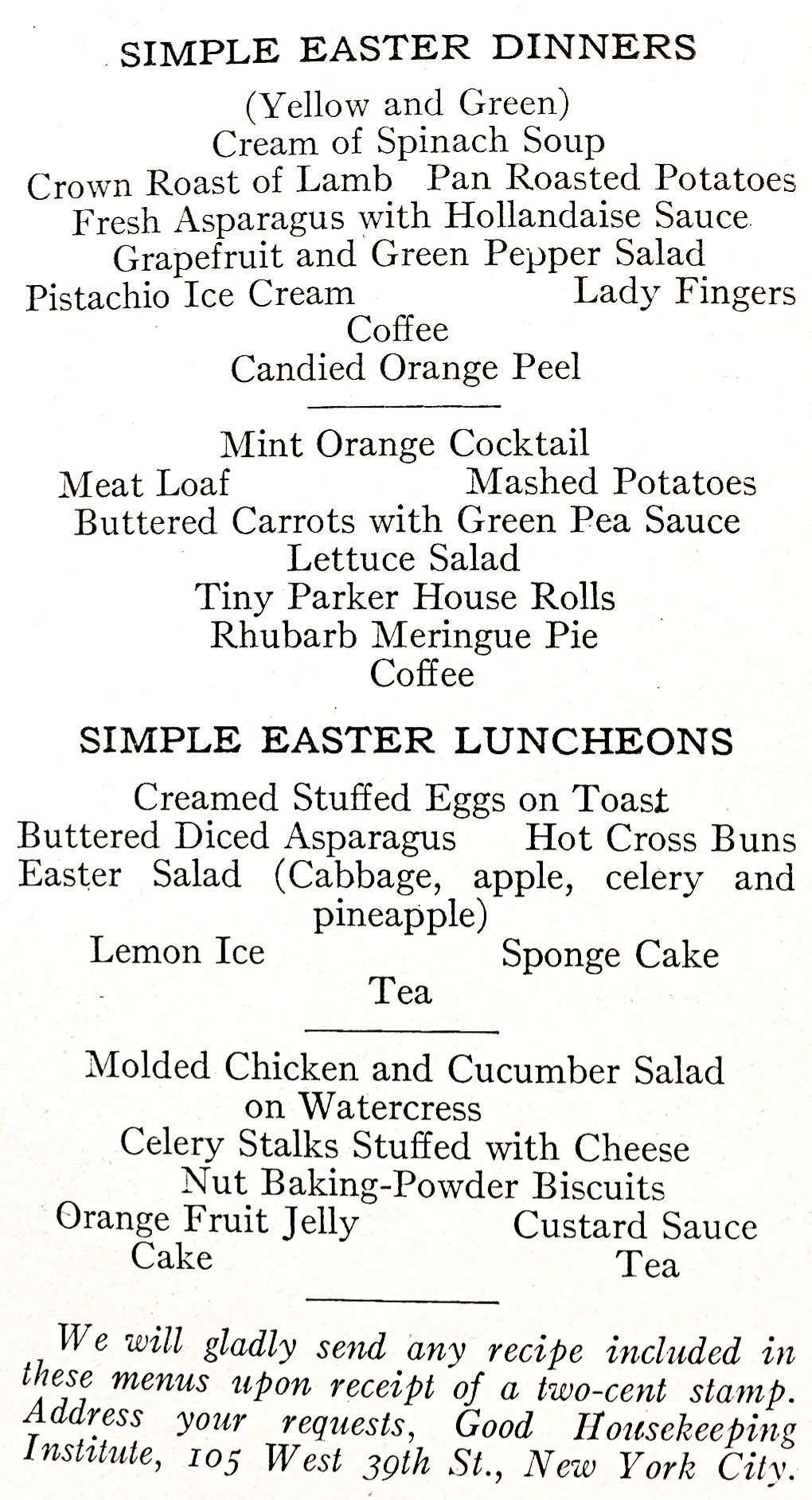
I recently found several hundred-year-old menus for Easter dinner and Easter luncheons in the April, 1926 issue of Good Housekeeping. I was surprised that none of the menus featured ham, and somehow think that Molded Chicken and Cucumber Salad on Watercress might not be a hit at my house. But it’s hard to tell since the magazine didn’t publish any of the recipes. Instead, readers were directed to send a two-cent stamp so that the recipes could be sent to them.
Wow, it’s amazing what you could get for a two-cents in 1926. I’m guessing that a Good Housekeeping employee wrote the name and address of the person requesting the recipes on an envelope that contained the recipes. The two-cent stamp was then pasted on the envelop and it was sent out to the reader. What a deal!

Life was so much simpler back then. How special it must have been to receive that envelope containing the recipes…
I remember how much I enjoyed cutting coupons off cereal boxes when I was a child, and then sending them in to get some small toy. I always could hardly wait for the toy to arrive. I’m guessing it was similar with the requests for recipes a hundred years ago. I can almost sense the excitement when the anticipated recipes arrived in the mail.
Instant gratification has its up-sides. But, waiting for something, the anticipation and then the joy of the reveal also has so many delights too. There are numerous ways this happens these days. Ordering on-line and waiting for the arrival sets up this sense of anticipation, especially when it’s been a longed for article.
As I write I am realising we are not so different from the life of yesterday. Perhaps the major difference being today we can order from almost anywhere in the world. The ‘arrival’ can be just as joyful.
I never thought about anticipation in quite that way, but it makes a lot of sense. It’s fascinating to think about how the anticipation precipitated by waiting for something that has been ordered hasn’t really changed across the years. Rather the change has been in the method of ordering and length of wait.
I notice there’s no lamb, either. Those menus don’t look all that simple, either. There are a lot of dishes in each.
Deeply buried in the “Simple Easter” menu, there was a mention of Crown Roast of Lamb. I have no idea where I’d find that today if I wanted to try to replicate the menu.
I’m curious about the rhubarb pies. I have some nice little seedlings that will hopefully provide some rhubarb ina few years. One thing that my family makes for easter is a rather strange green jello salad that has cottage cheese and horseradish in it. It’s actually not bad especially with ham.
Fingers crossed that you have good luck with the rhubarb seedlings. My sense is that rhubarb is generally fairly easy to raise, so hopefully yours will become large plants relatively quickly. I’m intrigued by the green jello you described. I don’t think I’ve ever seen any recipes for anything similar to it, but will pay more attention if I ever do. Food traditions form the basis for so many special memories.
Well the meat loaf option is a daily choice as opposed to a holiday menu.
Meat loaf isn’t on your holiday menu? 🙂 It may have been more difficult to get ground meat a hundred years ago, which may have resulted in people considering it a food worthy of serving at a holiday meal. I think that people back then often had meat grinders that they used to make their own ground meat.
I love how the invitation to request the recipes for a 2 cent stamp is worded. I have to agree with you about “molded chicken.” I’m not at all sure what that is!
The “gladly send” wording gives me a warm fuzzy feeling about the magazine. It makes me feel like they care about each and every reader, even though I know that millions of people read Good Housekeeping each month.
I so very much enjoyed these Easter meal plans, Sheryl, and I also liked skating along with your imagination back to 1926 with two pennies and the recipe sending.
Easter menus sure have evolved across the years.
I guess it’s a custom that’s dying out now, but certainly at the time these recipes were published, it would have gone without saying that in England, the meat served at Easter would have been lamb (Christian/Jewish symbolism about new life and in Christianity’s case, the Lamb of God). Chicken, ham etc. wouldn’t have had a look in. And when I was a child, the only other traditional foods were Hot Cross Buns, only to be served on Good Friday and a few days after (I still feel odd, if I eat them before that day), and Simnel cake for tea on Easter day, though originally, this was eaten on the 4th Sunday in Lent. Thrse days, Hot Cross Buns start appearing in the shops, like Easter eggs, shortly after Christmas, and I disapprove heartily!
Your comment makes me wonder if the same was true in the U.S. a hundred years ago. By mid-century in the U.S., ham was often served at Easter meals. Maybe that was a fairly recent custom at that time – though my sense is that in areas where lambs weren’t commonly raised, that it was not typical to serve lamb even a hundred years ago.
Hot Cross Buns are commonly served here, too. Like the U.K., they are available for several months each year. And, like you, I also heartily disapprove.
I’m not very familiar with Simnel Cake, and at least in the area where I live, I don’t think that it is typically served at Easter in the U.S.
You’re missing a treat!
I did an online search for “Simnel Cake” and it looks wonderful. Hopefully, I’ll get an opportunity to try it someday.
I love it. But like Christmas cake, it’s far less popular now. Younger people don’t seem to like a rich fruit cake. All the more for me then!
I love fruitcake. Not sure why tastes have changed – and unfortunately fruitcakes seem to have become a joke about how old they are.
Sometimes I think that people became less interested in making fruitcakes after gas and electric stoves became popular. Prior to that people had their wood or coal stoves going all day, and it was easy to steam a fruitcake (or steamed pudding) for hours. After they shifted to gas or electric, it required the use of additional energy to steam a fruitcake, and they became less popular.
Well, that’s true. But I think that selections of ready made ‘shop cakes’ include fewer fruit cakes, I tend to think. People are missing out!
The rhubarb meringue pie sounds wonderful!
It is! I actually made a hundred-year-old Rhubarb Custard Pie with Meringue Topping recipe several years ago.
Grapefruit and green pepper salad!!! -:)
Oh my, you’re not planning to serve it at your holiday dinner? 🙂
Hub hates green peppers! 😉
This is such a fun find! It’s wild to think about what two cents could get you back then. I’m reading this while waiting for my carpet cleaners to finish up, and it’s making me wonder what people in 1926 would think of something like that. Molded Chicken and Cucumber Salad sounds… interesting, to say the least! Thanks for sharing.
I bet that they’d be amazed. Technology advances over the past hundred years sure have changed how things are cleaned. Your comment makes me think about how we took rugs outside and shook them or hit them with carpet beaters when I was a child. I think that I will pass on the Molded Chicken and Cucumber Salad. Molded salads that contained meat and vegetables were more common a hundred years ago than what they are now. It’s definitely a type of food that has trended downward across the years.
Interesting, we always had a roast leg of lamb for Easter, along with asparagus from the garden. I guess we weren’t rich enough to have a crown roast of lamb! I wonder if having ham for Easter is a regional preference?
That makes sense. There probably was a lot of regional variation in what people ate for Easter dinners.
We had ham for Easter dinner too. Those menus would not have been a hit.
They won’t have been a hit in my family either for Easter dinner – though they might be willing to try one or two of the more interesting sounding dishes on some other occasion.
When my grandmother was alive, lamb with homemade mint sauce was an Easter staple, with potatoes and asparagus. She was born in 1904 🙂
mmm. . . Your grandmother’s menu sounds lovely.