
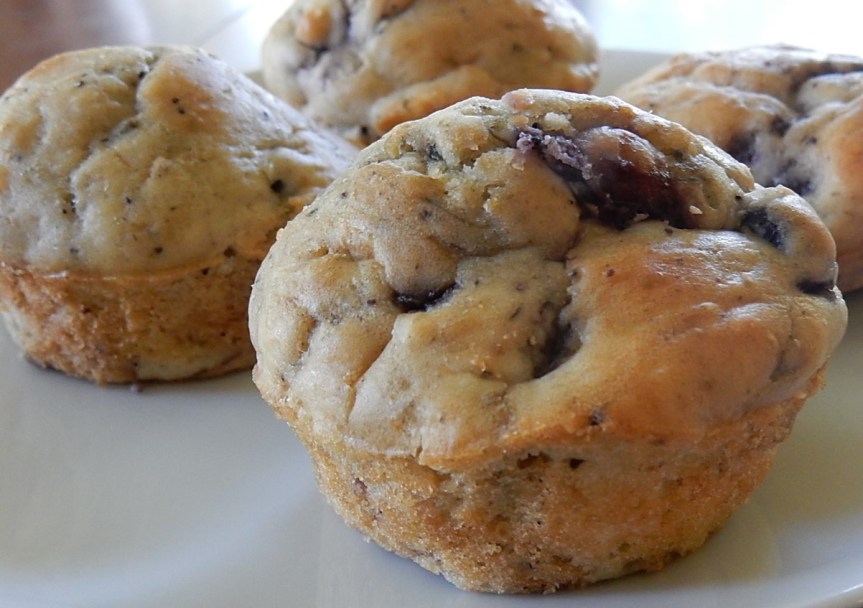
I have coffee with friends each Wednesday morning, and I frequently take a treat. I often make muffins. Occasionally I make hundred-year-old muffin recipes, and have my friends taste test them; but, often I make modern muffin recipes that I find online. Over time, I’ve come to the conclusion that modern muffin recipes generally are much sweeter than old-time ones.
For example, several years ago I made a hundred-year-old Blueberry Muffin recipe that called for 1 tablespoon of sugar. Most modern Blueberry Muffin recipes call for much more. The Glorious Treats Blueberry Muffins recipe calls for 1 cup of sugar. Sally’s Baking Addiction Blueberry Muffin recipe calls for 1 1/4 cups sugar (1/2 cup granulated sugar + 1/4 cup brown sugar + an additional 1/2 cup brown sugar for the topping). The exact number of muffins varied a little from recipe to recipe (mainly dependent on exactly how full the muffin cups were filled), but the recipes all made a similar number of muffins.
Similarly, modern Pumpkin Muffin recipes call for lots of sugar. The King Arthur Pumpkin Muffin recipe calls for slightly over 1 cup of sugar (3/4 cup granulated sugar + 1/4 cup brown sugar + additional granulated sugar to sprinkle on the top). Joy Food Sunshine’s recipe for Pumpkin Muffins calls for 1 1/2 cups of sugar (3/4 cup granulated sugar + 3/4 cup brown sugar. However, a hundred-year-old recipe for Squash Muffins (pumpkin could easily be substituted for the squash) only called for 1/4 cup of sugar.
Why were muffins generally less sweet a hundred years ago? I don’t know, but my hypothesis is that today they are considered a treat or sweet breakfast bread, while years ago they were frequently eaten as a dinner roll.

I wonder, was sugar more expensive so was less used with old recipes?
My sense is that sugar was historically considered a luxury item, but that numerous technological advances spread across many years has made it relatively inexpensive today.
Now I need muffins! 💕
I know the feeling. I also really enjoy muffins.
Interesting! We had lunch at a restaurant a few weeks ago where they served muffins with our entree salads. We really enjoyed them, and they definitely weren’t sweet. Also, this reminds me of the different styles of cornbread, where you have some recipes that are sweet and some not.
Cornbread is an interesting example. I’ll make cornbread occasionally and never put sugar in it, but some people really do. In my family I was told when young that cornbread omits sugar, whereas “johnny cake” is the same recipe with it.
FWIW, the same is true of soda bread. I’ll make soda bread with beer (one can or bottle to three cups of self rising flour). The recipe I use requires sugar which I never put in, and I don’t know why a person would.
Cornbread is a good comparison.
Very intersting.
I suspect almost all American breads were less sweet a century ago. American white bread is insanely sweet if you aren’t used to eating it.
FWIW, my mother used to occasionally make muffins when I was young and they were not sweet at all. Now, she was generally not a good cook in general, but I’ll note that she’d learned to cook in an Irish Canadian household that cooked in the British style. As an adult I was surprised by how sweet muffins that other people made are.
I really dislike muffins in general, and this may be why. I’m not a fan of really sweet breads for the most part, with sweet rolls being the exceptions. A bakery makes cupcakes where I am that’s really popular and people buy them for office events and I always avoid them. The same with homemade carrot cake, which is a type of cake I don’t like in general, but which some people make incredibly sweet and oily.
It’s interesting how much variation there is across recipes in the sweetness, oiliness, taste, etc. of some foods. Sometimes I wonder why some cooks prefer versions of some recipes that don’t seem very good to me. Clearly different people have different preferences.
I was thinking the same thing as another reader, that maybe sugar was more expensive. Also, I’m sure tastes change over time.
As you thought, overall sugar has become a little less expensive over the years -though some factors led to increases in price and others to decreases. Based on a quick scan of a Wikipedia article on the history of sugar, it sounds like a variety of factors have affected the price of sugar over the past two or three hundred years. Sadly, slaves were involved in sugar production until the 1800s, and the production of sugar shifted away from some areas as slavery ended. In the 1700’s and 1800’s, producers began to produce sugar made from sugar beets in addition to cane sugar. Also, there have been a lot of technological advances in the production of sugar (more mechanization, improved varieties, etc.)
Thanks for the info.
The cost of sugar was my first reaction, too.
Everything I’ve seen indicates that sugar is relatively less expensive today than it was a hundred years ago.
Well I know the muffins today are sweeter even then the ones 50 years ago. So many of them are more a cupcake then a muffin in days gone by
I agree – Many muffins today seem almost like a dessert.
Muffins were definitely less sweet in the past. Sugar was not prohibitively expensive in 1926. It was in 1920 after WWI ended, primarily due to lack of availability, but it had dropped in cost by 1926. The main difference was muffins were considered a type of bread historically, and if sweetened, it was with honey or jam, similar to scones or biscuits. I found savory scones and toast more frequently during the time I was in South Africa. Scones were served with shredded cheese or one could choose clotted cream and jam, and one could order a savory French toast which was delicious. I think we all know that the US habit of putting sugar in everything has not been good for our health.
Your comment led me to dig a little deeper into the price of sugar. I found a 1925 Monthly Labor Review article that says the retail price of sugar averaged 7.1 cents per pound in Feb. 1925. According to an inflation calculator, a dollar in 1925 is worth $18.67 in 2026 – so a pound of sugar back then would cost about $1.33 today. The most recent time I purchased sugar, I think it was on sale. It cost $3.89 for a 4-pound bag which would be about $.97/pound. That’s a little less expensive than in 1925.
If I’m not mistaken, the more sugar one eats the more it takes to get the same “sugar hit”. When table sugar was not overused, it took less to get things sweet.
When stationed in S.Korea, I got used to eating Korean chocolate bars. Once back in the USA, I went right to buying a large Hershey’s Milk Chocolate bar. It was abnormally sweet to my taste buds.
So, I’m trying to use fruit, molasses, honey, and other things to temper my white sugar fixation. As a diabetic, I also have to watch white carbs such as potato chips, french fries, etc. It converts to blood sugar quicker than table sugar.
Ciao for now,
Chow for laters
That makes a lot of sense. I think that people have a similar taste experience with salt. People who eat a lot of salty foods often think that foods taste very bland if they don’t contain a lot of salt, while people who eat a low-salt diet, often think foods with more salt taste too salty.
Was sugar more expensive back when?
Based on limited research, I believe that sugar was a little more expensive in the mid-1920s than what it is today.
One more explanation as to why (generally speaking) our population is so much more overweight these days….
Unfortunately that’s true. People often don’t eat in particularly healthy ways.
I generally find modern cake recipes way too sweet. Cutting sugar by a third seems to make them more palatable.
Similarly to how you adjust the amount of sugar when making cake recipes, I’ve noticed that people making online recipes sometimes adjust the amount of sugar. When I look at the comments on online recipes for cakes, muffins, and various other desserts, I notice that the individuals commenting often suggest reducing the amount of sugar.
Absolutely an American thing. American foods these days are super sweet. European sweet treats are lower in sugar – less sweet but tend to use more (and better) butter and cream so higher in fats. And quite frankly smaller portions of those are more satisfying for some reason. I prefer the lower sugar or eaven savory versions and it looks like many of your readers do as well. I wonder if there was more of a tradition of adding homemade jelly or jam to taste to breads for a sweet treat. I don’t use sugar in corn bread but depending on what I have it with I do like it with honey and butter. Tradition and taste.
I think you’re right that people probably were more likely to put jam or jelly on muffins in days gone by than what they do today. I often see muffins for sale in coffee shops – and they are sold with the expectation that people will eat them as is.
We think that over time food in the US and Europa has become sweeter and that sugar is more often added to food, including savory food. We searched for background information and found this article: https://time.com/6329462/history-sugar/. Of interest to you?
Thanks for the link. The use of slave labor to produce cheap sugar (as well as various government policies that resulted in low sugar prices) sure led to changing food preferences and increased sugar consumption over the past 600 years or so. Lots of food for thought about the relationship between how societies are organized, policies, nutrition, and health.
I’m always cutting back the amount of sugar in my current baking needs. I will be trying the blueberry muffin – 100 yr ago recipe, thanks for sharing it with me!
I think that you’ll like it.
It was more like a bread, than a muffin. But a real conversation starter with our dear foodie friends, thanks!
Like you, I’ve also found that serving foods made using hundred-year-old recipes is a great conversation starter.
You’ve encouraged me to cut the sugar in recipes! How do your Wednesday coffee friends like the 100 yo, less sweet muffins?
They have a lot of fun “testing” the muffins, and generally really like them. I’ve tweaked a few recipes based on their feedback.