
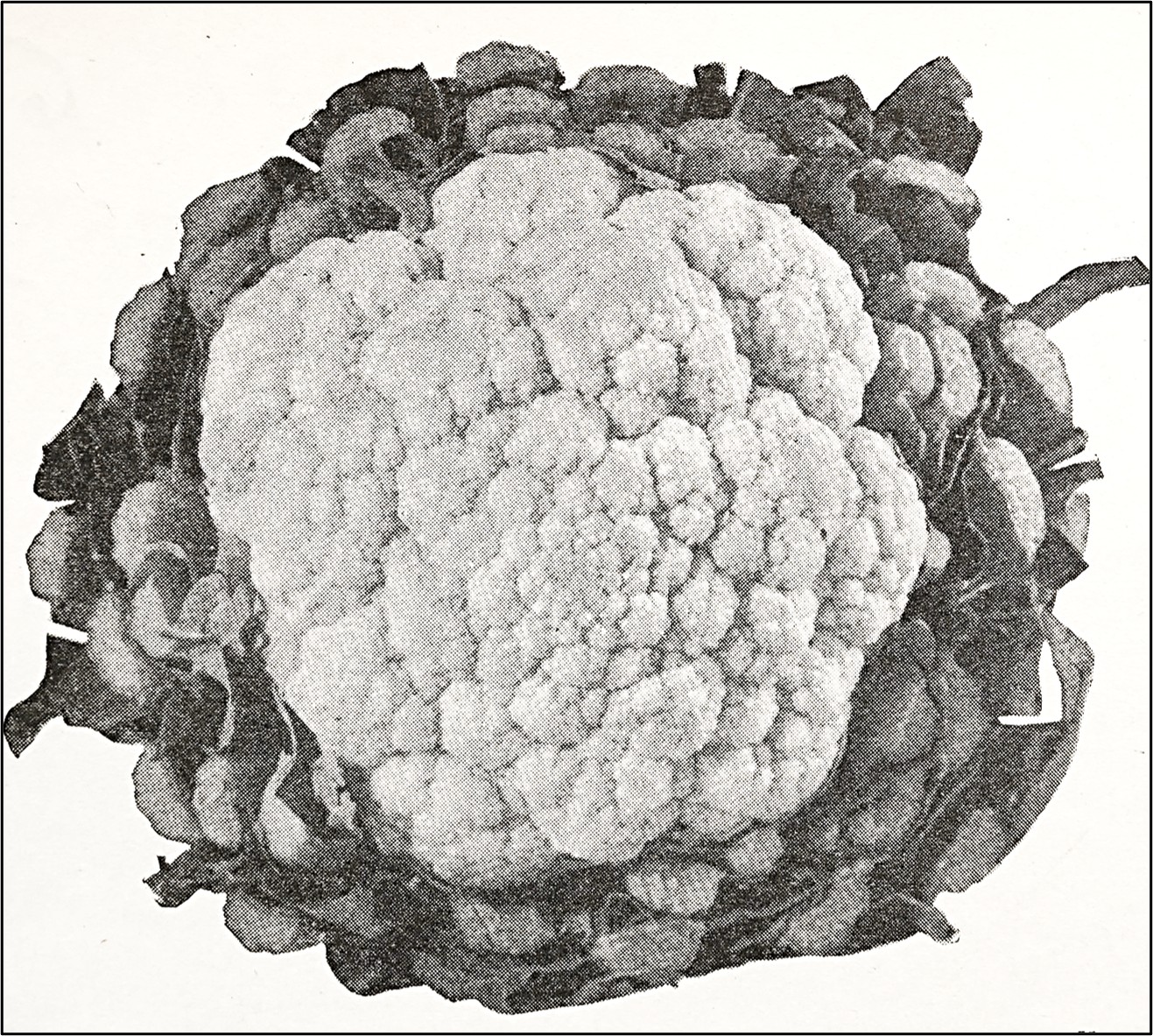
An article in the February, 1926 issue of Good Housekeeping showed photos of heads of cauliflower, and indicated whether they were high- or low-quality heads:
The head of cauliflower shown above represents an ideal purchase. Its jacket is fresh and bright, while the head is compact and of good color.
Below is shown a poor head of cauliflower. Its leaves are yellow and wilted, and the head is slightly opened.
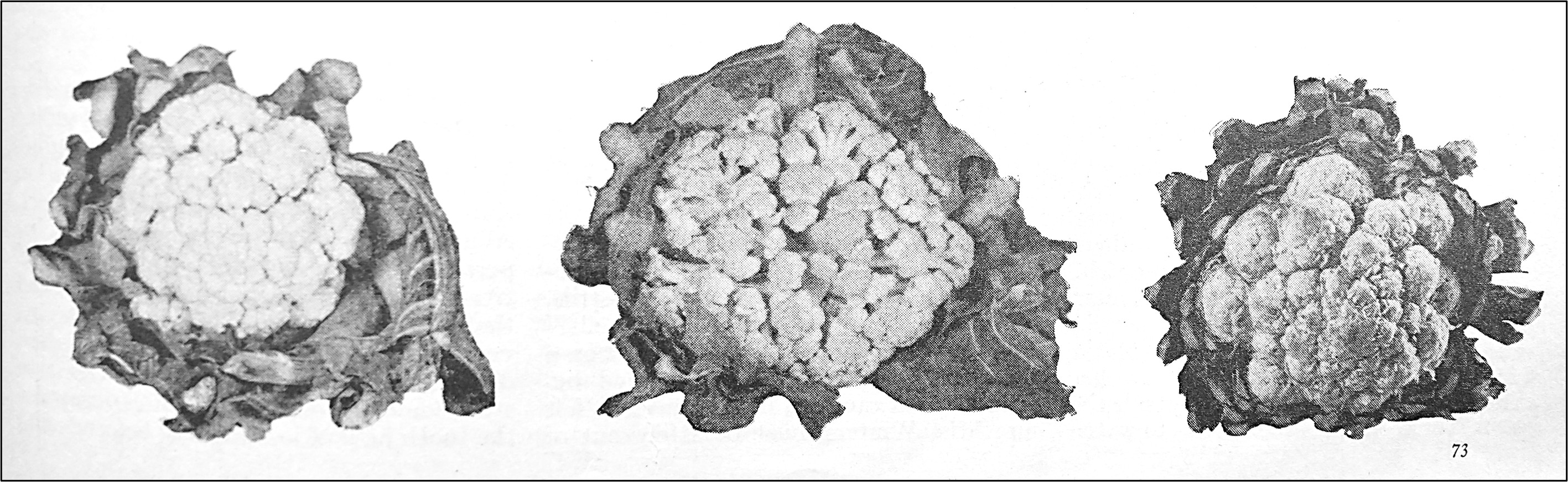
The old article also contained three questions to ask when considering which head of cauliflower to purchase:
Is the jacket green and bright?
Is the flower clean and pearly white?
Is it solid, closely grained, and free from discoloration and decay?
The characteristics of high-quality cauliflower haven’t changed much over the years. According to the Postharvest Research and Extension Center at the University of California – Davis, these are current quality indices for cauliflower:
Quality IndicesA firm and compact head of white to cream white curds surrounded by a crown of well-trimmed, turgid green leaves. Additional quality indices are size, freedom from severe yellowing due to sunlight exposure, freedom from handling defects and decay, and an absence of ‘riciness’.
When I saw the old 1926 article, I was surprised that cauliflower was considered a winter vegetable a hundred years ago. I knew that it was a cool-season crop, but didn’t think of it as a winter vegetable. But, after doing a little research, I learned that cauliflower can be grown during the winter months in southern parts of the U.S.
The Postharvest Research and Extension Center states that the “storage of cauliflower is generally not recommended for more than 3 weeks for good visual and sensory quality.” Assuming that cauliflower a hundred years ago could be stored for a similar length of time, it probably was transported to the north via train back then and available during the winter months throughout the U.S.

Some of the farmers here keep their cauliflower in the ground under a hoop house and can harvest them well into winter. Haven’t seen them for a few weeks now.
This is very helpful. I bet that they did something similar a hundred years ago. I was really struggling to figure out how they raised cauliflower in the north.
They used to use all the old trucks, I bet! Every season. I was always amazed, before refrigeration, that they would harvest thick blocks of ice from the ponds and lakes in winter and store them in insulated ice houses packed in sawdust. They would have ice all summer, for their ice boxes, at a price of course.
It’s amazing how they once harvested ice from ponds and stored it for use during the summer. I once read a book about how they did it. If I remember correctly, some of the ice from New England was even put on ships and shipped to the southern U.S.
I also once did a tour of a historic home that had an old bulbed glass pitcher with an ice chamber sitting on the table. It separated the water from the ice, which probably was important when stored, harvested ice was used.
Oh, I’ve never seen one of those but it makes total sense to not have that ice floating in one’s beverage!
It’s funny, all mom’s life, she referred to the refrigerator as the ice box, even though she only had one in her house when she was a very small child!
It’s interesting how people referred to refrigerators using other names. My mother always called our refrigerator the “Frigidaire” even though it wasn’t actually that brand.
Living in Florida for so long, and with my husband’s work in ag research, the winter growing season seems normal to me now. We really don’t grow much at all during the summer.
It’s fascinating how much variation there is in the timing of when various fruits and vegetables are grown and harvested across the U.S. I know that sometimes when I post a strawberry recipe in June (which is when local strawberries are available where I live) that I’ll get comments that strawberry season is long past in areas where some of my readers live.
It’s interesting how some things are the same after a hundred years. It makes me want to know about food purchases 200 years ago.
I agree it would be really fascinating to know more about foods 200 years ago. Foods would have been much more local and seasonal 200 years ago than 100 years ago. I just saw an article a few days ago about how children in the 1800’s weren’t picky eaters and that they typically ate a wider variety of foods (think turnips, rhubarb, organ meats, etc.) than they do today.
I can understand that. When you work hard, you are hungry and will eat what is put in front of you.
Exactly – The article made the point that today with microwaves and other modern cooking techniques (as well the wide availability of take-out foods) often each member of the family eats the foods they prefer. Children often eat “kid foods” like mac and cheese or hot dogs rather than everyone sitting around a table and eating the same foods.
It is a shame families don’t sit down and eat together anymore.
Agree
Anyone who would buy the cauliflower described as a “don’t buy”, probably wouldn’t be reading articles like this.
You’re probably right. 🙂
Cauliflower is a veggie I seldom eat. However, the compact and vibrant leaved ones available to me look fabulous. Even still, I’ve never quite enjoyed them!
I like most of the cruciferous vegetables, including cauliflower, though they have some unique tastes.
I love broccoli, in fact it’s a staple most days for me. Cabbage occasionally, especially baked is fabulous. Kale is a good addition. But cauliflower and brussels sprouts don’t like me at all.
I love cauliflower! And yes I do know how to pick a good one… Size is also a factor.
I’m sometimes surprised how small the heads of cauliflower are at some of the stands at the farmers’ market. The heads at the farmers’ market are also often greenish in color. I think that they don’t somehow cover the heads towards the end of the growing season to make them white.
Absolutely. I go to the Amish market and the heads are enormous! And they have white (really white), orange and purple!
I’m jealous! I wish that there was a market like that around here.
It’s about 30 minutes away but we visit once a month!
I think cauliflower is proof that, even the plainest things, can be full of healthy goodness.
Cauliflower is nice, tasty, nutritious white vegetable.
I am thinking that Cauliflower is having a moment right now. With Keto rice and keto pizzi crust and other stuff.
I think you’re right. It’s amazing how cauliflower is currently being used in so many different ways.
I didn’t know that about being grown in the winter!
Similarly to you, I didn’t realize that cauliflower could be grown in the winter until I started working on this post. And then after I published the post, I learned much more from commenters about how it is actually grown during the winter.
Thank you for sharing, great tips
You’re welcome. It’s nice to hear that you enjoyed this post.