
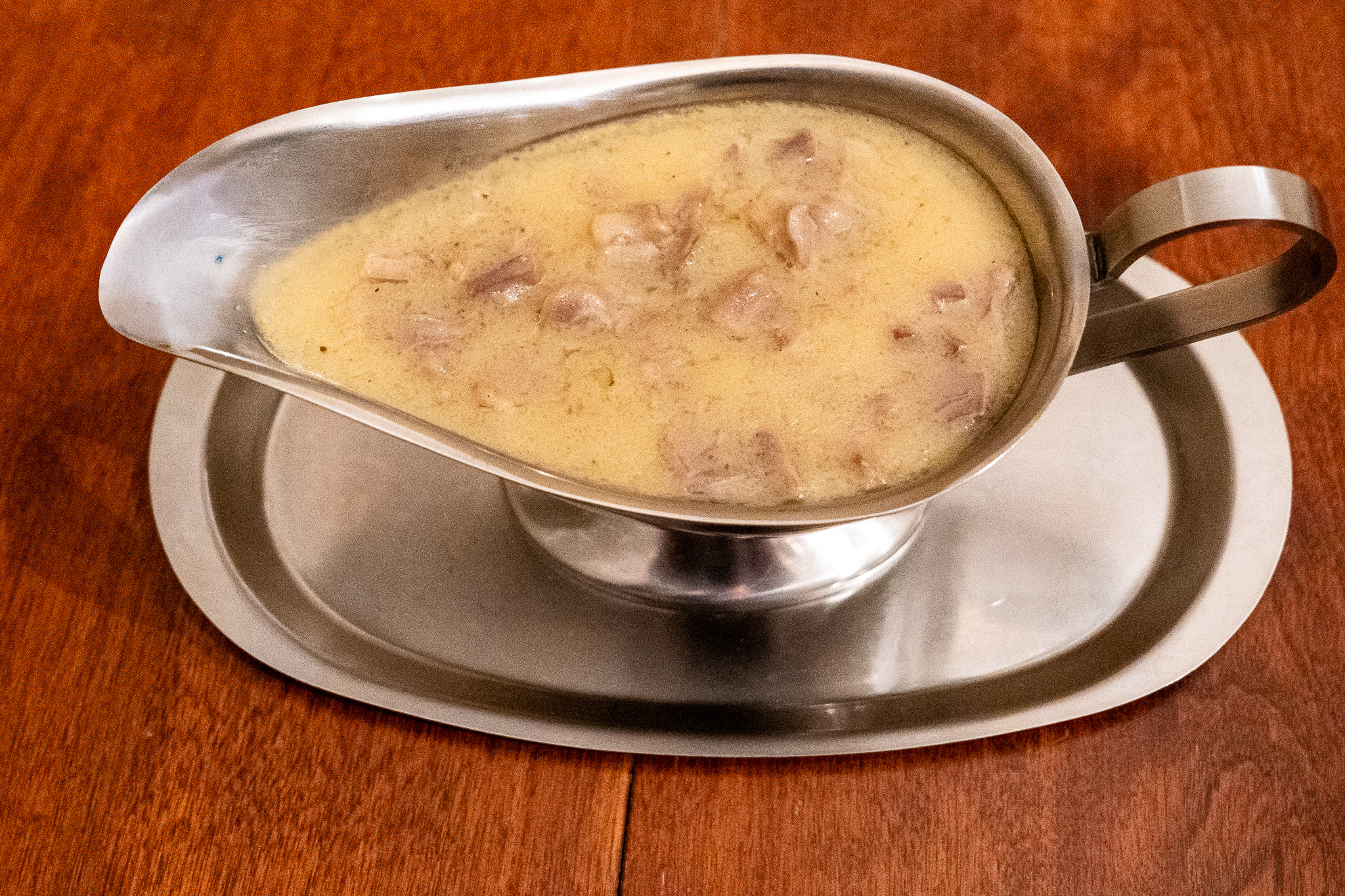
A hundred years ago when cooks were making turkey or chicken gravy, they often added chopped giblets (gizzard, liver, heart, neck) to the gravy. I always assumed that they added the giblets because they were frugal and did not want to waste anything, but after making Giblet Gravy using 1925 directions, I now realize that my assumptions were not totally accurate. Those cooks, so many years ago, may have been frugal, but they also knew that the giblets added lovely, complex flavors and textures to the gravy while making it rich and savory.
Over the years, when selecting recipes to make, I skipped over Giblet Gravy recipes. I had bad memories of the Giblet Gravy my mother and grandmother made when I was a child (though I’m not sure that I ever actually ate any of it), and I had little interest in trying a hundred-year-old recipe for Giblet Gravy. But this year, I came across a 1925 Thanksgiving menu in an old issue of Ladies Home Journal that listed Giblet Gravy as one of the foods on the menu, so I finally decided that it was time to give it a try. And, I am glad that I did. This classic gravy is a delightful comfort food that is lovely on mashed potatoes, slices of turkey, and stuffing.
The directions for making Giblet Gravy were somewhat scattered in a 1925 cookbook that I have, but here are the original directions for cooking giblets and making the gravy:
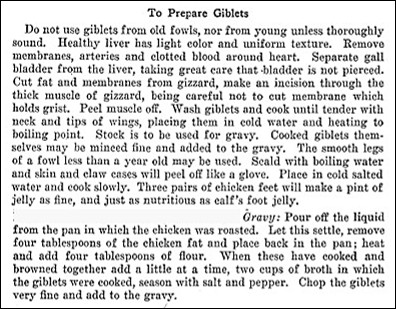
Today, the giblets typically packaged with a turkey or chicken include the gizzard, liver, heart, and neck. The membrane with the “grist” generally has already been removed from the gizzard, so that does not need to be removed. The old recipe also mentions the bladder – but I did not include it when I updated the recipe. I also did not include the wing tips or the claws in the updated list of ingredients.
Here’s the recipe updated for modern cooks:
Giblet Gravy
giblets from one turkey or chicken (gizzard, heart, liver, neck)
water
liquid and drippings from pan that the turkey or chicken was cooked in
4 tablespoons flour
salt and pepper
Step 1. The giblets can be cooked while the turkey or chicken is roasting. Put the giblets in a saucepan and cover with cold water. Put on the stove and bring to a boil using high heat, then reduce heat and simmer until tender (about 1 – 2 hours). Additional water can be added during cooking if needed to keep the giblets covered during cooking. Remove from heat and take the giblets out of the broth. Reserve the giblet broth. When the giblets are cool enough to handle, remove the meat from the neck and any gristle from the gizzards, then chop the cooked giblets.
Step 2. When the turkey or chicken is removed from the oven, pour the liquid and pan drippings from the roasting pan into a bowl. Scrape the bottom of the pan to get all the drippings. Let it settle and cool a little, then skim 4 tablespoons of fat off the top of the liquid. (Any additional fat can be skimmed off the top of the broth and discarded.)
Step 3. Combine the broth and drippings from the turkey or chicken with the broth from cooking the giblets.
Step 4. Put the 4 tablespoons of fat in a saucepan. Heat using medium heat, and stir in the flour. Gradually add 2 cups of the combined turkey and chicken broth/drippings, while stirring constantly.
Step 5. Bring to a boil while continuing to stir constantly. If the gravy is too thick add additional broth. If the gravy is still too thick, and additional liquid is needed, add water until the gravy is the desired consistency. (If the gravy is lumpy, strain, then return to pan.)
Step 6. Stir in the chopped giblets, then continue heating until the gravy again boils.
Step 7. Season to taste with salt and pepper, then remove from heat and serve.

I remember giblet gravy. We always had it, and I liked it as a kid.
It’s a nice traditional gravy.
Mom always made it.
Similarly, I remember my mother and grandmother making it.
It was so good when we were fed with love ❤
How true! Sometimes I miss those good old days.
As things get crazy in the US I really do miss the good old days more and more.
My mom and grandmothers made it. Just the idea of liver turned me off.
You could skip the liver when you make the gravy.
That is true!
Giblet gravy is always on my menu for Thanksgiving dinner even though it’s usually just me and my husband eating it. Instead of the flour I thicken mine with a spoonful of dressing and a chopped boiled egg.
I’ve never tried thickening gravy that way. I’ll have to try that method sometime.
I’m so cross that these days, chickens in the UK are sold without their giblets. I was brought up to use them to make gravy, and probably form the basis of a soup as well, together with the carcass. Nowadays I have to make do with the bones alone. Grrr!
Turkey are generally sold with giblets in the U.S., but, but chickens are often sold without giblets. I had to look at several brands to find a chicken with giblets. Stores sometimes sell separate packages of gizzards and livers – though that provides a lot more than needed for gravy.
You’re right, turkeys are different, and seem to come complete. Lucky you to get chicken giblets if you look hard enough!
Mom always used the giblets in her stock that simmered all morning while the turkey cooked, and she used this in the gravy. It was so good!
Even the turkey I get from the local farm has all the giblets already trimmed and cleaned. Thank goodness!
Mmm. . . your mother’s gravy sounds delicious. I agree with the “thank goodness” that the giblets we get today are already trimmed and cleaned. Even with hundred-year-old directions, I have no clue how to approach cleaning them.
Nor would I want to!
This is pretty much how my mother did it. With the inclusion of a couple of hard boiled eggs.
And so it is the way I do it.
And if you happen to have gravy left after the stuffing and mashed potatoes are finished its a great addition to the soup pot!
I often have left-over gravy. Putting it in the soup pot is a great suggestion. I also sometimes use it (and small pieces of left-over meat) to make chicken or turkey ala king.
My grandmother and mother and I always make giblet gravy. I assume my daughters do to, but I’ll have to check.
Over the years, I somehow broke the family tradition of making giblet gravy. I may need to restart it.
Giblet gravy was always on the menu at Mama’s, Grandma’s, and Mother’s houses for Thanksgiving and Christmas. My grandmothers and mother also put boiled egg in their giblet gravy. As a child, I never cared for giblet gravy. As an adult, and a “well-seasoned” one at that by that time, I ate turkey necks and was amazed at how good they were! I am sure now that since both of my grandparents raised their children during the Great Depression, and my mother and father grew up in it, that it had an impact on how they cooked as well as how they lived.
I’m sure that the Great Depression also affected how my parents lived and cooked.
Sometimes I wonder how children develop negative perceptions of some foods (such as giblets). Many foods that I wouldn’t even try as a child are quite tasty when I rediscover them as an adult.
That is an interesting question to ponder!
I think the only thing we get stuffed inside the whole chook is the neck!
sherry
I still put stuffing inside a chicken or turkey.
sorry no. I meant when you buy a whole raw chicken at the grocery store 🙂
Oops, I somehow misunderstood. Thanks for clarifying.
I believe my grandmother made giblet gravy – thanks for the memories!
It’s nice to hear that this post brought back some good memories.