
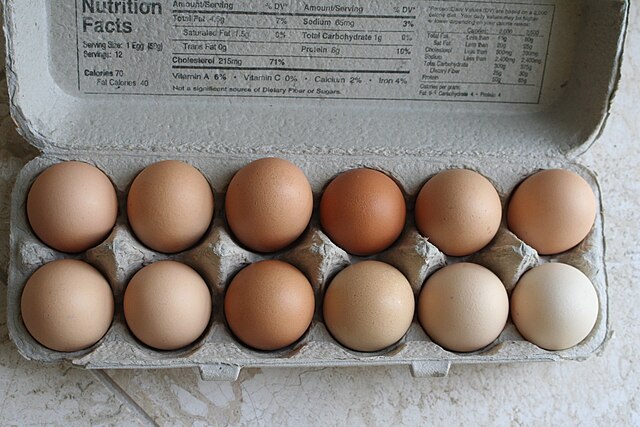
Today, there is wide variation across countries in whether eggs are washed. Eggs naturally have a coating on them called a cuticle that seals pores in the shell and keeps bacteria out. When eggs are washed, the eggs are very clean, but the cuticle coating is removed and the eggs must be refrigerated to prevent spoilage. In the United States, federal regulations require that eggs be washed and sanitized; therefore, they need to be refrigerated. In many other countries, including much of Europe and Asia, as well as much of Africa and South America, eggs are not washed or refrigerated.
Practices have changed in the U.S. over the last century. A hundred years ago, eggs were not washed until just before using. According to a 1925 home economics textbook that was published in the U.S.:
Washing removes a coating on eggs-shells. This coating prevents the entrance of microorganisms. Hence eggs should not be washed until they are to be used.
School and Home Cooking (1925) by Carlotta C. Greer

When we lived in Prague in the 90s, eggs weren’t refrigerated; they were sold in street markets. As a result, I was afraid to use them, so we went the entire five months we were there without eggs. I wish I’d known this!
You would have been fine if you’d eaten the eggs when you were in Prague. I find it amazing how perspectives differ so much across countries regarding the need to wash and refrigerate eggs.
When my sister-in-law was living in Germany she took me food shopping and the eggs sold in the store were not refrigerated. Interesting to know it used to be like that here.
According to a National Public Radio article:
“By 1970, the U.S. Department of Agriculture had perfected the art of the wash with the help of fancy machines, and it required all egg producers to do it. Meanwhile, many European countries were prohibiting washing, and Asian countries never got on board with it. The exception was Japan, which joined the egg-washers after a bad spate of salmonella in the 1990s.”
Well you learn something new everyday! And while we are on the subject of eggs, I’m not a fan of yard eggs. I’d rather buy them at a grocery store. I know a lot of people raise chickens these days for the convenience of fresh eggs.
I also know several people who have a few chickens. They seem to have a lot of fun being backyard chicken farmers.
Very interesting, Sheryl, thank you.
It’s nice to hear that you enjoyed this post.
I have friends with chickens and they don’t wash their eggs until right before they use them. They love they don’t have to refrigerate them, especially when they go camping.
When we used to camp, we always kept eggs in an ice chest, but It would be much more convenient if we had not needed to keep them cold.
People knew lots of things 100 years ago that later proved to be true.
Agree- people had a lot of very practical knowledge.
Yup, we neither wash or refrigerate eggs here in the UK. I presume that, like us, you can buy cheaper eggs that are ‘colony caged’ (i.e. raised indoors but with some freedom of movement). Battery raised eggs have rightly been illegal here since 2012 Or for preference there are, free range ones that are naturally more expensive. But more humane.
There is wide variation across states in the U.S. regarding whether chickens are caged. It’s not allowed in some states, but is allowed in others. Where I live, the less expensive eggs are the “generic” ones that probably are from caged chickens. Free range eggs are also available, but, as you noted, they are more expensive (but more humanely produced).
I was a student in England, the eggs were not refrigerated and my young mind couldn’t figure it out.
Well now you know. 🙂 The eggs in England weren’t washed.
This is an amazing piece of history – who knew!
I’m glad you enjoyed this post.
When I get eggs from a small stand I usually wash them right away and then put them in the fridge, but I’m thinking now I could just leave them out.
Yes, if they haven’t previously been washed, you won’t need to refrigerate them.
I get my eggs from my friend and farmer and they still have the bloom on them. I wash them before I use them, and don’t worry if they are left out.
You’re lucky to be able to get eggs directly from a farmer.
I know, and I feel grateful for all we have available here. I know many folks don’t have easy access to the amazing produce we have here.
Thanks for explaining why in some countries eggs are refrigerated and not in others! Eggs is the Netherlands are not washed. We wash our eggs right before we use them.