
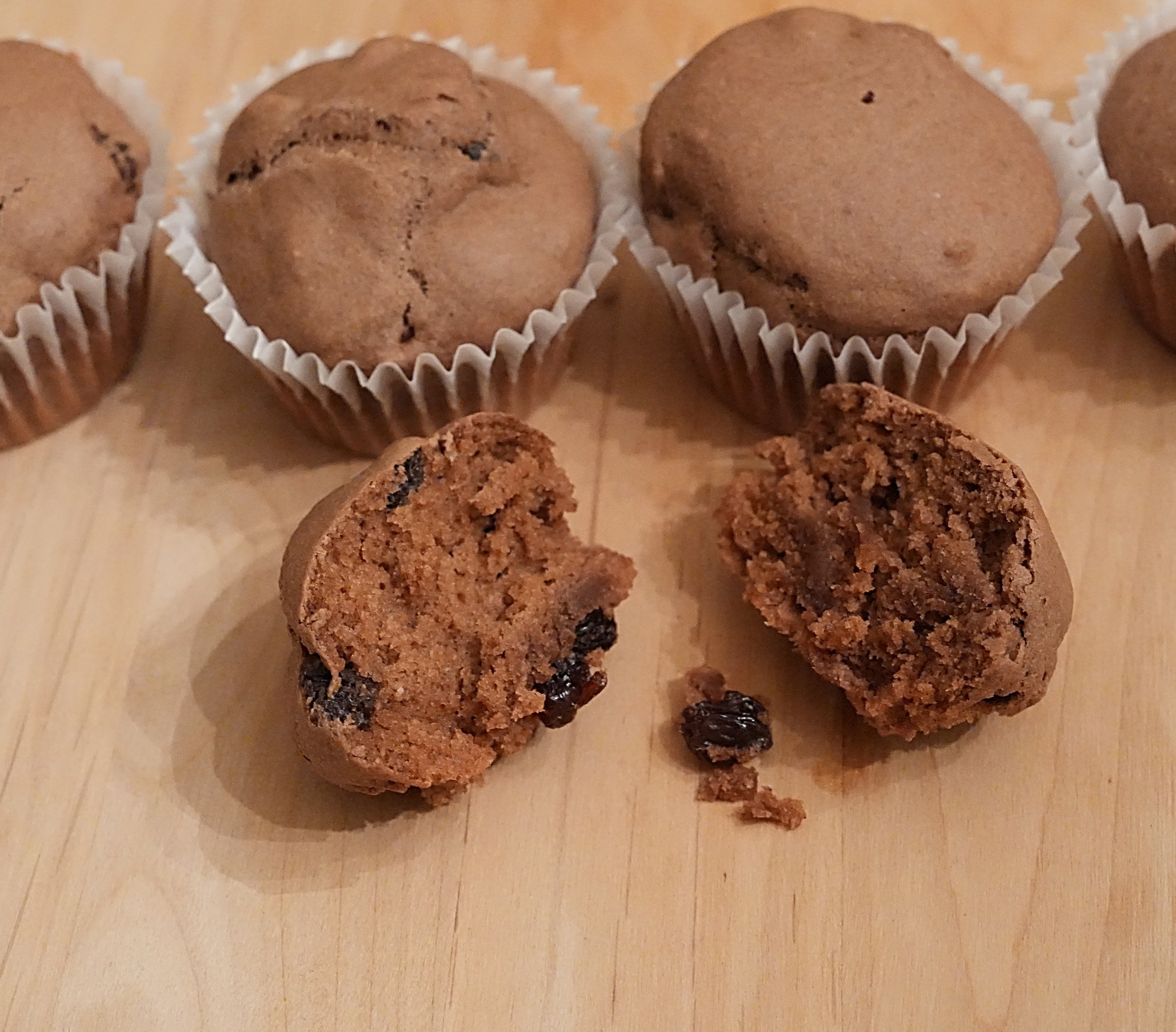
There is a fun children’s book that contains both a story and recipes called Billy in Bunbury. It was a promotional book that was published in 1925 by the Price Baking Powder Company. I decided to make a recipe in the book for Cocoa Raisin Muffins.
The muffins were delicious. They were chocolatey with a hint of cinnamon, and had a nice texture with lots of raisins. And, the recipe does not call for any eggs – an added bonus during this time of exorbitant egg prices. Here’s the original recipe:

It is a little surprising that a recipe in a children’s cookbook calls for 7/8 cup of milk. I seldom see recipes that call for eights of a cup, and it seems like an especially complex measure for a child to navigate when making this recipe.
Raisins were the last ingredient I added when I made this recipe, and that worked fine.
The recipe indicates that this recipe will make 16 muffins, but when I made this recipe, it only made 12 muffins. The number of muffins is very dependent upon the size of the individual muffin cups in the muffin tin. Apparently, muffins were fairly small a hundred years ago.
Here’s the recipe updated for modern cooks:
Cocoa Raisin Muffins
1 3/4 cups flour
2 tablespoons cocoa
5 tablespoons sugar
1/2 teaspoon salt
1/4 teaspoon cinnamon
4 teaspoons baking powder
2/3 cup raisins
7/8 cup milk
5 tablespoons butter or shortening, melted
Preheat oven to 400◦ F. Sift together flour, cocoa, sugar, salt, cinnamon and baking powder. Slowly add milk while stirring. Continue stirring until the batter is smooth, then add butter or shortening, and stir until combined. Stir in raisins. Put batter into prepared muffin tins. Fill each muffin cup about 3/4th full. Bake for approximately 20 minutes or until lightly browned.

This muffin recipe sounds very interesting. I have never made muffins with raisins, but my husband would have loved that.
The raisins were good in this recipe. I don’t think that I’ve ever previously eaten anything that contained both chocolate and raisins, and I wasn’t sure about the combination when I saw this recipe, but it worked well.
I am glad you recommend it
It is good that the recipe worked out. I have made some from magazines that were incorrect.
This recipe was fine, and worked well. It is so frustrating when a recipe has issues or contains errors.
I’m surprised by the 7/8 measurement too; usually, any recipe for kids or adults, would say a scant cup.
It’s an anomaly of this recipe. I wish I could ask the recipe author why the recipe called for 7/8’s of a cup.
Did any of the other recipes in the pamphlet have funky measures?
I have to say with a 7/8 measure I would probably just go to the 1 cup….
Good question – I wasn’t sure, so I flipped through the booklet. No, there are no other really any other funky measures. There are a few that maybe are a bit unusual, but not really strange. For example, the Butterscotch Curls recipe calls for 2/3 teaspoon of salt. In general, I think that modern recipes tend to measure salt in quarter teaspoons (1/4 teaspoon, 1/2 teaspoon, 3/4 teaspoon, 1 teaspoon).
Yes that is a different measurement. Those look good.
The muffins were yummy.
Next time the guys are home at the same time I will have to try the recipe out.
Wonderful to see this century-old recipe, Sheryl. My eye spotted that 7/8 too and pondered it. I don’t usually bake with shortening, so I was glad to know that it works to merely substitute the same amount of butter for shortening. Fun recipe, thank you.
Like you, I seldom use shortening. I tend to want to think that foods were more natural a hundred years ago – but I know that some commercial products like shortening were very popular back then. There were several brands of shortening available back then. I’ve seen old Crisco ads which emphasize how clean, pure, and wholesome it was.
For baking, shortening (pure vegetable, not lard) causes the baked goods to rise higher. Butter, being dairy fat and water, adds flavor, but does not create as high a rise factor in cakes, brownies, cookies, cornbread, rolls, biscuits, etc.
I get frustrated because vegetable shortening may not be as healthy as butter and other fats, but, as you noted, many baked goods turn out really well when it is used. I still use vegetable shortening for pie dough. I’ve tried using butter, but it just doesn’t seem to turn out as well.
All of the recipes I inherited from my mother called for shortening, not butter. Not lard, but pure vegetable shortening, specifically Crisco. If you made any of the recipes with butter or margarine, they did not turn out as tasty or the same texture,and in the case of cakes, or pie dough, would not rise. To this day, if I make one of Mom’s recipes that requires shortening, I use Crisco, and never had a failure yet. I do use butter on biscuits, rolls, baked potatoes, toast, and making sauces, or if a recipe specifies butter.
My mother also almost always used Crisco. Growing up on a farm, we also often had a can of lard around – but she seldom used the lard. She felt strongly that Crisco was healthier (and probably cleaner and purer) than lard. Lard also added a bit of a distinct flavor to some foods.
Yes, kind of like bacon fat did, only not as tasty!
Apparently, Mississippi and Arkansas still use 7/8 cup in their elementary schools when teaching measurements. They have some really cool looking charts in the state Departments of Education. On the other hand, I would have no idea what a ‘scant’ cup of anything was. Apparently, that is 2 tablespoons less than a full cup.
It’s fascinating that at least two states use 7/8 cup when teaching measurement. Until I read your comment, I didn’t know that there was an actual definition for “scant cup.” I never thought much about it, but if recipe called for it, I generally just filled the measuring cup a little less full.
And my guess is so did the rest of the folks who needed a scant cup!
I should be less picky, but raisins in this recipe just feels like chocolate chips hadn’t been invented yet.
You may be right. I don’t think that chocolate chips were invented until the 1930’s. That said, the muffins may look similar to ones with chocolate chips, but they definitely had a different flavor and texture.
Love this vintage recipe – 7/8 measurement!
It’s a fun recipe.
That sounds delicious
They’re tasty.
Just about any chocolate is. I like getting double chocolate muffins when I can.
mmm. . . double chocolate muffins sound good.
Thank you for this, from a former children’ librarian!
It’s nice to hear that you enjoyed this post.