
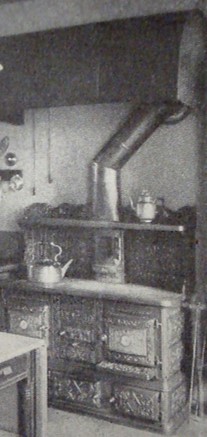
 Here’s some abridged tips for caring for wood and coal stoves from a hundred-year old magazine:
- Stove grates will last ten years, or longer, if well cared for (that is if the ashes were removed once or even twice daily).
- Grates should not be kept red hot with ashes banked up against them.
- Do not bank the fire overnight with the ashpan fun of ashes, thereby keeping the grated heated all of the twenty-four hours, never giving them a chance to cool.
- A cheap stove is poor economy. Therefore, always purchase a stove of a well-known make, and then take care of it.
- Clean out the soot from underneath the stove.
- Brush the soot and ashes from around the sides of the stove. The butterfly, in the back of the stove, should be opened, and the stove rake, or poker, slipped in, so that the soot may be pushed downward into the space below the oven, where it may be taken out through the opening made for that purpose. This pipe is often entirely clogged or closed by the unburned particles of carbon deposited there from the coal.
- Clean the stove pipe, which may be responsible for lack of draught and may be half full of soot, especially if it is a long pipe, or has more than one turn in it.
- Keeping the stove red hot, for any length of time. will warp the lids, and burn out the various parts. After a fire is started, the drafts should be adjusted, so that it burns well, but not so as to permit the stove to become red hot.
- Piling up coal until it is against the top of the stove will also cause the lids to warp.
- Another cause of injury to a stove is the burning of wet garbage. Coffee grounds or liquids should not be poured on the red hot lining of the stove. This may produce cracking.
- If one is going away for some time, the stove should have a liberal coating of grease, or liquid black shellac, to prevent rusting; or otherwise the dampness of a closed house may cause serious damage. Under such conditions the stove pipe should be taken down, oiled and left down, or else rain, coming down the chimney may cause the pipe to rust out in one season.
- Even if one is at home and does not use the coal stove in summer, papers should be burned in it occasionally to dry out the stove pipe and inner parts of the stove.
- If the stove has an enameled back or trimmings, these may be cleaned with a scouring powder, which is not gritty.
- Foods, grease, etc. must not be allowed to collect on the surfaces, or these will be burned on from the intense heat, and cannot be removed without injury to the surface.
- Clinkers will not form so readily if the fire is made every day.
Excerpts from American Cookery (March, 1925)

How lovely to read instructions that I don’t have to follow! There were many details I would never have thought about.
Maintenance is so much simpler for modern electric and gas stoves.
I’m glad I don’t have to do all that. Cleaning off a glass top is work enough.
Agree – I had a glass top stove for awhile, but now have one with the older style coil burners. In my opinion the coil burners are easier to keep clean.
So 20 years ago my granny still had a wood stove….right next to it set a electric stove that she used daily. I do not think she ever regretted no using the wood stove anymore but kept it cause you could never know when this new flanged electric might be a problem
That should read 70 years ago…. Granny and wood stove have been gone a long while
There’s something to be said for having backup equipment. 🙂
I am sure we are all grateful we do not have to worry about clinkers. 😀
I’ve definitely glad that I don’t need to worry about clinkers. I actually did a search on the term “clinker” when I wrote this post and learned that they are hard, fused-together deposits.
I had to look it up also. My ancestors used wood fired stoves, but I do not think coal was ever used to cook in the part of Texas in which I grew up. Even the family in Newcastle, Texas, which had a coal mine, did not cook with it.
When I was growing up in Pennsylvania I knew people who had coal stoves. The area my family lived in was relatively close to the anthracite coal region.
Phew! Our wood burning stove isn’t half so demanding.
Good to hear that your wood-burning stove is much easier to maintain.
I used my wood cook stove for many years and followed none of this advice, except I never let it get red hot! That would have been terrifying.
The author probably got carried away with directions and cautions. 🙂
I love my 2 Jotul coal stoves they are 3′ tall by 12″ x 12″ and are red but turn Burgandy when hot.
Coal stoves can make a room seem cozier.
My 900 sq foot camp/home is very cozy lol
That is a lot of work!! It now makes sense that the kitchen was out back and away from the living areas of the house!! What a mess to clean up ….
It had to have been a lot of work to maintain these stoves, as well as to remove the ashes. My sense is that because rooms with wood or coal stoves tended to get sooty that people back then needed to paint or wallpaper them every few years.
Paint perhaps but my mother talked about cleaning the wallpaper. She said they used a ball of putty that smelled just like Play-doh and they’d roll it on the wall and it would pickup the dirt and make the wall paper look like new. She and her cousins would do the low areas and the adults would do the high parts. They didn’t have “washable” wallpaper back then…
That’s a new one for me. I never hear of that kind of putty ball. It sounds like a lot of work, but that it worked well to refresh the wallpaper.
It was one reason my mother was resistant to buying me Play-doh as a kid. She equated it with a cleaning product… I’m pretty sure it worked well. My grandmother’s wallpaper was a hold over from the 1930s and she used the putty clear into the 1960s (with coal and then an oil furnace). She would clean the walls next to the heating vents on the regular during the winter!
Wow, it’s amazing that it worked so well that wallpaper from the 1930’s still looked good in the 1960’s.
I had no idea you could clean wallpaper that way. Thanks for sharing.