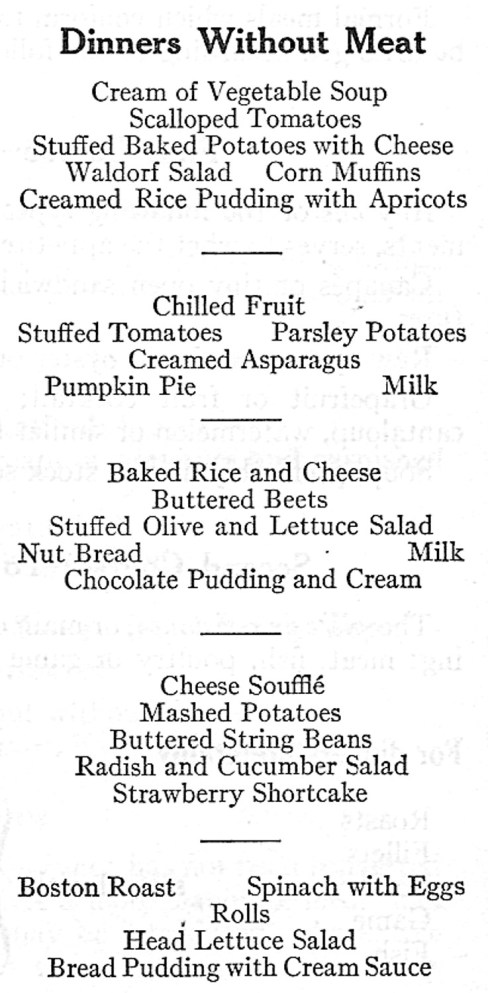
Today people often eat meatless meals for health, environmental, ethical, cost, or religious reasons. A hundred years ago people also sometimes ate meatless meals. Some of the reasons were probably the same – others different.
Today people often eat meatless meals for health, environmental, ethical, cost, or religious reasons. A hundred years ago people also sometimes ate meatless meals. Some of the reasons were probably the same – others different.

What surprised me most about this was the name ‘Butterick.’ I’ve always associated it with sewing patterns. I had no idea they’d produced a cookbook.
I also think of them as a sewing pattern company, though I knew that Butterick published cookbooks years ago because I’d made a few recipes from a 1911 Butterick cookback during my first year of doing this blog (2011).
The dishes do look filling with lots of cheese and cream.
In general, I think that meatless meals tend to have fewer calories, but these dishes do look filling.
Dose anyone know what a “Boston Roast” is and why its on a meatless menu?
I wonder if it’s a big typo. I was wondering that too until I realized it’s probably “Boston Roast Spinach With Eggs. Having said that, I can’t find any reference to that anywhere.
Perhaps it was made with beans?
I found the recipe for Boston Roast in the cookbook that contained these menus. The ingredients include kidney beans, cheese, chopped onions, bread crumbs, and milk. The kidney beans are chopped after they are cooked, and the ingredients are then mixed together and shaped into a loaf. I may have to make this recipe sometime. 🙂
FWIW, in 1924 American Catholics ate a “meatless” meal every Friday of the year, as opposed to just Lenten Fridays like they do now. Orthodox Christians also observed meatless days, although I’m less sure of when they were and how often. I know that they occured during Lent (Great Lent for them) and during Advent.
When I was a child, I lived in a small town that was home to many Catholic families. Every Friday at school lunch, we had fish sticks and macaroni with cheese.
Boy do I remember the fish sticks on Friday!!
Sounds just like the Friday school lunches that were served at the school I attended – though some Friday’s we had grilled cheese sandwiches and tomato soup.
Yes, Lenten staples in my household growing up. Fish sticks still are in my household today.
My mother was a terrible cook, but you can’t really mess up fish sticks, and she made macaroni from scratch, so to speak. I.e, she boiled the pasta and mixed in cheese, which when I was young was more often than not Kraft American cheese. Probably because of that, I 1) never have liked the box mac & cheese that lots of people like, and 2) I’ve never been able to grasp why people order any kind of macaroni dish in a restaurant.
Similar to that, my father was a tremendous fisherman, and we tend to have trout on Friday’s year around, or at least much of the year, even after meatless Fridays only applied to Lent. I like trout, but I’ve always been baffled, as a result of that, that some people will order it in restaurants.
Fish sticks were quite the treat when I was growing up, though we had catfish fries often because they were plentiful. Now, as to mac and cheese, my maternal grandmother made it often, using what we called “rat cheese” from the red rind kind you got at the local grocery meat case. I make homemade mac and cheese occasionally, with sharp white Vermont cheddar with the breadcrumb topping. Now that is some good mac and cheese! In Mississippi, it is catfish and spaghetti on Friday if you are in the Delta.
Google does not know what a 1924 Boston Roast is, but the 1924 newspapers featured a recipe called Boston Roast. It was made with canned kidney beans, salt, one-half pound grated cheese and bread crumbs, mashed and formed into a roll and then baked in oven. It called for basting the roast frequently with hot water with butter, and served with tomato sauce. I think I will make one for dinner!
The dreaded bean loaf!!!
Although that one dose not look half bad.
I wonder if you could make a bean burger with it?
I made a black bean burger not long ago, and it was quite delicious. I stuffed it into a portabella cap.
Yes, it would be a bean dish since Boston was, and still is, known as Bean Town!
First I thought of Boston Baked Beans, and that didn’t sound like a “roast” but I did think of beans.
Makes sense. 🙂
This sounds similar to the recipe for Boston Roast that is in the 1924 Butterick Cook Book – though it starts with dry kidney beans and calls for basting with hot water and fat.
If you do, report back on what it was like.
Yah…let us know if you make this one up.
I can think of no better way to convince a child to become an obligate carnivore than to serve creamed asparagus!!
Yep…that could scar a kid to green food for life!
Creamed asparagus apparently is not a hit at your house. 🙂
I love asparagus. steamed, broiled,roasted, fresh and raw from the garden…. but cream it and it looks like sludge and smells about the same
Bean loaf would probably help do that as well!
Hehe! Son#2 was a fruitarian as a child – had no problem with fruit but turned a suspicious eye toward all veggies. Finally (at 35) he’s come around to all the veggies but not asparagus. He must have inherited the gene that tastes the very bitter part of asparagus!!
I’ve heard that some people have a gene that makes cilantro taste bitter, but until I read your comment I hadn’t realized that there was also a gene that makes asparagus taste bitter to some people.
Some people even have a problem with raw celery
I definitely don’t have that gene. Celery tastes very bland to me.