
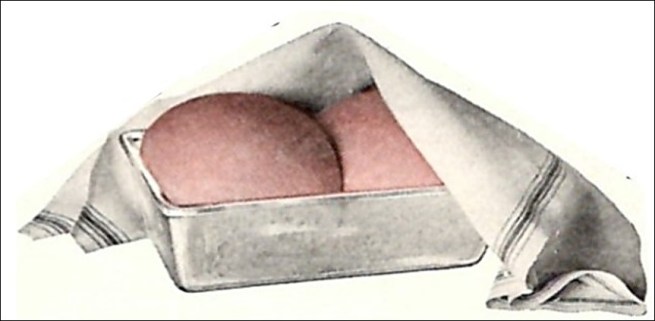
Today we tend to think of gluten in a negative way. But here is what it said about gluten in a 1924 cookbook:
BREADS
. . . The protein in flour is in the form of gluten, and while elasticity is a property of all proteins, the gluten of wheat possesses this property in marked degree. This strong elastic gluten makes a good framework to retain the air and carbon dioxide, and renders wheat the ideal grain for bread making. The protein in oats and corn are deficient in this property and when used in bread making are combined with wheat.
Wheat and flour vary greatly in the quantity of gluten present; even the same variety of wheat will vary from season to season. Also, in connection with the kind of wheat, the time of planting affects the quantity and quality of the gluten. Spring wheat sown in the spring and harvested the same season contains more protein and, consequently, more gluten than winter wheat sown in the fall and harvested in the early part of the summer. Flour from spring wheat, rich in gluten, is well adapted to bread making and is known as bread flour. It is creamy in color, granular to the touch and passes through a sieve easily; a slight jar sends it through. Flour from winter wheat is whiter in color and soft to the touch; if a quantity be crushed in the hand it will retain the impress of the lines in the hand. It tastes sweet. It is adapted to the making of starch. It is adapted to the making of cake and pastry articles; foods in which delicacy rather than strength is sought. Such flour is known as pastry flour.
Source: The Whys of Cooking by Janet McKenzie Hill (1924)

An interesting post on how the seasons affect the gluten in flour 🙂
I think that there are some fairly major differences between wheat that is planted in the fall (and that can go through the winter weather) and wheat that is planted in the spring. But I’m not an agronomist so I don’t understand it. 🙂
Neither do I Sheryl…
As one who cannot eat gluten, I am well aware that it is gluten that makes wonderful bake goods and bread. Anything made without gluten is not very good. 😦
I can eat foods that contain gluten, but sometimes eat gluten-free breads and pastas. Generally, gluten-free foods taste pretty good to me if they are fresh. After they are a day or two old, they are much less tasty.
A good article. I enjoyed the descriptions of the various flours.
It’s nice to hear that you enjoyed this post.
I knew gluten couldn’t be all bad. Our previous generations all ate it and lived well.
Past generations did eat well. I must admit that I definitely enjoy most of the foods that I make using hundred-year-old recipes. 🙂
My grandmother would buy Gluten Bread which was the consistency of English Muffin Bread. I disappeared by the time I was out of college.
It’s really interesting that a type of bread was once sold that was called Gluten Bread. That won’t name wouldn’t work well for marketing purposes today. 🙂
Very interesting.
I agree – I found it very interesting that a cookbook writer a hundred years ago thought that readers would want to know so much about gluten.
If you don’t mind me posting a link, this one talks about gluten sensitivity!
https://www.science.org/content/article/what-s-really-behind-gluten-sensitivity
Thanks for sharing.