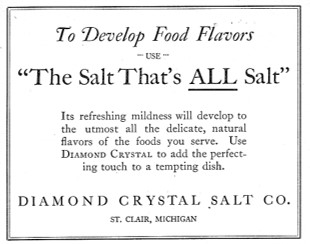
I do believe this was before Iodized salt! I think I want my sodium chloride to have some other ingredients – iodine (to prevent goiter), an anti-clumping agent (so I can actually get it out of the salt shaker), and maybe some trace minerals that are necessary for good health (selenium, iron, manganese, copper, iodine, zinc, cobalt, and fluoride). Pure is not always better!
According to a lengthy series on Diamond Crystal, salt in its natural form as found in nature is not purely all salt–other chemicals will appear in the salt–probably depending on from where it was sourced. Mixed with salt in the natural state includes calcium chloride, magnesium chloride, sulphate of lime (gypsum). Diamond Crystal processing removed those “impurities” to produce the “pure salt that is all salt” and produced it in a flake form rather than cube or crystal. In 1923, the state of Michigan began study on adding “iodization” to table salts in order to prevent the development of goiter. Goiter was considered a public health problem in Michigan since it was particularly prevalent in the area around the Great Lakes. With the help of the Michigan State Medical Society, Dr. Gowie consulted with the Swiss solution of adding sodium iodide or potassium iodide to table and cooking salt and began talks with the Michigan salt producers, including Diamond Crystal. By spring 1924, 5 major salt producers in Michigan began distributing iodized salt and in fall 1924, Morton Salt took it nationwide. Numerous medical research studies demonstrated the association between a reduction in goiter and the use of iodized salt. As early as the 1800s, physicians and scientists had learned that iodine could treat goiter, based on research on goiter-free regions across the world where iodine in food or water was common. Iodine is necessary for thyroid function.
True; if it comes out of the ground or the ocean or the air, there is likely other things in it. There used to be a salt creek near where we lived in Texas and they “mined” salt from it. Lots of other things ran through that creek along with the salt, but all folks knew was “salt.”
I like Celtic salt, and have tried pink salt, too. Both have more minerals than “regular” salt, but I have to find out if we still need the iodine. Nevertheless, love the old ads you find!
1923 is shortly after the US government started cracking down on adulterants–dangerous and otherwise–in foods.
Companies jumped on that bandwagon to tout how “pure” their product was, and some got in trouble for false advertising.
Adulterants in salt, for example, could have included plaster dust or other cheap white powdery “fillers”–although salt was already pretty darn cheap, so it might have been a product that was never profitable to adulterate in the first place.
Even today, advertisers say silly things like “caffeine-free” and “gluten-free” for products (like bag of lemons I saw recently) that never had those things in it–they’re just trying to catch consumer’s eye with the latest food-phobia-fad.

Who knows? They don’t blaze the fact that it’s sea salt, or any of the other apparently superior salts.
hmm. . . there’s no clue where the salt comes from. I suppose it could come from either mines or be sea salt.
I’m going to read the salt box when I go to the kitchen. I know many use a chemical to keep salt from clumping. I wonder if that would be listed.
And, salt often has iodine added.
I just started using Diamond Crystal Kosher salt as it has lower sodium. It says on the box “since 1886”. It was hard to find.
I never would have guessed that the amount of sodium might vary from one salt to the next.
By volume, the coarse-grained Diamond Crystal has less sodium, but by weight, it’s the same sodium content as table salt.
I do believe this was before Iodized salt! I think I want my sodium chloride to have some other ingredients – iodine (to prevent goiter), an anti-clumping agent (so I can actually get it out of the salt shaker), and maybe some trace minerals that are necessary for good health (selenium, iron, manganese, copper, iodine, zinc, cobalt, and fluoride). Pure is not always better!
You are so right but…neither is it good to have all the “other stuff” they are putting in our food.
There’s something about balance. Things can be so complicated.
Agree!
According to a lengthy series on Diamond Crystal, salt in its natural form as found in nature is not purely all salt–other chemicals will appear in the salt–probably depending on from where it was sourced. Mixed with salt in the natural state includes calcium chloride, magnesium chloride, sulphate of lime (gypsum). Diamond Crystal processing removed those “impurities” to produce the “pure salt that is all salt” and produced it in a flake form rather than cube or crystal. In 1923, the state of Michigan began study on adding “iodization” to table salts in order to prevent the development of goiter. Goiter was considered a public health problem in Michigan since it was particularly prevalent in the area around the Great Lakes. With the help of the Michigan State Medical Society, Dr. Gowie consulted with the Swiss solution of adding sodium iodide or potassium iodide to table and cooking salt and began talks with the Michigan salt producers, including Diamond Crystal. By spring 1924, 5 major salt producers in Michigan began distributing iodized salt and in fall 1924, Morton Salt took it nationwide. Numerous medical research studies demonstrated the association between a reduction in goiter and the use of iodized salt. As early as the 1800s, physicians and scientists had learned that iodine could treat goiter, based on research on goiter-free regions across the world where iodine in food or water was common. Iodine is necessary for thyroid function.
This is fascinating. Thanks for researching. Now that you mention it, it makes sense that salt in its natural state is mixed with other things.
True; if it comes out of the ground or the ocean or the air, there is likely other things in it. There used to be a salt creek near where we lived in Texas and they “mined” salt from it. Lots of other things ran through that creek along with the salt, but all folks knew was “salt.”
Interesting ad AND discussion about salt!
I am so fortunate to have wonderful readers. Across the years, I have learned a lot from them.
As we have from you, Sheryl! Thank you for keeping the past before us. Some things are better, and others are not, as we all know!
And you start it all off with such interesting content, Sheryl!
Thanks for the kind words. I have a lot of fun doing this blog and it’s always nice to hear when others enjoy it.
I like Celtic salt, and have tried pink salt, too. Both have more minerals than “regular” salt, but I have to find out if we still need the iodine. Nevertheless, love the old ads you find!
I don’t know about iodine, but it’s wonderul to hear that you enjoy the old ads that I post.
Cottage cheese used to be much firmer when made at home or from a local dairy. The cheese balls would have held up much better.
Thanks for the info. Cottage cheese (and many other foods) have changed a lot across the years.
1923 is shortly after the US government started cracking down on adulterants–dangerous and otherwise–in foods.
Companies jumped on that bandwagon to tout how “pure” their product was, and some got in trouble for false advertising.
Adulterants in salt, for example, could have included plaster dust or other cheap white powdery “fillers”–although salt was already pretty darn cheap, so it might have been a product that was never profitable to adulterate in the first place.
Even today, advertisers say silly things like “caffeine-free” and “gluten-free” for products (like bag of lemons I saw recently) that never had those things in it–they’re just trying to catch consumer’s eye with the latest food-phobia-fad.
It’s hard to believe some of the adulterants that were put into foods in days gone by.