
I always enjoy comparing old advertisements to modern ones. What’s similar? What’s different?
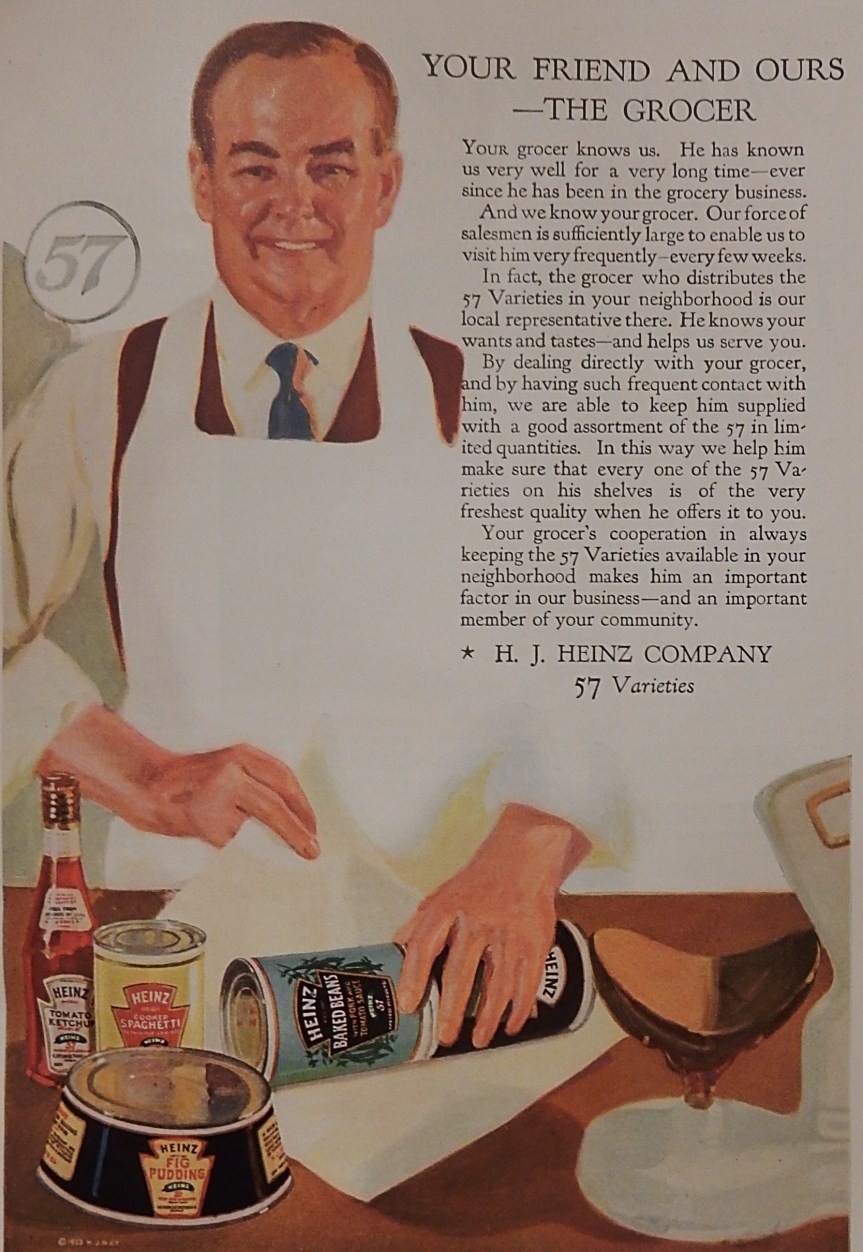
I found this ad about how Heinz salesmen and grocers work together to ensure that stores have all 57 varieties of Heinz products fascinating. What is the purpose of the ad? . . . to impress readers with the large number of Heinz products? . . . to encourage customers to look at the Heinz display in their local store, and request products if some of the 57 varieties are missing?

What in the world were the 57 varieties, if there were, and how many do they have now?
Who knows? I’m guessing one of the varieties featured in the ad, Heinz Fig Pudding, is no longer made.
You know me, I had to look that up. They also made plum pudding. I think Heinz mincemeat was the one my mother used when she made pies at Thanksgiving and Christmas. I hated mincemeat pies…just sayin’.
I also hated mincemeat pies when I was a kid – though they have grown on me over the years. 🙂
You evolved better than I did.
I think the ad was to make people ask their grocer for the products. Oddly, I see more varieties of Heinz at British shops.
Interesting that there are more Heinz varieties in British shops than U.S. ones. I also think that the ad probably was to encourage people to ask for more of the Heinz products –which likely would lead to the store stocking more varieties.
These old ads calm me down, even though I know they are manipulating me ; ) That’s the point, I guess, feel calm and come on in and buy! There are many stories online as to the beginning of the “57” tagline. It really worked out for them. Heinz is the only ketchup my hubby will eat, and I have made him do taste tests. ha ha
Marketing experts have a good understanding of human psychology. 🙂
I found the ad interesting as I recently read William Alexanders “Ten Tomatoes That Changed the World” and there were some stories about H.J. Heinz and his company. Per Wikipedia He was involved in (helping with) the passage of the 1906 Pure Food and Drug Act. From that I think a company focus on freshness and quality makes sense. It is interesting that the grocer appears to be wrapping those cans carefully in paper, imagine getting that sort of service now!
This book sounds like something I’d enjoy. I just went to my local libary’s webpage, and they have the book, and I put it on hold.
And who could forget those of us who had a Heinz 57 dog?
What a fun description of some really nice dogs!
We had several of them over the years, with the exception of my dad’s and grandad’s bird dogs. Those needed to be obtained from the blood line and then carefully trained, although back then, you just found someone who would give you one. Pretty sure none of the good old boys in our neck of the woods who hunted dove and quail in Texas ever paid for a dog.
It was different back then.
What struck me was the friendly neighborhood grocer part. As opposed to the present day big supermaket.
We’ve lost something important over the years. Years ago shops owned by local people were an integral part of communities.
So true, Sheryl. I grew up going to grocery stores owned by independent merchants and my parents were loyal to them even when the chain supermarkets began to emerge in the small rural towns. While I was in high school 1964-1968, we still drove 13 miles to my dad’s hometown to buy groceries from the locally owned grocer/butcher. That store still exists, although owned by other locals now, and whenever I was home I would still drive over and purchase items from them just to help support their business. I remember when my high school job was to go buy the groceries from my mother’s list and sign the ticket, and once a month, we took the check to pay them.
It’s wonderful that the store still exists -even if with different ownership. I suppose credit cards have largely eliminated the need for grocery stores to provide in-house credit and invoices.
Probably so, but it was a lifeline then. People honored that trust, and if they didn’t they figured out pretty quickly that the credit was over. I recall the first “credit” card my folks got–it was for gasoline and called a “courtesy” card. You paid the bill at the end of the month, or you had no more “courtesy.” No doubt that was before the days of high interest rates, late fees, etc.
It’s intriguing to think about the community dynamics when someone didn’t regularly settle up with the grocer, and their credit was cut. It must have been difficult for both parties.
My great grandfather was a grocery and that is exactly how it was! When his sons took over the store during the depression, they bartered and allowed people to make payments so that families didn’t go hungry! My mother used to talk about having to eat sauerkraut for weeks because one of the customers bartered a giant crock of it for bread and eggs!
What a fun story! Thanks for sharing. Your great grandfather sounds like a really caring person – though things couldn’t have been easy for him either during the depression.