18-year-old Helena Muffly wrote exactly 100 years ago today:
Monday, June 2, 1913: About the same as any other day. Didn’t do anything of note.
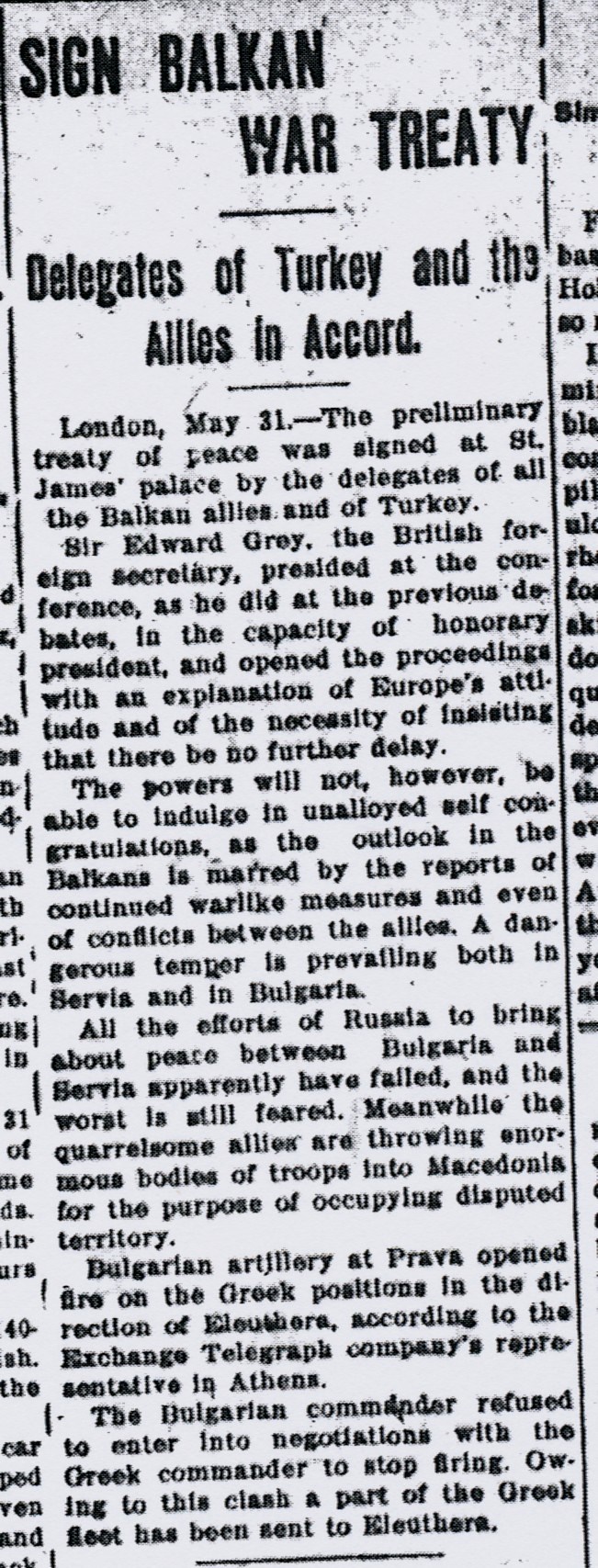
Source: Milton Evening Standard (June 1, 1913)
SIGN BALKAN WAR TREATY
Delegates of Turkey and the Allies in Accord
London, May 31.—The preliminary treaty of peace was signed at St. James palace by the delegates of all the Balkan allies and of Turkey.
Sir Edward Grey, the British foreign secretary, presided at the conference as he did at the previous debates, in the capacity of honorary president, and opened the proceedings with an explanation of Europe’s attitude and of the necessity of insisting that there be no further delay.
The powers will not, however, be able to indulge in unalloyed self congratulations as the outlook in the Balkans is marred by the reports of continued warlike measures and even of conflicts between the allies. A dangerous temper is prevailing both in Servia and in Bulgaria.
All the efforts of Russia to bring about peace between Bulgaria and Servia apparently have failed, and the worst is still feared. Meanwhile the quarrelsome allies are throwing enormous bodies of troops into Macedonia for the purpose of occupying disputed territory.
Bulgarian artillery at Prava opened fire on the Greek positions in the directions of Eleuthera, according to the Exchange Telegraph company’s representative in Athens.
The Bulgarian commander refused to enter into negotiations with the Greek commander to stop firing. Owing to this clash a part of the Greek fleet has been sent to Eleuthera.
Her middle-aged granddaughter’s comments 100 years later:
Grandma’s world often seems so small. The diary provides little evidence that she was aware of happenings across the US and around the world.
But the newspaper that Grandma would have read, the Milton Evening Standard, regularly reported national and world events.
For example, the previous day the paper contained the above article about a peace treaty–it’s called a war treaty in the headline, but the text says it’s a peace treaty– that was signed by the Balkan countries and Turkey.
The article indicates that the treaty may not have been totally successful—and obviously over the longer run it failed since World War I began a little over a year later due to continued unrest in the Balkan countries. The war was triggered when Archduke Ferdinand of the Austro-Hungarian Empire was assassinated in Sarajevo, Serbia on June 28, 1914.
An aside—it’s interesting how the spelling of several cities and countries have changed across the years. In the old article:
–Serbia was spelled Servia.
–Prague was spelled Prava.
–And, I’m not quite sure what Eleuthera referred to in the article (“. . . the Greek fleet has been sent to Eleuthera”), but I’m pretty sure that it wasn’t the island in the Bahamas. 🙂
18-year-old Helena Muffly wrote exactly 100 years ago today:
Sunday, June, 1913:
What is so rare as a day in June ,
For then if ever comes perfect days,
When song of bird and hum of bees
Bring to us fair summer’s sweetest day.
Went to Sunday school this afternoon. Took my time a getting home. I heard some of the best speaking I have ever listened to this evening. A converted Jew talked about some of the customs of the Jewish people in the Reformed Church at McEwensville.
Her middle-aged granddaughter’s comments 100 years later:
Grandma’ diary entry made me wonder: What percentage of the US population were considered members of the various religions in 1913 and 2013?
I discovered that this was a much more difficult question to answer than I thought it would be. The data on religious affiliations were collected very differently in the early 1900s than how it is gathered now—so when the data are compiled to do a comparison, it’s kind of like comparing apples to oranges.
This gets complicated, but let me try to explain what I did to create the figure above:
In the early 1900s , the US Bureau of the Census conducted a religious census every ten years. Religious leaders were asked how many members their congregation had; whereas in recent years, various non-profit organizations have conducted surveys where they asked a sample of the population about their religious preferences. As a result of these differences in methodology many more people were considered to have no religious affiliation a hundred years ago than now.
Calculation of 1913 Percentages
For the figure above, I used data from an article titled “U.S. has 42,043,374 Members of Church, New Census Shows” in the May 2, 1918 issue of the Minneapolis Morning Tribune. According to the article:
The term ‘members’ has a wide variety of uses. In most Protestant bodies it is limited to communicants or confirmed members; in the Roman Catholic, Eastern, and some other churches it includes all baptized persons, while in some bodies it covers enrolled persons.
The membership for the Jewish congregations requires some explanation. Some congregations reported as members all who contribute to the treasury of the congregation and not infrequently included women and children. The more orthodox, of the other hand, reported only those males who have incorporated the institution or have bought share or membership in it, but do not recognize as members other persons who are regular attendees or even contributors.
For the figure, I used data from the 1916 Religious Census, as reported in the Minneapolis Morning Tribune article, since this was the one done closest to a hundred years ago. To calculate the percentages I used the US population estimate for 1916 as reported by the US Bureau of the Census. I assumed that the percentage of the population who were members of various religions did not change much between 1913 and 1916 when creating the figure.
Calculation of the 2013 Percentages
For the 2013 percentages, I used data from a survey conducted by the Pew Research Center. Phone interviews were used to survey a sample of the US population. Respondents were asked which religion they identified with.
The survey was conducted in July, 2012—and I assume that the percentages have not changed significantly since then.
Monthly Poem
On the first of each month Grandma included a poem in the diary. For more information about the poems, see a previous post: