17-year-old Helena Muffly wrote exactly 100 years ago today:
Tuesday, April 30, 1912:Took my dress uptown to get made. Wonder when it will be done. Hope it will be satisfactory. I have a sore fore-finger, but can’t account for the cause.
Her middle-aged granddaughter’s comments 100 years later:
Hmm. . . I’m not sure what Grandma meant when she said that she took her dress uptown to get it made.
Three days earlier, she’d written that she and her mother went shopping in Milton and purchased a hat, several other items, and a white dress:
. . . I got a white dress . . .
Diary entry, April 27, 1912
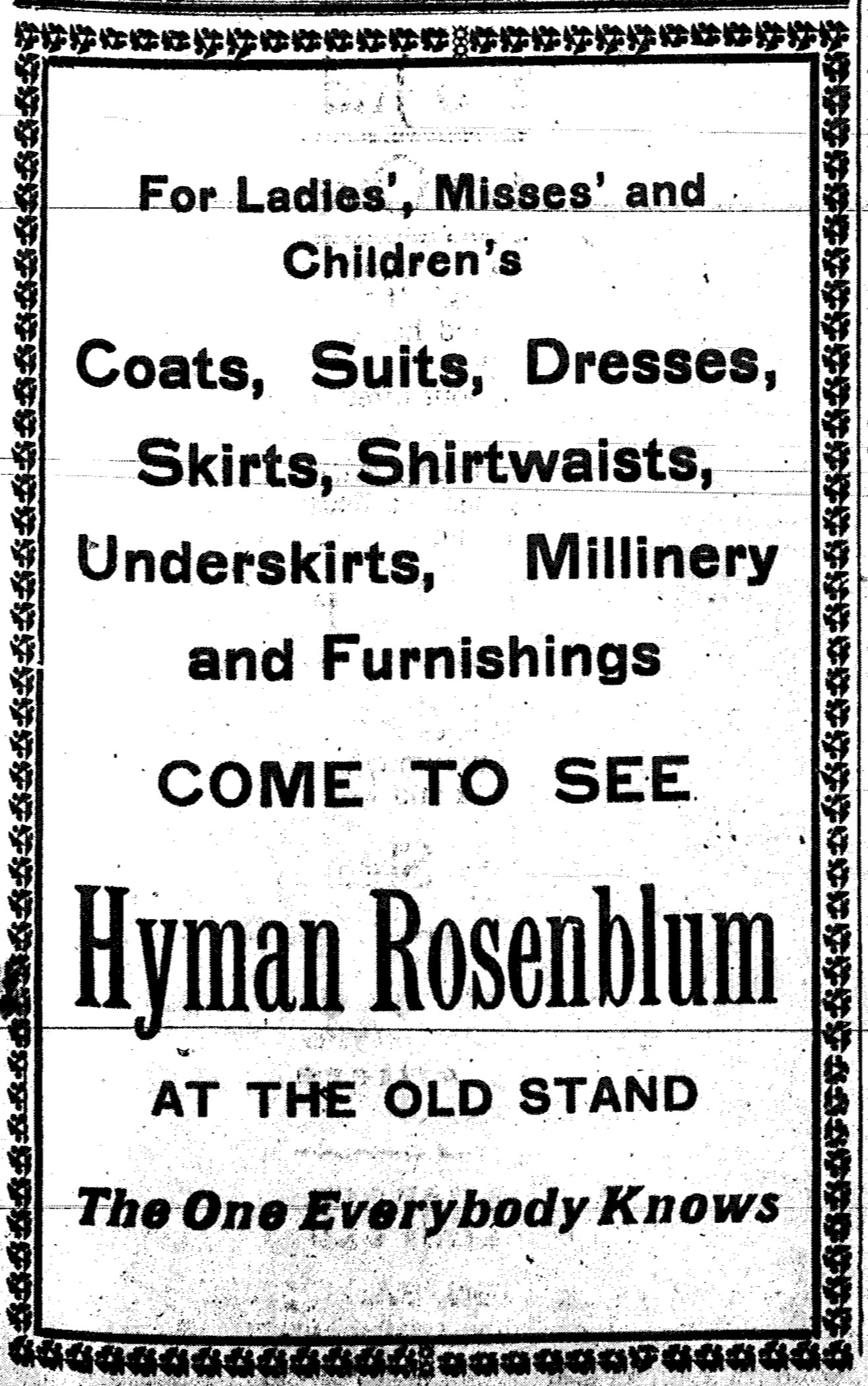
Advertisement in Milton Evening Standard
Sometime a diary entry raises more questions than it answers.
— Had they really purchased cloth and a pattern, instead of a dress?
— Or did they buy a dress, but it needed alternations?
–Where was uptown? . . . somewhere in McEwensville? . . . in Watsontown? . . . (Uptown sounds like such a classy word to describe any section of the little towns near Grandma’s home.)
–And a lingering question—Do I worry too much about the details? In the bigger picture of Grandma’s story, does it really matter whether she bought a dress or had someone make it for her?
12 thoughts on “Old Womens’ Clothing Store Advertisement”
I love that you wonder about the details! Being so interested in the way the world was for our ancestors is a great use of our imagination. In my humble opinion. 🙂
Another mystery! Like the others said, I love that you wonder about the details! As a result of your wondering we learn many new things and get a fascinating glimpse of an era gone by…
I agree with all the sentiments expressed … and am STILL obsessing over the “gigger-mer-rows” 🙂 My latest thinking is that “gigger-mer-rows” may be the “bits & pieces”, “thinga-ma-bobs”, “doo-dahs”, “bibs & bobs” for “tissying up” (decorating) a hat, or maybe even/also a dress? … mmmhhh
It’s such a lyric word. I tend to think that it’s something like “bits and pieces”, “thinga-ma-bobs” or other small things that didn’t merit individual mention as opposed to a dress. . . though maybe it could have included the dress. I wonder if the word was commonly used a hundred years ago–or if it was some sort of very localized slang.
(For other readers, this comment is referring back to April 27 diary entry.)
I think dresses always needed alterations in those days. They were complicated garments, not ready to wear off the hanger. A lot of women made modest livings as seamstresses, like some in my family.


I love that you wonder about the details! Being so interested in the way the world was for our ancestors is a great use of our imagination. In my humble opinion. 🙂
You worry too much about the details…just as I would:)
I second the humble opinion posted earlier! It is good to ponder these things.
Another mystery! Like the others said, I love that you wonder about the details! As a result of your wondering we learn many new things and get a fascinating glimpse of an era gone by…
It’s absolutely important to focus on those devilish details! That’s where the fun is!
Thanks everyone for the great comments! It’s helpful to know that I’m not alone in thinking that the details are important.
As they say, more will be revealed. 🙂
I agree with all the sentiments expressed … and am STILL obsessing over the “gigger-mer-rows” 🙂 My latest thinking is that “gigger-mer-rows” may be the “bits & pieces”, “thinga-ma-bobs”, “doo-dahs”, “bibs & bobs” for “tissying up” (decorating) a hat, or maybe even/also a dress? … mmmhhh
It’s such a lyric word. I tend to think that it’s something like “bits and pieces”, “thinga-ma-bobs” or other small things that didn’t merit individual mention as opposed to a dress. . . though maybe it could have included the dress. I wonder if the word was commonly used a hundred years ago–or if it was some sort of very localized slang.
(For other readers, this comment is referring back to April 27 diary entry.)
I think dresses always needed alterations in those days. They were complicated garments, not ready to wear off the hanger. A lot of women made modest livings as seamstresses, like some in my family.
Yes, that makes sense. It probably did need to be altered.