Muffly Magnetic Retriever Used to Remove Metal Objects from Cows’ Stomachs

18-year-old Helena Muffly wrote exactly 100 years ago today: 

Thursday, December 4, 1913:  Ditto.

muffly_retriever.2The New Improved Muffly  Magnetic Retriever

Is now available through your favorite supplier or direct from

Dr. John W. Vandeven, D.V. M. , Belleville, Pa. 17004

Her middle-aged granddaughter’s comments 100 years later:

The “ditto” refers to  a diary entry the previous day which said, “Nothing—That word I have good use for.”

One of the things that I really enjoy about blogging is how I occasionally get comments from wonderful people who knew my Grandma or other relatives. It is awesome to learn more about family members and what they were like.

I tingled with excitement when I read Pat Lukas’s recent comment, and  I’d like to thank Pat for sharing information that she had about Grandma’s little brother, Jim Muffly.  Jim did some amazing things.

Jim became a veterinarian with a practice in Lewisburg, Pennsylvania.  I learned from Pat that he was also an inventor.

This is what Pat wrote in her comment:

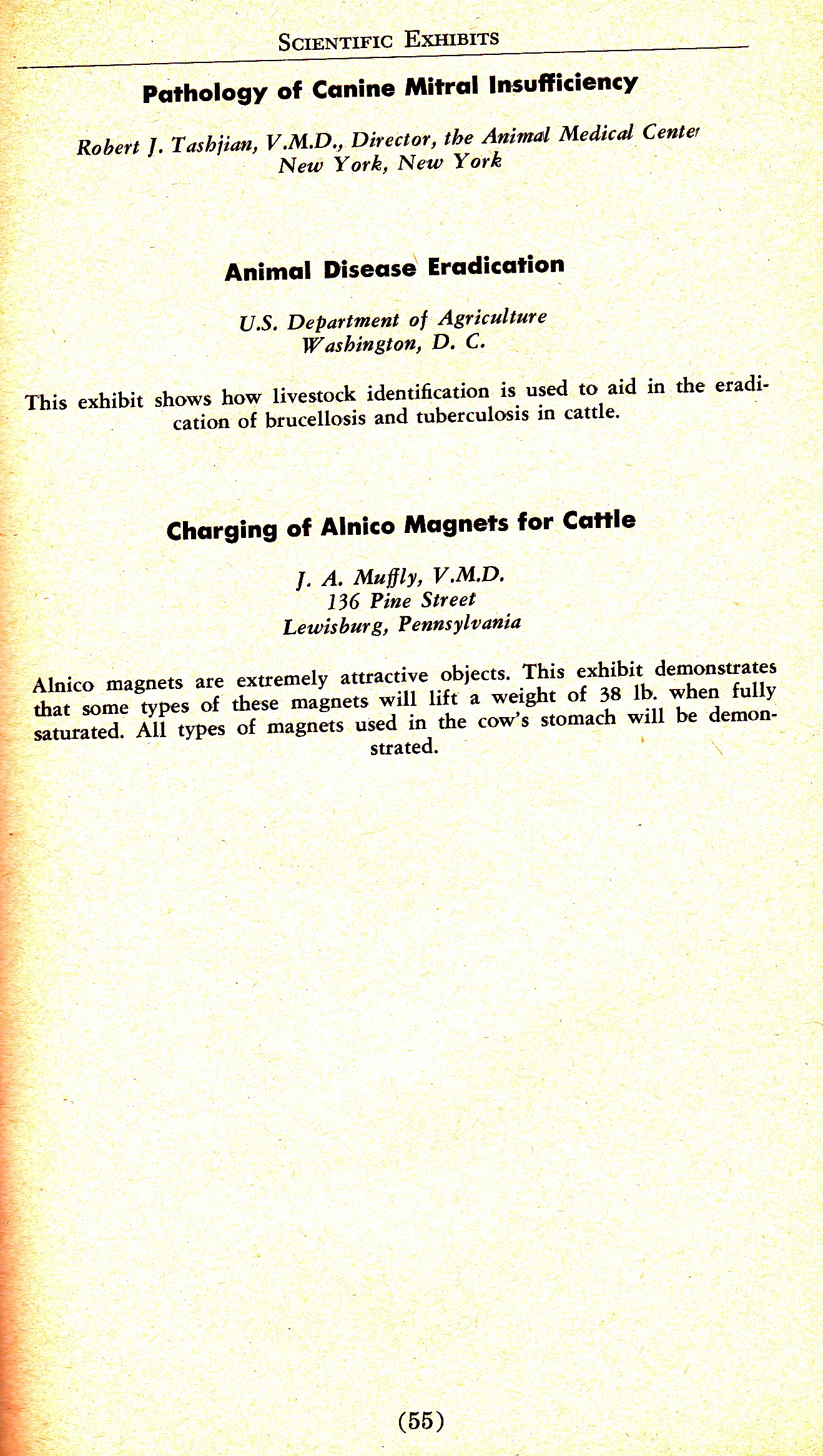
At this very moment I am looking at the “Program of the 101st Annual AVMA (American Veterinary Medical Association) Meeting” which took place in Chicago in July of 1964. James A. Muffly, V.M.D. exhibited his invention for charging magnets which were used to remove metal, such as nails and bailing wire, from the stomachs of cattle.

I remember Dr. Muffly. My father, John Vandeven, D.V.M., worked with him to develop the design for the Muffly Magnetic Retriever and helped him market it. I also remember seeing my father use the retriever on dairy cows.

Pat was kind enough to share the cover of the 1964 American Veterinary Medical Association Meeting program and the page that describes Jim Muffly’s invention in the program, as well as a copy of an advertising flyer for the invention.

Muffly.AVMA cover-1

Dr. Muffly-2

Pat shared information from an article that her father wrote about the Muffly Magnetic Retriever that appeared in the May 1965 issue of Modern Veterinary Practice which provides a sense of the economic importance that the invention had in helping small farmers who had sick cows. It said on page 65 of the article:

In a herd of 55 Holstein cows, 13 were vomiting. Although hardware might have been ruled out because so many animals were affected, 7 lbs. of electric fence wire pieces and various other metal objects up to 5 inches in length were retrieved from 53 of these cows.

Pat also wrote:

My father considered Dr. Muffly a very good friend. The impression I carry of Dr. Muffly is that of a kind and gentle person.

The information Pat gave me started a snowball that led to the discovery of Jim Muffly’s patent.   My son Nathan was recently home over Thanksgiving and I mentioned the Muffly Magnetic Retriever to him.

Nathan said, “I wonder if we could find the patent for Jim Muffly’s invention.”

And, within minutes he’d found Jim Muffly’s 1956 patent for the instrument that could be used to remove metal from cows stomachs.

The tool Jim Muffly developed was flexible and could be maneuvered into the cow’s stomach. Nathan also found where Jim Muffly’s invention had been cited in several more recent patent applications as a basis for those inventions—including several applications for inventions of human catheters.

Thank you Pat and Nathan for all of the wonderful information.  It’s fun to learn more about an awesome relative.

___

If you’d like to see pictures of Jim Muffly you might enjoy a previous post:

What Ever Happened to Jimmie Muffly? 

Hundred-Year-Old Dolls from Russia

18-year-old Helena Muffly wrote exactly 100 years ago today: 

Wednesday, December 3, 1913: Nothing——-That word I have good use for.

1913-12-37.dThe Schoolboy must be coming home from school since his luncheon is all gone. He wears a cotton suit with a wool coat, and crocheted shoes.

Her middle-aged granddaughter’s comments 100 years later:

Grandma—

It can’t be that bad. Where’s your Christmas cheer?  Maybe you should read the current issue of Ladies Home Journal, there were a couple of articles that made me smile.

—-

Here are some pictures of Christmas Dolls from Russia that were in the December, 1913 issue of Ladies Home Journal. According to the magazine:

Christmas Dolls from Russia

Most dolls are clothed with the idea of making them pretty, but the dolls on this page were dressed to typify certain kinds of people and are accurate representations. The most interesting things about them is the fact that they were dressed by children in an orphan asylum in far-away Russia, and the money the children earned is their own. They are reproduced courtesy of the Russian Peasant Handicraft Center.

 Ladies Home Journal (December, 1911)

1913-12-37.aThe Russian Gentleman in velvet and gold braid looks very proud, with his fur-trimmed turban, and his dainty kid boots, which were made from someone’s old kid glove.

.

1913-12-37.bThe Russian Lady is dressed in a satin gown, velvet coat and elaborate headdress.

.

1913-12-37.cThe Coachman, to make himself quite pompous in the doll world, has stuffed his coat in front with cotton.

.

1913-12-37.eThe Water-Carrier looks so pretty and warm in her plaid shawl and green coat, beneath which there is a glimpse of a wool dress and a gingham apron. The water-pails have been whittled out of pine.

.

1913-12-37.fThe Broom-Seller being a poor little lady, is dressed in gingham.

Diary Blues

18-year-old Helena Muffly wrote exactly 100 years ago today: 

Tuesday, December 2, 1913:

Now if I was an energetic girl, I’d have these pages filled with things overflowing of great doings, but alas and alack, it’s actually the reverse.

DSC03318.crop.b

Her middle-aged granddaughter’s comments 100 years later:

Grandma—

Don’t be so hard on yourself, you have the diary blues—today people talk about the blogging blues when they struggle to come up with things to write.

Old-Fashioned Christmas Greenery Decorating Ideas

18-year-old Helena Muffly wrote exactly 100 years ago today: 

Monday, December 1, 1913:

The very last, December comes

That month that is held so dear

With a shout of mirth

We welcome the birth

For the month that dies the year.

It seems to me that old father time must be running a race with something or other, the days spin ‘round so swiftly.

1913-12-81.c

Her middle-aged granddaughter’s comments 100 years later:

Were the Muffly’s starting to decorate for Christmas as the days spun by? Here’s some ideas for using greenery that were in the December, 1913 issue of Ladies Home Journal.

1913-12-81.e

1913-12-81.d

1913-12-81.aYou might also enjoy several previous posts that showed hundred-year-old Christmas decorating ideas:

Christmas Tree Decorations a Hundred Years Ago

Christmas Table Decorations and Centerpieces a Hundred Years Ago

One Hundred-Year-Old December School Bulletin Board Ideas

Old-fashioned Mistletoe and Candy Kiss Decoration

Monthly Poem

Grandma begins each month with a poem.  For additional information about them see:

Monthly Poem in Diary

Old Advice About How to Make Sunday School More Interesting for Teens

18-year-old Helena Muffly wrote exactly 100 years ago today: 

Sunday, November 30, 1913: Went to Sunday School this afternoon.

DSC06534This isn’t the church Grandma attended–she went to the Baptist church which was torn down years ago–, but here is a recent photo of St. John’s United Church of Christ in McEwensville.

Her middle-aged granddaughter’s comments 100 years later:

Grandma went Sunday School almost every Sunday, so she obviously got something important out of attending: however, a hundred years ago church leaders sometimes worried about teens who did not attend Sunday School.

I found an interesting book published in 1913 called The Sunday School and the Teens. It is a report of the Commission on Adolescence of the International Sunday School Association.

The Commission sent a questionnaire to girls between the ages of 13 and 20 in “widely scattered sections of the country.”

Girls who answered the survey question who no longer attended Sunday School gave many reasons including:

“We had no regular teacher.” “The Sunday School lessons weren’t interesting.” “I didn’t get anything out of it.” “There were so few girls my age in Sunday school I finally left.” “My family moved and I did not enter a new school.” “Sunday is my only day and I did not want to spend the afternoon in Sunday school.” “The other girls in the class weren’t sociable and I got sick of it and left..” “ I think Sunday school is well enough for children but I don’t see anything in it for a business girl” “ I’m too tired.” “I’d rather go to church.” “I simply did not like it.”

The Sunday School and the Teens (1913)

The report concluded that the girls wanted Sunday Schools with:

1.         Competent and interesting teachers.

2.         Some form of class organization.

3.         Some social life connected with the class.

4.         Something definite to do.

5.         Lessons that have to do with life.

Putting Things in Order

18-year-old Helena Muffly wrote exactly 100 years ago today: 

Sunday, November 29, 1913: Put things in some kind of order here, but how long they’ll stay. Goodness only knows.

boxes

Her middle-aged granddaughter’s comments 100 years later:

What was Grandma organizing?  Did she put similar items into a box or other container?  In the days before container stores, people used to save boxes, jars, and cans to store things in.

Actually, I still save jars and boxes. When I’m cleaning, I’ll gather a group of like items—and then search for a saved container to store them in.

Sometimes I think that I’m the only person  still saves old containers—and that most people buy nice matching containers—but I never can bring myself to buy them when I have a closet full of saved ones.

jars and cans