Hundred-Year-Old Suggestions for Serving Food to Sick Children

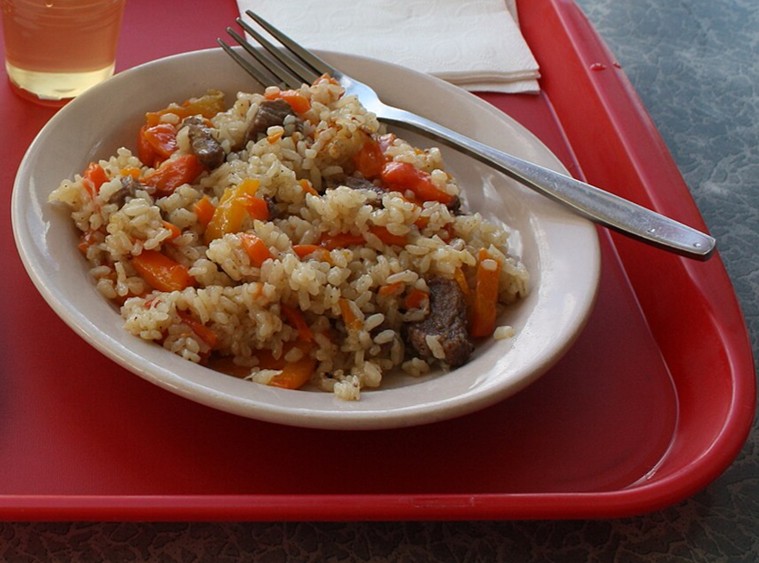
food on trayWhen caring for a sick child it is important to keep them hydrated and well-nourished. Often a child will eat little while complaining that nothing tastes good. An article on serving food to sick children in the January, 1925 issue of American Cookery began:

The sick child that loved his “land of the counterpane” in Robert Louis Stevenson’s poem by that name must have had a resourceful nurse or mother to prepare interesting food for him, or he would have been just as irritable as any other youngster, recovering from the measles or grippe.

My first reaction to the sentence was not about food for a sick child. Instead, I started digging deeply into my brain trying to remember what “counterpane” and “grippe” meant. They’re words I’m familiar with, but that I don’t think that I’ve heard since I was a child. “Counterpane” is another word for bedspread. I did an online search and found Stevenson’s lovely poem: The Land of the Counterpane. “Grippe” is an old-fashioned word for flu.

The article continues with suggestions for making food more appealing to sick children:

  • The appearance of the tray has much to do with tempting the convalescent child. For instance, by folding a tent out of white wrapping paper, and standing it over the dishes, commonplace foods become delicacies of interest, particularly if a tin soldier stands near the tent to “guard your health.”
  • A little girl would, likewise, eat her food with more gusto if her tray were covered with a box that could be used for a doll house after dinner.
  • One little girl, who was too ill to go to a picnic she had planned attending, enjoyed her supper that night just because her mother thought to bring it to her in a picnic basket.
  • Children who have eaten toasted sandwiches in the sandwich shops will be delighted with three-deckers stuck together with toothpicks, and will eat them, even when the sandwich filling is composed of oft-despised scrambled eggs or stewed prunes.
  • Graham crackers are good,  as well as nutritious, when served with milk. Try putting a few drops of hot syrup on the graham crackers, and standing an animal cracker on each one. It will be lots of fun to eat the circus parade along with the milk.
  • One child even learned to like grapefruit when his mother put the juice in a bottle, and let him pretend it was medicine.
  • To encourage the finicky child to eat up all the food on his tray, a meal ticket may be issued and every time the food is all eaten the ticket is punched. When a certain number of “meals” have been punched the child may be given a small reward.

American Cookery (January, 1925)

Hundred-Year-Old Directions on Folding an Omelet

Folding an omelet
Source: School and Home Cooking (Carlotta C. Greer, 1925)

It can be challenging to make an omelet. I often struggle to successfully fold them. Here are directions in a 1925 home economics textbook for folding an omelet:

To Fold an Omelet

Run a spatula underneath the omelet to loosen it. Make a slight incision with a knife through the middle of the omelet at right angles to the handle of the pan, and fold the omelet over upon itself away from the handle of the pan. Grasp the handle of the pan in the right hand, placing the back of the hand underneath with the thumb pointing away from you. then turn the omelet upon a platter (see Figure 40).

School and Home Cooking by Carlotta C. Greer (1925)

Hundred-Year-Old Considerations When Cooking Poultry

Chickens hanging from hooks

Often hundred-year-old cooking tips and advice still are relevant today, but sometimes the old advice is very different. Here are some tips for cooking poultry in a 1925 cookbook:

No poultry should be cooked before it has hung for at least eight hours. In many large cities there are live poultry markets and each bird is killed as it is bought. These birds should be hung overnight before they are drawn and prepared for cooking.

When any fowl or game is being prepared for cooking, it should be thoroughly washed inside and out, and if there is an unpleasant odor from the inside, rub it with a little cooking soda. If the odor disappears quickly the bird is good to eat. If the odor persists it is best to cut the bird open to see whether there are any bruises or recognizable bad places. A fowl that has a bad odor had better not be eaten.

The young chicken lends itself to many kinds of savory cooking. The older chickens are better for soups, stew, and salads. If a fowl is very old it will hardly make even a good salad because the white meat is apt to be coarse and somewhat tasteless.

Leftover fowl and game is excellent for pies, stew, croquettes and any number of casserole dishes. They should be combined with a rich gravy to give the best results.

The Home Makers’ Cooking School Cook Book (1925)

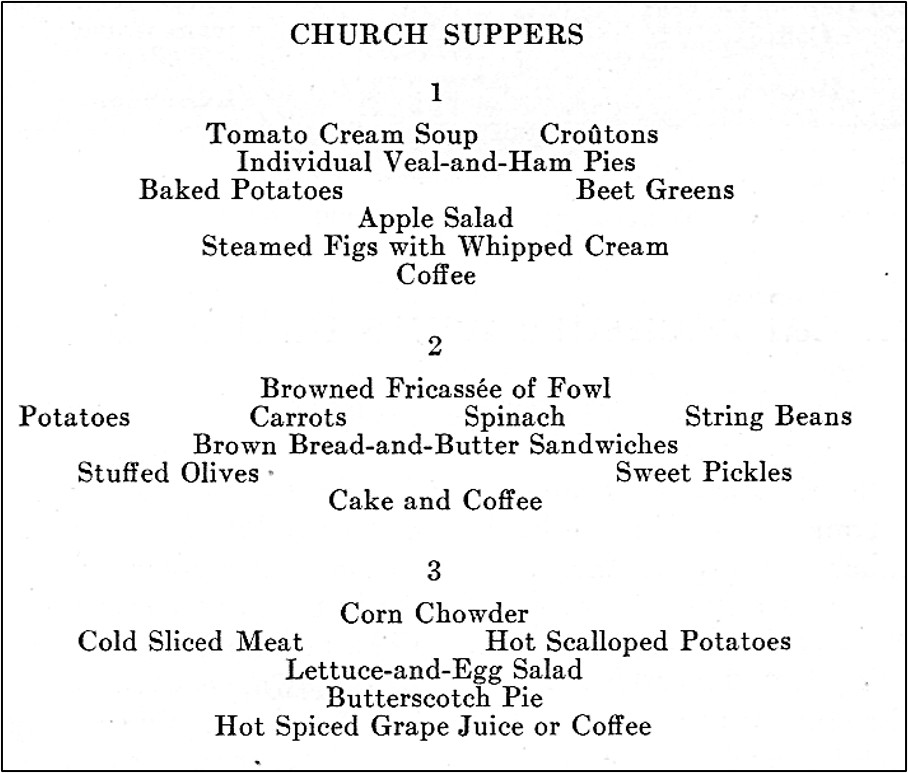
1925 Church Supper Menus

Church Supper Menus
Source: American Cookery (February, 1925)

Most churches I’ve attended had potluck dinners and picnics where people bring a dish to share, but some churches have dinners with menus. Sometimes these dinners might be fund-raisers. A hundred years ago churches also held dinners. Here’s some church supper menus in a 1925 magazine.

Hundred-Year-Old Tips for Caring for Wood and Coal Stoves

coal stoveHere’s some abridged tips for caring for wood and coal stoves from a hundred-year old magazine:

  • Stove grates will last ten years, or longer, if well cared for (that is if the ashes were removed once or even twice daily).
  • Grates should not be kept red hot with ashes banked up against them.
  • Do not bank the fire overnight with the ashpan fun of ashes, thereby keeping the grated heated all of the twenty-four hours, never giving them a chance to cool.
  • A cheap stove is poor economy. Therefore, always purchase a stove of a well-known make, and then take care of it.
  • Clean out the soot from underneath the stove.
  • Brush the soot and ashes from around the sides of the stove. The butterfly, in the back of the stove, should be opened, and the stove rake, or poker, slipped in, so that the soot may be pushed downward into the space below the oven, where it may be taken out through the opening made for that purpose. This pipe is often entirely clogged or closed by the unburned particles of carbon deposited there from the coal.
  • Clean the stove pipe, which may be responsible for lack of draught and may be half full of soot, especially if it is a long pipe, or has more than one turn in it.
  • Keeping the stove red hot, for any length of time. will warp the lids, and burn out the various parts. After a fire is started, the drafts should be adjusted, so that it burns well, but not so as to permit the stove to become red hot.
  • Piling up coal until it is against the top of the stove will also cause the lids to warp.
  • Another cause of injury to a stove is the burning of wet garbage. Coffee grounds or liquids should not be poured on the red hot lining of the stove. This may produce cracking.
  • If one is going away for some time, the stove should have a liberal coating of grease, or liquid black shellac, to prevent rusting; or otherwise the dampness of a closed house may cause serious damage. Under such conditions the stove pipe should be taken down, oiled and left down, or else rain, coming down the chimney may cause the pipe to rust out in one season.
  • Even if one is at home and does not use the coal stove in summer, papers should be burned in it occasionally to dry out the stove pipe and inner parts of the stove.
  • If the stove has an enameled back or trimmings, these may be cleaned with a scouring powder, which is not gritty.
  • Foods, grease, etc. must not be allowed to collect on the surfaces, or these will be burned on from the intense heat, and cannot be removed without injury to the surface.
  • Clinkers will not form so readily if the fire is made every day.

Excerpts from American Cookery (March, 1925)

Hundred-Year-Old Tips for Crisp Waffles

waffles on plate

When I make waffles, I’m sometimes surprised by how much the texture varies from one batch to the next. Sometimes they are nice and crisp; other times they limp and almost soggy. I recently was browsing through a hundred-year-old magazine and came across some advice that still is helpful and relevant:

Crisp Waffles

Several small points affect the crispness of the waffle. First, we would put a hot iron. The iron should be hot enough immediately to cook the batter, it should be sizzling and more than sizzling hot. Equally important is it that too much batter shall not be poured into the irons, for a thick waffle is never crisp. Most of the waffles served to us in restaurants are, we regret to say, too thick. A strong bread flour tends to toughness, so does too much egg, unless balanced by a good deal of butter. Pastry flour helps to make a tender waffle, and so does rich milk. If you use skimmed milk it inclines to toughness, while water and butter are aids to tenderness. Further, if you pile the waffles on a plate, while they are smoking hot, they will be sure to lose crispness from the absorption of moisture from the steam.

American Cookery (April, 1925)