Images sometimes jog memories of things that have been totally forgotten. I recently was browsing through a hundred-year-old home economics textbook and came across a drawing of a bread box. Suddenly memories of my parents stainless steel bread box came flooding back. And, then I remembered my Aunt’s white plastic bread box that had flower decals on it. . . . and our neighbor’s wooden roll-top bread box. Back then almost everyone had a bread box. Today, I don’t think any of my friends have one.
I’ve never owned a bread box, and just put plastic-wrapped loaves of bread on the kitchen counter. Are bread boxes just an old-fashioned way of storing bread, or do they help maintain quality?
Here’s what the old home economics textbook had to say:
Bread may be made ever so carefully, but if it is not properly cared for may not be palatable. After they have been cooled the loaves should be put into a clean tin bread box (Fig. 133). Before each baking the bread box should be washed thoroughly, scalded, and aired. Scraps of bread should never be allowed to accumulate, and under no circumstances should bread be allowed to mold in the box. Mold sometimes occurs when bread is wrapped in a cloth or when a cloth is used to line the box. Clean white paper makes a better lining.
Household Arts for Home and School (Vol. 2) (1920) by Anna M. Cooley and Wilhelmina H. Spohr
I can accurately estimate how much my family will eat when I make some foods, but I’ve never been able to figure out how much rice they will eat at a meal. Which means that I often end up with left-over rice that I’m not quite sure how to use.
So I was thrilled when I recently came across a hundred-year-old recipe for Rice Griddle Cakes which called for left-over cooked rice. The recipe was easy to make. The Rice Griddle Cakes were delicious and tasted very similar to typical pancakes, but they were more textured because of the addition of the cooked rice.
Here’s the original recipe:
Source: The Cook Book of Left-Overs (1920) by The More Nurses in Training Movement
Put flour, sugar, salt, baking powder, egg, and 1 cup milk in a mixing bowl, beat until smooth. Stir in rice. If the batter is too thick, add additional milk. Heat a lightly greased griddle to a medium temperature, then pour or scoop batter onto the hot surface to make individual pancakes. Cook until the top surface is hot and bubbly, and then flip and cook other side.
According to the United States Department of Agriculture, in 2010 there was 218.9 pounds of food waste per person in the United States. Food waste has been an issue for at least a hundred years. This is what it said in the introduction of a 1920 cookbook which contained recipes that used left-overs:
Can you truthfully say that there is no waste in food in your home?
It has been reiterated many times that a French family could live on what an American family throws away. Is that true in your case?
True thrift and economy in cooking means planning so that nothing is wasted and all foods whether freshly cooked or reserved at another meal are tasty and appetizing.
The whims of fancy and capricious appetite require forethought and careful planning in order to keep a varied and tempting menu and at the same time utilize all left-over food.
Source: The Cook Book of Left-Overs (1920) by The More Nurses in Training Movement – Illinois Ladies
When I cook foods in the oven, the first thing that I think about is: What temperature should I use?
Modern recipes indicate the temperature setting. A hundred years ago, recipes might say that a “medium” oven or a “hot” oven should be used, but the exact temperature was left up to the cook. .
In 1920, many cooks still used wood or coal stoves which had their own unique challenges when it came to maintaining a constant temperature; but, more modern electric and gas stoves were becoming more common – though they may not yet have had a temperature control. However, cooking thermometers were available.
But, a hundred years ago the idea of regulating the oven temperature was still a new concept, and home economists were trying to figure out the best temperature to use when making various foods. For example, home economists at the Good Housekeeping Institute, which was affiliated with Good Housekeeping magazine, did experiments to compare how foods turned out when different oven temperatures were used. Here are some excerpts:
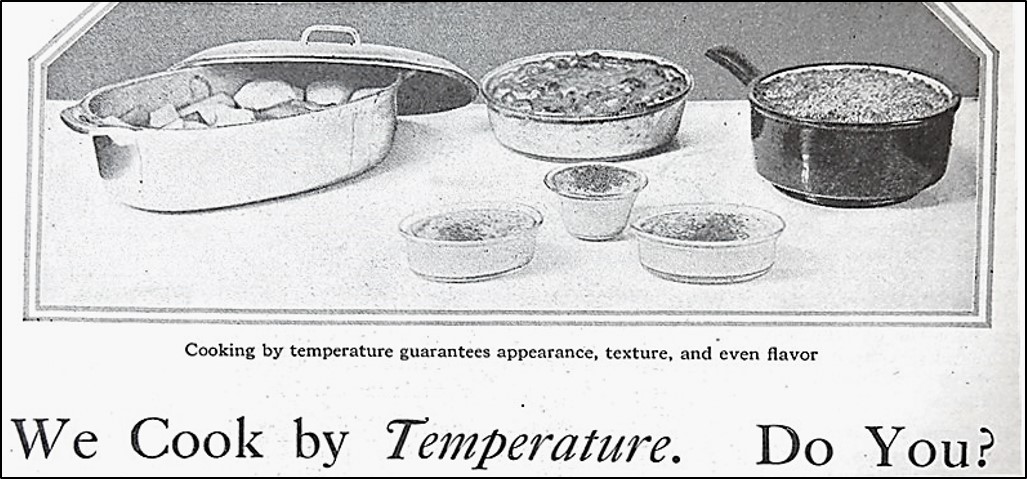
We Cook by Temperature. Do You?
From time to time this department has published articles on the cooking of foods by temperature. In our testing work here in the Institute, we have used these findings constantly, and each time become more and more enthusiastic over the uniformity and perfection of the results. We realize more each time the great importance which the correct temperature bears to the production of good cookery results.
Just a word in regard to the use of a thermometer in baking. The thermometer should be placed as near the center of the oven as is convenient, and on the shelf, if possible, where the bulk of the baking is to be done. If your range has a very even distribution of heat, this precaution will not be so necessary. If several dishes are to be placed in the oven at one time, it is advisable to try the pans in the oven before it is heated so that the thermometer in a position which will best suit the necessary arrangement. The thermometer should be placed in the oven while it is cold, preferably and thus allowed to heat gradually as the oven heats.
The experiments made to determine the best temperature for the baking of scalloped dishes proved most interesting. It is necessary that this kind of dish shall look well, because it is intended to be served at the table in the dish in which it is baked. So it was appearance that we looked for at first in determining the best temperature. But much to our surprise, we found a marked difference in the flavor as well, even though the dish was made in exactly the same way, when cooked at different temperatures. For the comparative test to determine the baking temperature for scalloped dishes, Delmonico Potatoes were made. Into a greased baking-dish were placed alternately layers of diced, cooked potatoes, and well-seasoned cheese sauce. The top of the dish was covered with thin slices of cheese. Dishes prepared thus were baked at 350° F., 400° F., 450° F., and 500° F. Another dish was placed at the very bottom of the broiler oven of a gas range and allowed to brown beneath the broiler flame.
The time required for browning at the different temperatures varied. At 350° F., twenty-seven minutes did not produce a very satisfactory brown, and the sauce “bubbled” badly, giving the dish a very unsightly appearance. Twenty minutes at 400° F. gave slightly better results, and fifteen minutes at 450° F. showed still greater improvement in appearance and flavor, but the dish cooked at 500° F. for twelve minutes proved without a doubt that this was the very best temperature of all. The sauce bubbled very slightly about the edges but did not give so unsightly an appearance to the dish as the lower temperatures had produced. The browning was good, but the perfection in seasoning and taste was the biggest determining factor. It was, indeed, supreme. The flavors seemed to be perfectly and thoroughly blended.
The dish baked beneath the broiler flame required only ten minutes for the browning. The result was very pretty to look at, because no bubbling had taken place, and the browning was even and delicate, but the flavors were not at all blended, so this method was immediately ruled out as not at all desirable.
Source: School and Home Cooking (1920) by Carlotta C. Greer
Some cakes look better than others, and some cakes taste better than others – but the best cakes are the ones that are both attractive and tasty.
Specific criteria can be used to judge cake quality. A hundred years ago was the heyday of local fairs. Almost every community – both large and small – held an annual fair where people could showcase their baked and canned goods, farm produce, and livestock. Women (and it usually was women in 1920) enjoyed competing to see who made the best cake. A blue ribbon and maybe a small amount of prize money were the official rewards – but the real reward was the bragging rights. Score cards that listed various criteria such as flavor, lightness, and appearance – and the maximum score for each criteria – were often used to judge the quality of cakes.
In addition to formal judging of cakes, cakes are regularly informally judged by the individual who baked them and the people who eat them. Is this a good cake? Why isn’t it as tasty as some other cakes? . . .
And, when a cake isn’t perfect, a good cook often tries to figure out exactly what went wrong, so that the next cake is better. Here is some hundred-year-old advice for troubleshooting cake problems:
The Quality of Cake
Desirable cake is tender and light, but of fine grain. The quantity of eggs, sugar, fat, and moisture affects these qualities. Too much sugar makes a cake of coarse grain and of waxy or tough texture. On the other hand, a cake containing too little sugar is not as fine grained as one having “just enough.”
A cake in which there is too much fat is crisp or crumbly, – i.e., it will not hold its shape. Too little fat may make it tough in texture. Generally, the more fat a cake contains the smaller the quantity of moisture needed.
Many eggs without a proportionate quantity of fat and sugar produce a tough cake. The toughness occasioned by eggs, may be offset, of course, by the tenderness produced by fat. It is a most interesting study to compare cake recipes. Some are well proportioned, others could be greatly improved by variations in the quantity of ingredients.
The flavor of a cake is largely affected by the proportion of ingredients in a cake. For the sake of economy, however, certain ingredients, especially fat and eggs, must be decreased even though texture, grain, and flavor are sacrificed. The matter of wholesomeness must also be taken into consideration.
School and Home Cooking (1920) by Carlotta C. Greer
Source: Household Arts for Home and School, Vol. 2 (Anna M. Cooley & Wilhelmina H. Spohr, 1920)
Is it important to look your best at breakfast? To be frank, I don’t often give much thought to how I look at breakfast, but then I read some advice in a hundred-year-old home economics textbook:
Breakfast is an important meal, not only because of the food that is eaten, but because it marks the beginning of the day and exerts its influence upon the members of the family for the entire day. The members of the family who leave home to work like to enjoy the memory of an attractive breakfast table surrounded by a happy family. It makes them eager to return to their homes as early as possible after the day’s work.
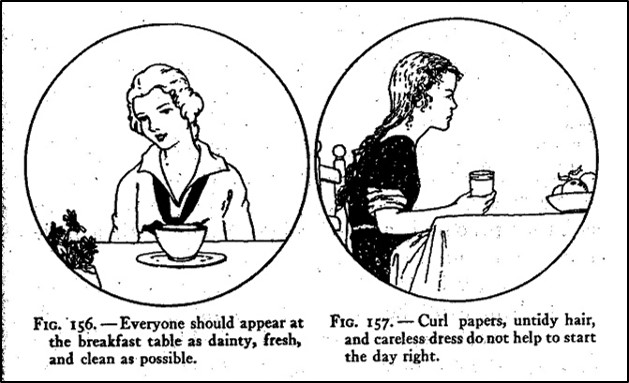
There is too often a temptation to neglect the details of the meal, and too often the personal appearance of the members of the family is neglected. Everyone should appear at the breakfast table as dainty, fresh and clean as possible. Curl papers, untidy hair, and careless dress do not help to start the day rightly, and no girl should feel that she has the right to come to the dining room until she can present a pleasing appearance.
Household Arts for Home and School (Vol. 2) by Anna M. Cooley and Wilhelmina H. Spohr (1920)
Source: School and Home Cooking (Carlotta C. Greer, 1920)
Today when people talk about how each dollar that is spent on food is distributed across categories, they are often referring to how much farmers get compared to processors, retailers, and others. For example, according to the United States Department of Agriculture, in 2017 farm producers got 7.8 cents of each dollar spent on food, while the retail trade received 12.6 cents, and 36.7 cents went to food services (restaurants).
A hundred-years-ago, the division of each dollar spent for food often referred to how the cost of foods purchased by consumers should be distributed across food categories. A 1920 home economics textbook said:
How Much to Spend for Food
Anyone, no matter how ignorant or thoughtless, can get rid of money. But it takes a wise person, one who understands values and quality to get value received for money spent. Whether one is purchasing for all the meals of a family or is only selecting a luncheon or one meal, it is desirable to spend money wisely.
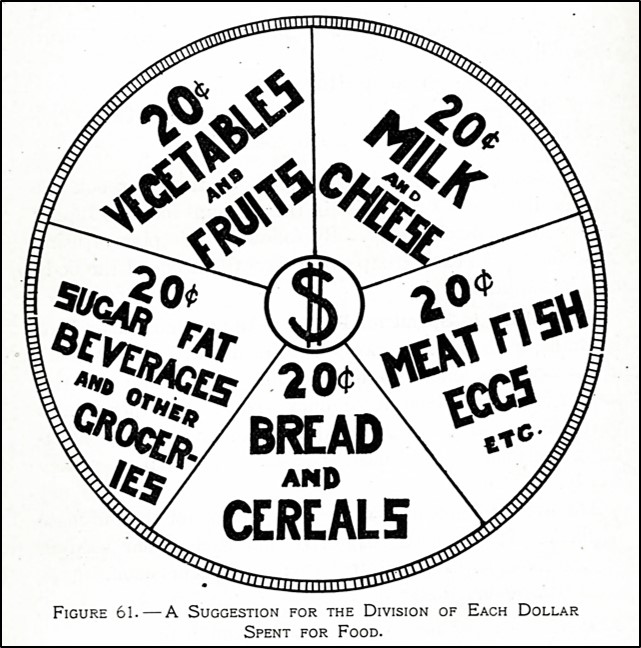
The five food groups may serve as a basis for the purchase of foods. It has been suggested that each dollar used in buying foods be divided into 5 parts of 20 cents each.
Out of every dollar spent use:
20 cents, more or less, for vegetables and fruits
20 cents, or more, for milk and cheese
20 cents, or less, for meat, fish, eggs, etc.
20 cents, or more, for bread and cereals
20 cents, or less, for sugar, fat, tea, coffee, chocolate, flavoring