Today when people talk about how each dollar that is spent on food is distributed across categories, they are often referring to how much farmers get compared to processors, retailers, and others. For example, according to the United States Department of Agriculture, in 2017 farm producers got 7.8 cents of each dollar spent on food, while the retail trade received 12.6 cents, and 36.7 cents went to food services (restaurants).
A hundred-years-ago, the division of each dollar spent for food often referred to how the cost of foods purchased by consumers should be distributed across food categories. A 1920 home economics textbook said:
How Much to Spend for Food
Anyone, no matter how ignorant or thoughtless, can get rid of money. But it takes a wise person, one who understands values and quality to get value received for money spent. Whether one is purchasing for all the meals of a family or is only selecting a luncheon or one meal, it is desirable to spend money wisely.
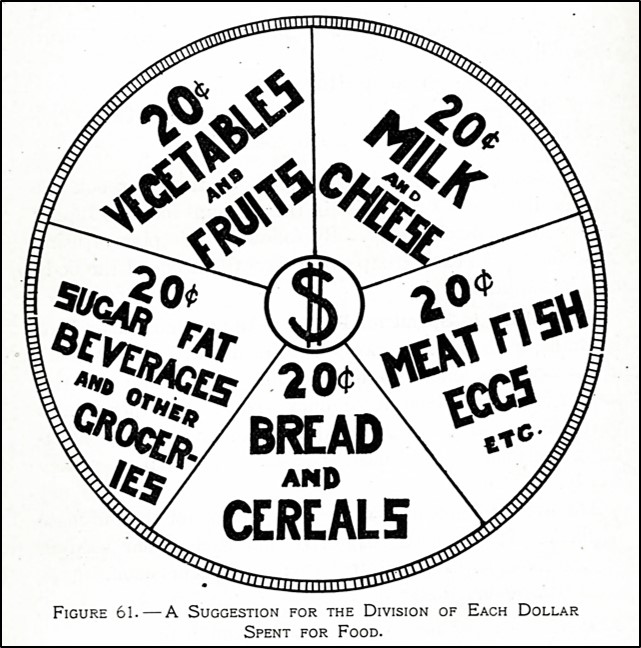
The five food groups may serve as a basis for the purchase of foods. It has been suggested that each dollar used in buying foods be divided into 5 parts of 20 cents each.
Out of every dollar spent use:
20 cents, more or less, for vegetables and fruits
20 cents, or more, for milk and cheese
20 cents, or less, for meat, fish, eggs, etc.
20 cents, or more, for bread and cereals
20 cents, or less, for sugar, fat, tea, coffee, chocolate, flavoring
School and Home Cooking (Carlotta C. Greer, 1920)