How to Live 100 Years

16-year-old Helena Muffly wrote exactly 100 years ago today: 

Wednesday, June 28, 1911: Nothing much to write about unless it would be that I was an exceedingly industrious girl today.

Her middle-aged granddaughter’s comments 100 years later:

Since Grandma didn’t write  much today, I’m going to post some century-old advice by Eugene V. Brewster, the author of What’s What in America, about how to live to be a hundred years old:

How to Live 100 Years

I expect to live one hundred years. It is very simple when you know how.

Here’s how:

1. Keep clean. All disease is caused by uncleanliness—principally internal.

2. Drink nearly a gallon of fluid a day—pure water and milk are best.

3. Eat not more than two meals a day of wholesome food. Overeating kills more people than tuberculosis and pneumonia combined.

4. Let all food remain in the mouth twice as long as most people do. It you don’t it will be worse than wasted.

5. Sleep winter and summer with the head of your bed under an open window. Colds are impossible if Rule 1 is followed.

6. Get busy—not merely exercise, but useful work. Walking will do though.

7. Eat sparingly of meat. Three or four times a week is enough.

8. Be extremely moderate with such poison as tobacco, liquor, tea and coffee.

9. Make better friends of nuts, fruits and grains, and cut down your supply of cooked foods. Fire destroys life and many of the nutritive qualities of food.

10. Breath and speak low. Subdue your emotions and keep an even poise.

If I die before 1969 you will know that I fell down on one of these rules.

Eugene V. Brewster, Pure Foods Magazine (June, 1910)

Note: Mr. Brewster died in 1939, so I guess that he fell down on one of these rules.

Home Remedy: Bee Stings

16-year-old Helena Muffly wrote exactly 100 years ago today: 

Wednesday, June 21, 1911: Got stung twice by a bumble bee this afternoon. I didn’t feel too well.

Bumble Bee (Photo source: Wikepedia)

Her middle-aged granddaughter’s comments 100 years later:

I wonder if Grandma used baking soda to reduce the pain and swelling caused by the sting. When I was a child my parents always treated bee stings by first gently pulling the stinger out if it had broken off and was embedded in the skin. Then they’d mix together a couple tablespoons of baking soda and a little water to make a paste.  The paste was then thickly spread over the sting site.

The baking soda home remedy has always worked well—and when my children were growing up I continued to use it to treat bee stings.

1911 Weight Loss Tip: Fletcherize Your Food

16-year-old Helena Muffly wrote exactly 100 years ago today: 

Friday, June 16, 1911: Please excuse me for I have forgotten what I did today. It’s hardly worthwhile to keep a diary, when you can’t remember anything.

Her middle-aged granddaughter’s comments 100 years later:

I’m still enjoying reading a 1911 book by Dr. Mary Galbraith called Personal Hygiene and Physical Training for Women. Last week I told you how about how obesity was defined in 1911. Today, I’ll give you an old-time suggestion for reducing weight and maintaining good health: thoroughly chew (or masticate) each bite of food before swallowing:

Obese patients grow fat because they overeat, but with a thorough mastication of the food their appetites would be satisfied with far less food than they have been accustomed to eat and the superfluous fat would drop off.

Personal Hygiene and Physical Training for Women (1911)

A hundred years ago, many people followed the beliefs of a food faddist named Horace Fletcher. He argued that for good health, it was very important for everyone to completely chew each bite of food before swallowing.

In 1911 people often talked about Fletcherizing (thoroughly chewing) their food. Depending upon the food, Fletcher argued that it should be chewed 32 times, 45 times, or even more before swallowing.

Also, it wasn’t considered healthy to eat too many soft easy-to-eat foods because that encouraged bolting of food, over-eating, and indigestion.

Are You Obese?: 1911 and 2011

16-year-old Helena Muffly wrote exactly 100 years ago today: 

Friday, June 9, 1911: Must have forgotten what I did today. It won’t come into my head when I am ready to write it down.

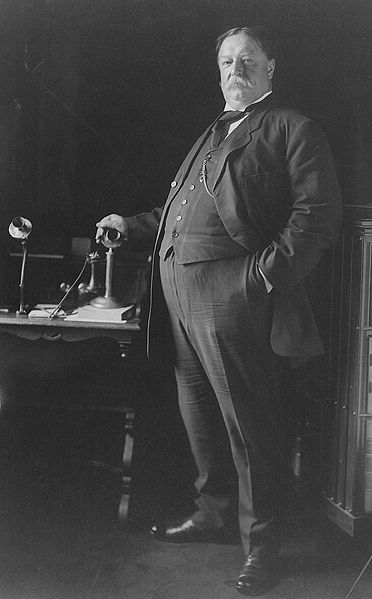
 William Taft (President in 1911): The most obese president in US history

Her middle-aged granddaughter’s comments 100 years later:

Since Grandma didn’t have much have much to say today, I’m going to go off on a tangent. When I look at photos from a hundred years ago some of the people look stout to me—well, frankly they look obese.

We hear that people are more likely to be obese today than in the past—and I wondered what people considered a healthy weight to be a hundred years ago.

I did a little research and found how one author defined obesity 100 years ago. According to Anna M. Galbraith, M.D. in a book published in 1911 called Personal Hygiene and Physical Training for Women:

Women should range in weight from one and eight-tenths to two and two-thirds pounds to each inch in height. In order to determine your own factor in this respect divide your weight in pounds by your height in inches. Any weight above two and one-half pounds to the inch in stature may be considered as excessive, inasmuch as it adds nothing to one’s mental or physical efficiency, and is frequently the forerunner to obesity.

According to the book, in 1911 the average woman was 5 feet 4 inches tall and weighed 133 pounds. According the Center for Disease Control and Prevention website the average woman today is still 5 feet 4 inches tall, but now weighs 165 pounds.

The chart above indicates when a woman was considered normal weight, overweight, and obese in 1911 and 2011. I was amazed to discover that according to the chart I’d be considered normal weight in 1911, but overweight today.

For 1911 I used the quote above to estimate the weights. I assumed that:

Normal weight = 1.8 pounds X height in inches to 2. 5 pounds X height in inches

Overweight = 2.5 pounds X height in inches to 2.67 pounds X height in inches

Obese =  Over 2.67 pounds X height in inches

Today a person’s body mass index (BMI) indicates whether they are a healthy weight. BMI is calculated based upon a person’s height and weight and is calculated using a formula that is more complex than the ones used in 1911.

Why use Botox or Juvederm When You Can Use Paraffin?

16-year-old Helena Muffly wrote exactly 100 years ago today: 

Friday, May 5, 1911:  I believe I have forgotten all that I really did do today. It must have been a case of carelessness or laziness.

Her middle-aged granddaughter’s comments 100 years later:

Since it sounds like Grandma had a fairly quiet day a hundred years ago, I’m going to go off on a tangent —

Sometimes I’m surprised at the similarities between 1911 and 2011. According to the March 15, 1911 issue of Ladies Home Journal in an article titled ” Other Girls are Pretty: Why Can’t I Be? ” women a hundred years ago sought to erase wrinkles by going to beauty doctors for paraffin injections. Who would have thought?

Many women apparently got the paraffin injections, though there were risks. The woman profiled in the article had been to “one of the quack beauty doctors who belongs to that army of charlatans who promise to perform miracles.”

The woman was quoted as saying that the beauty doctor had, “filled my dimple and made it into a pimple and he turned two frown wrinkles into ridges, and the lines on my face are all lumps. They tell me nothing can be done. I don’t see how I’m going to spend the rest of my life with a face like this.”

According to the author, “The lines running from nose to mouth were raised like the ridges of mountain ranges on a model map, and two lumps protruded on her forehead where the paraffin, or whatever the injection was, had coagulated into an indissoluble mass.”

The author continued, “Now girls, a direct word to you—I mean you girls who think you are the only ugly girls in the world, and who grow morbid and sensitive and allow your shoulders to stoop dejectedly—I beg of you, do not look for beauty in the cheap parlors of a quack beauty doctor, or in the advertisements of lotions and beautifiers you see in the papers. . . .”

Have times changed??

Juvederm is a currently used facial filler designed to eliminate wrinkles. According to a  Q and A forum on Juvederm on the RealSelf website:

Question: Why does Juvederm leave bumps after the injections?

Answer: Juvederm Should Not Leave Lumps or Bumps.

Injecting filling agents such as Juvederm or Restylane is very much technique- and physician-dependent. In other words, the doctor must know what he or she is doing, and many do not.

When you inject Juvederm, if it is too deep, it is absorbed by underlying tissues and does not specifically fill the wrinkle. But if you inject too superficially or too close to the surface, you can end up with lumps. Generally, these will go away within a week, but for persistent lumps, you may need to undergo additional injections with an enzyme named hyaluronidase to dissolve the filler material.

Arnold W. Klein, MD – Beverly Hills Dermatologist

Old-Time “Cure” for Toothache

16-year-old Helena Muffly wrote exactly 100 years ago today: 

Tuesday, April 18, 1911:  I believe I have forgotten what I really did today. It was so much and yet so little. Toothache still continues.

Her middle-aged granddaughter’s comments 100 years later:

I want to yell at Grandma’s parents and tell them to get their daughter to a dentist. NOW! For the past week or so, Grandma has complained about her tooth (see April 11 and 15). Maybe people didn’t go to dentists as quickly a hundred years ago—

According to The Compendium of Everyday Wants (1908):

TOOTHACHE—The most complete and speedy cure for toothache is to pour a few drops of compound tincture of benzoin on cotton and press it into the cavity of the tooth.

The Facts of Life

15-year-old Helena Muffly wrote exactly 100 years ago today: 

Saturday, March 18, 1911:  I got up with a funny feeling this morning, not just exactly sleepy, but rather achy like I was to wash up the oil cloths today but I didn’t do it. Momma said something about she wouldn’t let us go to parties if we couldn’t do any work afterwards. Of course it was all rot.

Her middle-aged granddaughter’s comments 100 years later: 

Grandma was feeling achy and referred to oil clothes. I think that she has pre-menstrual cramps. In the old days pieces of sheep hides (oil clothes) were sometimes used to make homemade, reusable sanitary pads.

Mothers talked with their daughter’s about menstruation and the facts of life then as now. An article in the February 15, 1911 issue of Ladies Home  Journal gave mothers suggestions for talking with their daughters about the facts of life:

Many mothers are asking me, “Please tell me what to tell my daughter, who is approaching her teens.”

As in telling the “story of life” the main purpose has been that of awakening reverence for fatherhood and motherhood, so now it is reverence for self that must be taught.

The mother may say:

“Dear little Daughter, I’ve already told you what it is to be a mother, haven’t I? How mothers live for their babies and care for them; and you have begun to realize what a wonderful thing it is to be a mother. I want you to come and sit with my now while I tell you more about it.

——–

First your figure will begin to change. Little by little you will lose the angularities of childhood and your body will begin to take on gentle curves. In time you will outgrow your boisterous ways and become graceful in all your acts, expressing that gentleness of spirit which a true mother must have. Your will begin to care more about your appearance because you will want your children to love and admire you in every way.

And there will be still other changes. The little room must be prepared for its great work; so each month, special nourishment will go to that part of your body. In order that this work may not be interfered with it will be necessary for you to take special care of yourself at this time.

—————-

 It will, of course, be necessary for the mother to give her daughter detailed instruction as to her own physical care, but there should be nothing in this teaching to give the child a shrinking from what is before her. This is not a disease, as some have characterized it. It is one of the natural, physiological functions of the body.”