Old-time Directions for King of France Game

16-year-old Helena Muffly wrote exactly 100 years ago today: 

Tuesday, September 5, 1911: Started to school this morning. Jimmie started also. The teacher we have at present is a substitute, so that will be something like starting in twice when our real teacher comes back.

Recent photo of building the once housed McEwensville School.

Her middle-aged granddaughter’s comments 100 years later:

Both Grandma and her little brother Jimmie attended the school at McEwensville.  Grades 1 through 8 were on the first floor of the building. Jimmie was starting first grade. There was no kindergarten, so this was Jimmie’s very first day ever as a student.

The high school was on the second floor of the building. It was a 3-year high school and Grandma was starting the 2nd year of high school.

Maybe Jimmie’s teacher had the students play some games.  According to a book published in 1911 called Social Plays: Games, Marches, Old Folk Dances and Rhythmic Movements:

Games and plays have an important educational value. The sense perceptions are quickened, the motor powers are strengthened, powers of volition, inhibition, and accuracy are gained through them. By their agency is acquired a balanced power of will, the love of fair play, and a sense of true moral . . .

Here are the directions in the 1911 book about how to play The King of France:

The King of France

The King of France with forty thousand men

Marched up the hill and then marched down again.

The players stand in two rows facing each other, each row having a leader, which is the king leading his army. The players imitate the motion given by the kings, who take turns at singing the verse, at the same time marching forward at the first line of the verse and back to t their places during the second line, imitating the motion that is to be taken by all. The verse is then sung by both groups, advancing toward each other and retreating.

Social Plays: Games, Marches, Old Folk Dances and Rhythmic Movements (1911)

Ruth’s First Day as a Teacher

16-year-old Helena Muffly wrote exactly 100 years ago today: 

Monday, September 4, 1911: Ruth’s school started today, so I had to hustle around and help Ma with the work. Mine doesn’t start until tomorrow. I’m so glad of that. Am getting nervous already.

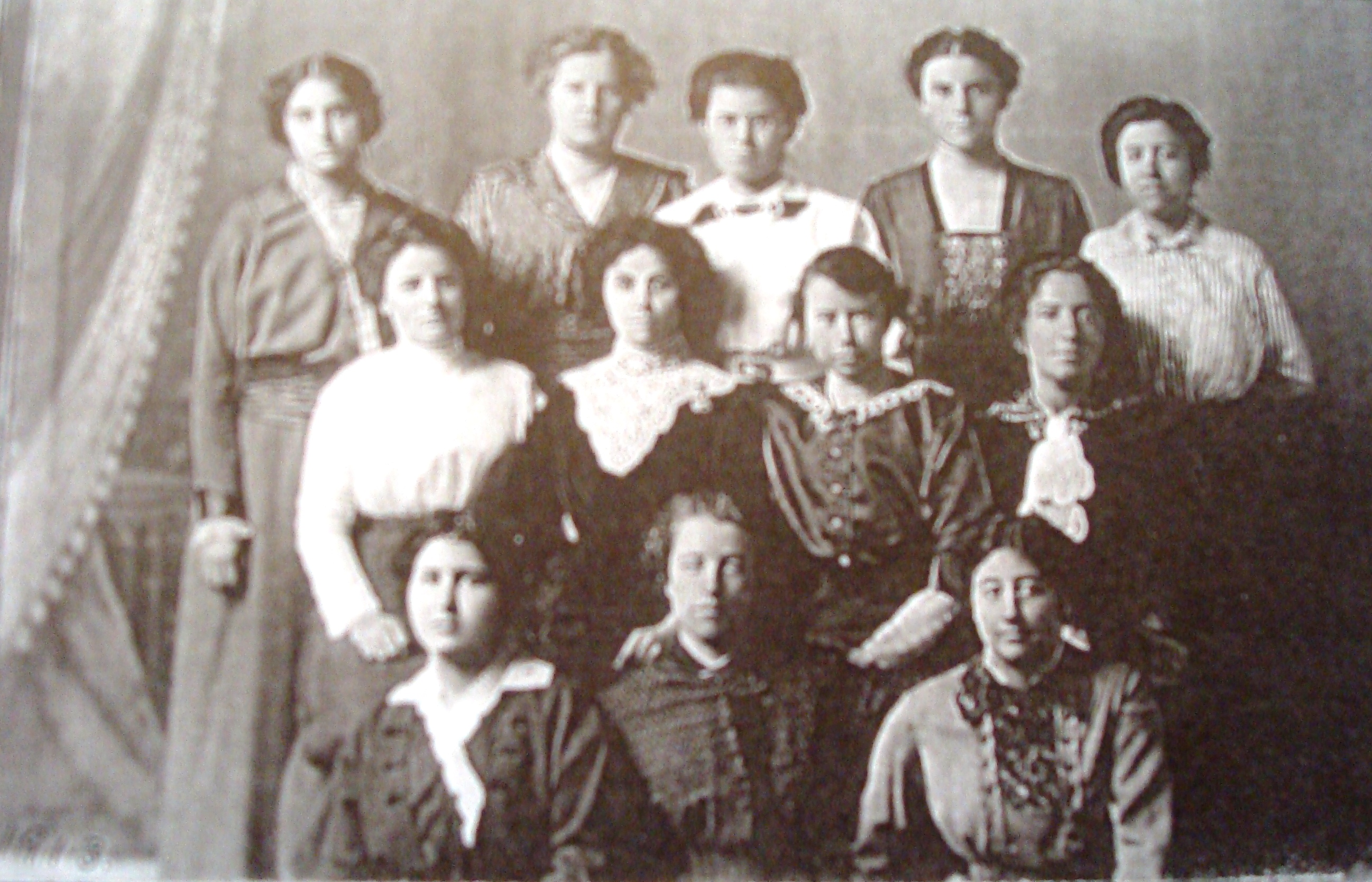
Photo of Ruth at a 1913 teachers' meeting in Sunbury. She is the first person on the left in the second row. She's wearing a white blouse.*

Her middle-aged granddaughter’s comments 100 years later:

Whew, what an exciting (and probably slightly scary) day for Grandma’s sister Ruth. It was her first day as a teacher.

Ruth graduated from high school in April 1911—and was hired as a teacher in late June. Teachers weren’t required to have college degrees in 1911—they just needed to pass a test.

(See the  June 30 post for a discussion of the requirements for teachers in 1911.)

I haven’t been able to figure out which school Ruth taught at during the 1911-12 school year, but it must have been one of the one-room school houses near McEwensville. There would have been students in grades 1-8.

I wonder if Ruth worried about behavior management. Ruth would have been 18-years-old, and some of her students were probably just a few years younger than her.

She would have had no one to back her up if she had problems. Even today behavior management is supposedly the biggest concern of first year teachers.

Differentiating instruction for a wide range of students is challenging. And Ruth would have had little or no training in pedagogy. It’s hard to picture how she had the skills needed to teach—totally without support—in a multi-grade setting.

An aside– I’m not sure why Ruth’s school didn’t observe Labor Day. According to Wikipedia Labor Day has been a federal holiday since 1894.

*The photo is from the History of McEwensville Schools by Thomas Kramm (used with permission). Two of Ruth and Grandma’s friends were also teachers and are in this picture. Rachel Oakes is in the middle of the first row, and Blanche Bryson is on the right in the first row. This photo suggests that teachers did receive a little professional development at occasional meetings held in Sunbury which is the county seat of Northumberland County.

Ruth’s Going to be a Teacher

16-year-old Helena Muffly wrote exactly 100 years ago today: 

Friday, June 30, 1911: Rufus is going to teach school next winter, as she has just been elected to that office. Am glad.

Her middle-aged granddaughter’s comments 100 years later:

I haven’t been able to figure out where Grandma’s sister Ruth taught school during the 1911-12 school year, but it apparently was at a nearby one-room school house.

Ruth had just graduated from high school in May 191. A hundred years ago teachers were only required to have a high school diploma—though there was a movement toward encouraging teachers to complete a program of study at a normal school. At that time teacher preparatory schools were called normal schools, and the program of study was typically 2 years.

Since Ruth did not go to normal school she must have passed a examination that qualified here to become a teacher. She would have been a “provisional” teacher and paid at the lowest level.

In 1911 schools were primarily controlled by school boards and other local governments. There was a lot of tension over how much control the state should have over schools—though the state was beginning to regulate teacher licensure.

The state of Pennsylvania adopted teacher certification requirements on May 18, 1911:

Provisional—passed exam in spelling, reading physiology and hygiene, English grammar, arithmetic, elementary algebra, history of the US and PA, civil government including state and local government, school management, and methods of teaching.  One year duration—could be renewed 4 times.

Professional—Two years successful teaching. Passed two additional exam from the list of: vocal music, drawing, English literature, plane geometry, general history, physical geography, elementary botany, elementary zoology, or elementary physics. Must have “carefully and intelligently read” two books on pedagogy on approved list from state Superintendent of Public Instruction.

State normal school certificate: Issued to graduation of state normal schools. After 2 years teaching teacher receives permanent state certificate.

Permanent state certificate: Hold professional certificate, 2 years experience, passed all exams, read 4 books on pedagogy,  Passed exam in all subject areas listed for provisional and professional certificates—Exams held once a year by Examining Board appointed by state superintendent.

Jack Williams in A Historical Study of Education in Milton Pennsylvania

Last Day of School, Graduation Ceremony, and a Wedding

16-year-old Helena Muffly wrote exactly 100 years ago today:

Thursday, April 6, 1911: A warm spring day today it was. We had our second annual picnic out on the school ground. Oh my what fun we had. This afternoon I helped to carry flowers to the church. Alas the afternoon soon passed. When I got home, I had to hurry and get my work done in time to go to the commencement. I had to take my Mamma along, so that impeded my progress somewhat. After commencement came the wedding of Edith and Harry. It was the first one I was ever present at. Well, I guess about all I anticipated was realized. I can hardly believe I can only see him so seldom now even if the distance is short when I used to see him so often.

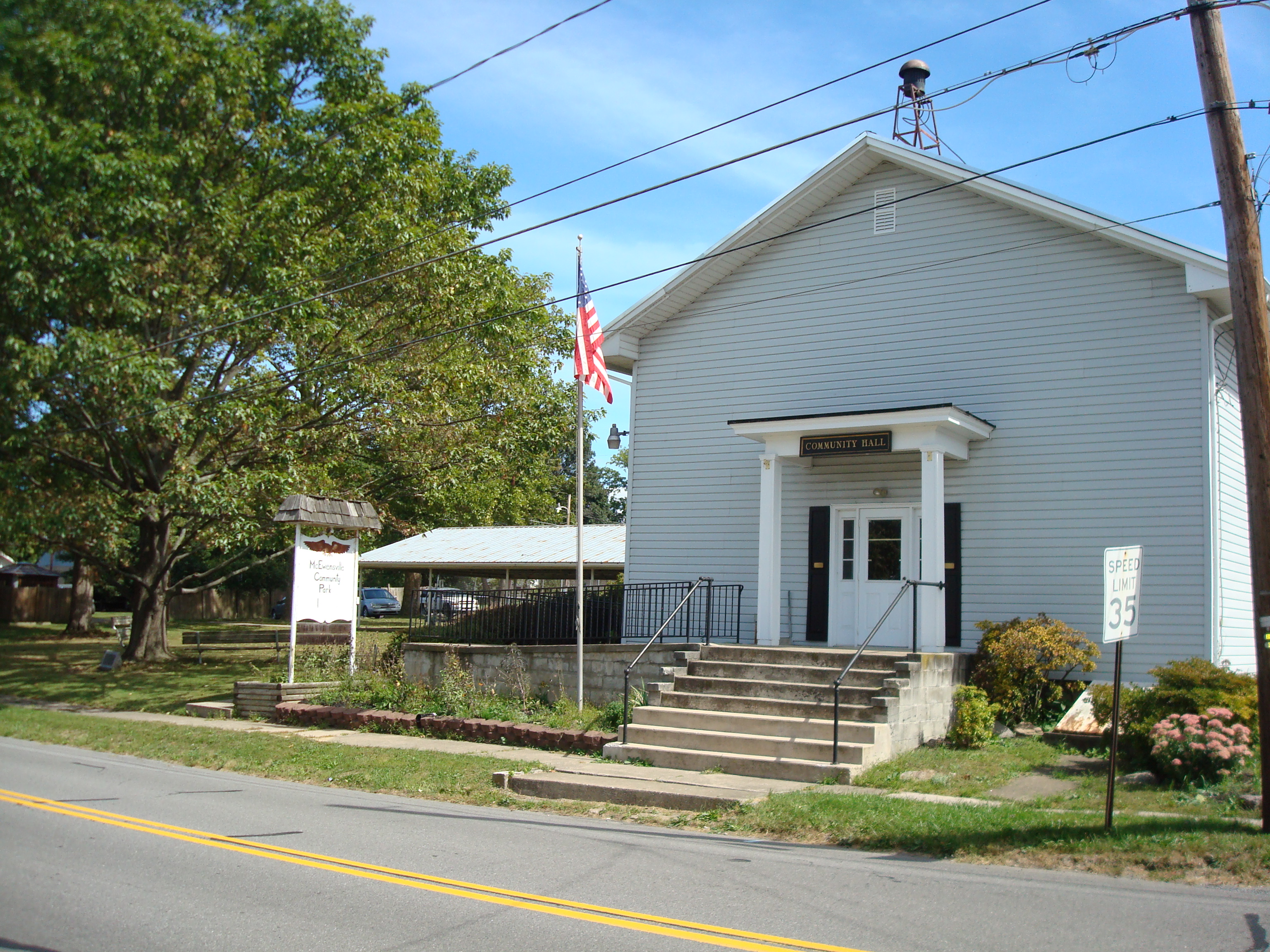
2010 photo of McEwensville Community Hall. The community hall has a stage that  probably was the site of the graduation.

Her middle-aged granddaughter’s comments 100 years later:

Whew, what a day! The last day of school, the annual school picnic (I wonder if people liked Grandma’s fudge.), Grandma’s sister’s high school graduation ceremony. . . .and A WEDDING (with farm chores somehow squeezed in between the picnic and the graduation ceremony).

It sounds like Grandma’s friend Edith graduated from high school and then a few minutes later got married. I’m amazed how compressed these two activities were. Was there a break, with people perhaps moving from the Community Hall to a church?

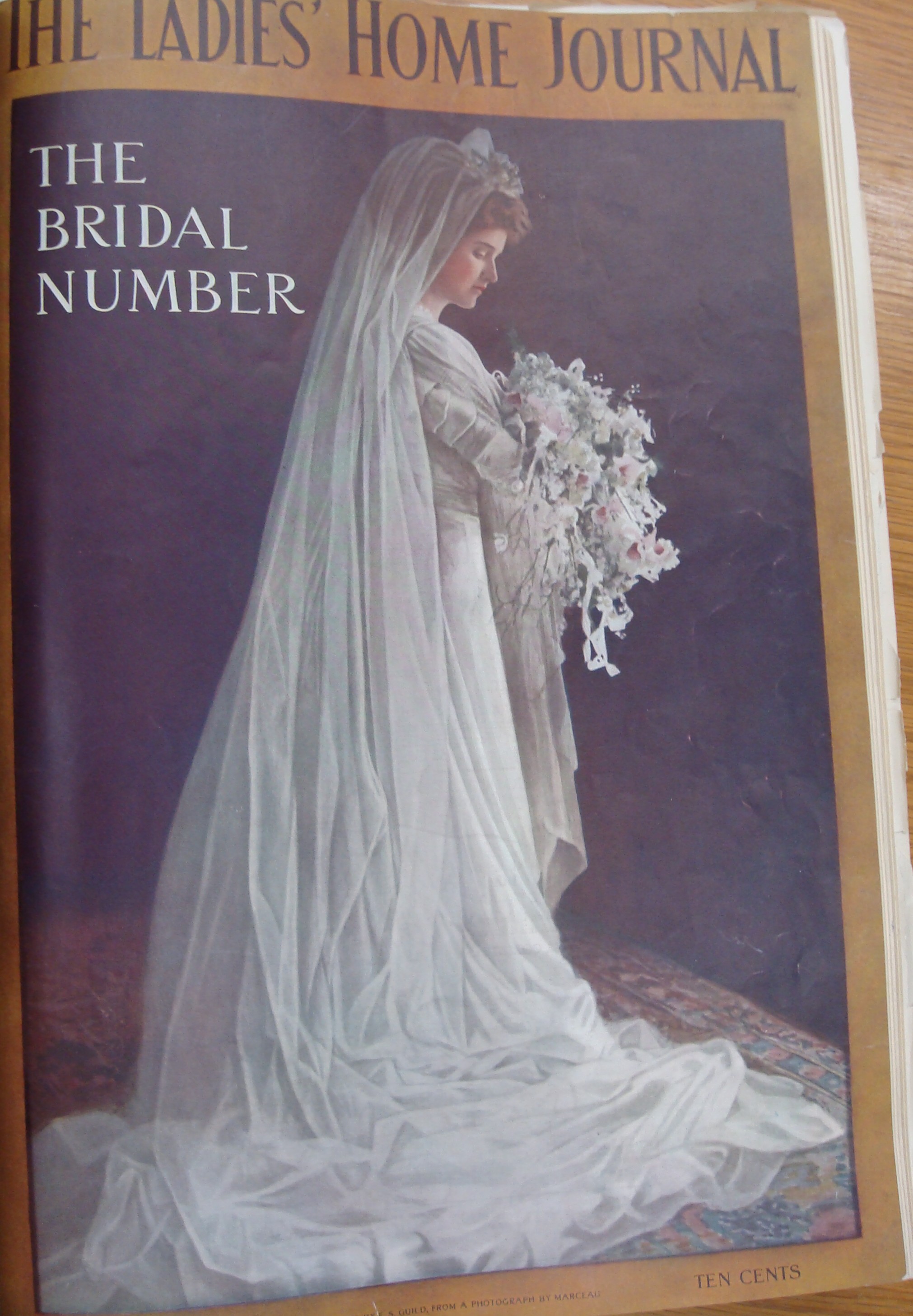
Cover of Ladies Home Journal, April 15, 1911

Did Edith change into a wedding gown following the graduation ceremony—or did she just wear the same clothes that she’d wore at graduation?

And, what did Grandma mean when she wrote, “I can hardly believe I can only see him so seldom now even if the distance is short when I used to see him so often”? It sounds like she had a crush on someone at school. Who? One of the graduating seniors?  . . .a classmate?

There’s a lot of information in today’s diary entry.

Another. . . hmm . . . I wonder why . .

Grandma’s older sister Besse was married prior to the time that Grandma kept this diary.  But Grandma says that Edith’s wedding was the first wedding  she’d ever attended. I wonder why Grandma hadn’t attend her sister’s wedding. Might Besse have eloped?

Final Exams Are Stressful!

16-year-old Helena Muffly wrote exactly 100 years ago today:

Monday, April 3, 1911: One day is passed of the dreaded three, and they will soon be over, for we are having our final exams now. I’m so anxious about what I will make, fraid it won’t be any too high, and sincerely hope it will not be the opposite.

Her middle-aged granddaughter’s comments 100 years later:

A few minutes ago my college-aged daughter called and asked what I was doing. I said that I getting ready to write about Grandma’s final exams.

My daughter replied, “Final exams are stressful!”

Some things never change.

Young People and Marriage

16-year-old Helena Muffly wrote exactly 100 years ago today: 

Thursday, March 23, 1911:  Ruth and I received an invitation to the wedding. But oh dear me it is two wks. off. It took a streak of being cold today. This is such uncertain weather. Hope I will be warm on the sixth for then I intend to have some fun.

Her middle-aged granddaughter’s comments 100 years later:

Grandma seems excited about getting an invitation to the wedding of a senior in her high school. I wondered what people thought made a good marriage a hundred years ago. I found an article in a 1911 issue of Ladies Home Journal about marriage.  Just as we do now, older people worried about young people making good decisions about relationships. Some of the concepts, suggestions, and concerns seem incredibly modern—others extremely quaint.

 Our Young People and Marriage

Whether it is because of the increase in divorce or whatever it is, we are hearing a great deal these days about new forms of the marriage relation or changes in our present form of marriage. With all these suggested changes there is always sounded one note: that monogamy as we call the present sex relation of marriage of one man to one woman, and vice versa, was forced upon the world by the authority of a church, or by stern moralists who were regardless of the finer aesthetic interests of human nature. And then generally follows some argument, carefully put into the form of a question, as to whether the love feeling, the love relation, could not be better realized if the present yoke, the present form of marriage, which has been put upon men and women, were shaken off in part if not in whole. 

To those of us who have lived a few years all these alternative arrangements between men and women that are suggested are read with interest, perhaps, and then dismissed. We know that all these brand-new and novel suggestions have been tried and found wanting. But to the minds of the younger people they are new, and to their minds also they bring thoughts that are dangerous unless healthfully met. The ideas, generally very seductively put, of what one writer will call “trial marriage”, another will call “experimental marriage,” a third will call “a ten-year arrangement,” and a fourth will base upon that meaningless, but more alluring word “affinity”—all these are tremendously fascinating to a young developing mind. It is all very well for us elders to “pooh-pooh” these ideas and dismiss them as unworthy of thought, but the young do no “pooh-pooh” them, and they are not dismissing them. We ought to wake up to the fact that certain questionings about the present form of the marriage relation have not only fallen into the minds of our young people, but that they are also resting here, and in some instances actually taking root. This is particularly true of young girls. What we need to do, whenever one of these wonderfully interesting, and novel proposals (for such they are to the young) finds expression, is to take down our histories of the world and read a bit to our young people, and show them that these seemingly new ideas are not new: that they have all been tried: and that the poor, lumbering, halting human race has, after all, found—not because in the nature of God said it, not because moralists said it, but because in the nature of things it is so—that the faithful and steadfast relation of one man and one woman is the best and only relation that has stood the test of time and of practically all peoples. And to our young girls should it be particularly pointed out that it is the only sound relation on the interest of women, because if other relations were tried women would inevitably be the first and the greatest sufferers.

Ladies Home Journal (August 1911) 

—————————–

An aside to those of you who managed to get through that dense article and are still reading—

Every time I read Ladies Home Journal articles from 1911 I’m amazed at how hard they are to read—long paragraphs, complex sentences, and difficult words. I put the above 1911 text into the “SMOG” readability tool—and found that the grade level was 15.3 years. Text from recent issues of the Ladies Home Journal is at about an 8th grade level. The Journal then as now, was a mass circulation women’s magazine. It’s absolutely amazing how well most women could read a century ago. The schools must have been doing something right!

1911 Algebra Problems: The Lusitania and Molasses

15-year-old Helena Muffly wrote exactly 100 years ago today: 

Thursday, March 2, 1911:  Dear me, what shall I write? Mrs. Hester was out this afternoon. I intended to work thirty-one algebra problems this evening or rather tonight but instead of that I only worked one. Perhaps I may get the remaining thirty tomorrow, but it is only perhaps.

Her middle-aged granddaughter’s comments 100 years later: 

Sometimes I have a vague idea about what I might say about a diary entry—and then I discover something interesting that sends my post in a totally different direction. Today is one of those days—

I found a high school algebra textbook published in 1911 at the library and idly flipped through the pages while pondering—Should I include some example problems from the chapter on Simple Equations  . . . or from the chapter on Quadratic Equations? And then I saw the problem on the Lusitania:

4. One ton of coal will make 8.7 tons of steam. If the Lusitania requires 1200 tons of coal a day for this purpose, how many tons of steam are required for an hour?

First Year Algebra (1911, page 157) by William J. Milne

Lusitania

Wait—Isn’t the Lusitania famous because it was sunk  during World War I by the Germans  in 1915? Why was the Lusitania in a textbook published in 1911?

And, as I sought answers, this post  headed in a totally different direction.

The Lusitania was a British ship that made its first trans-Atlantic trip in 1907—and it periodically held the world record as the fastest ship to make the crossing. For example, in October 1907, it held the record for an eastbound trip with a time of 4 days, 19 hours, and 53 minutes. The average speed was 24 knots/hr. (27.6 miles/hr.).

(Cruise ships today don’t cross the Atlantic as quickly as they did a hundred years ago. It now takes at least 6-7 days to make the crossing. I guess that if  someone wants to cross quickly they just fly.)

In the early 1900s there were several very fast ships that held the record at one time or another. They informally competed with one each other and the newspapers regularly reported on when the ships entered the New York harbor –or  the harbors in England on eastward trips– since there was the potential with every trans-Atlantic voyage that the world record would be broken.

A hundred years ago the general public across the US knew about the Lusitania and were following its story even before it was sunk by a German torpedo. (And, the Lusitania was apparently considered a good topic for an algebra problem since it was a timely, high-interest topic that might motivate students ).

Algebra problems provide lots of hints about what was common knowledge a hundred years ago. For example, would you ever find a problem about molasses pumps and tubing in a text today? Well, it provided the context for the word problem that followed the Lusitania problem in the 1911 textbook:

5. A grocer paid $8.50 for a molasses pump and 5 feet of tubing. He paid 12 times as much for the pump as for each foot of tubing. How much did the pump cost? the tubing?

First Year Algebra (1911, page 157) by William J. Milne