
How Do You Spell ‘Man’?

15-year-old Helena wrote a hundred years ago today:

Friday, January 20, 1911: Brought home some maps I drew at school last year. They were very excellent specimen’s of drawing, so I thought it would be worthwhile to save them and exhibit them to my friends if I ever have an reason to. Perhaps I shall not. Missed the word (man) in spelling. Now looked surprised, anyone else might have missed it too under the same circumstances.

Her middle-aged grand-daughter’s comments 100 years later:

Recent Photo of McEwensville High School

It was just one of those days with a high point and a low spot. Today’s five sentence diary entry gives lots of hints about Grandma:

  • She’s proud of her drawing ability (or at least her map-making skills).
  • She wants to share her successes with friends, but seems to hold back and feel uncertain about how they’ll react. Grandma so wants affirmation that the maps are good but fears that maybe her friends wouldn’t think the maps were as cool as she thinks they are—and then she’d feel bad.
  •  And, I guess she wasn’t much of a speller. (That trait seems to have carried down to my generation–though I can definitely spell man.)  Was there a spelling bee?—Maybe it was supposed to be a fun way to end the week on Friday afternoon.  Did Grandma really mean that she misspelled the word “man”? What were the circumstances? Was she horsing around with friends instead of paying attention? . . . Daydreaming? Did she feel humiliated when the class laughed? . . . or did she enjoy the attention? 
No Multiple Choice Tests

15-year-old Helena Muffly wrote exactly 100 years ago today: 

Thursday,  January 12, 1911: Finished taking examinations today for this month. I don’t believe I made very good marks. It seems to me as if I am going backwards every month instead of going forward.

Her middle-aged granddaughter’s comments 100 years later: 

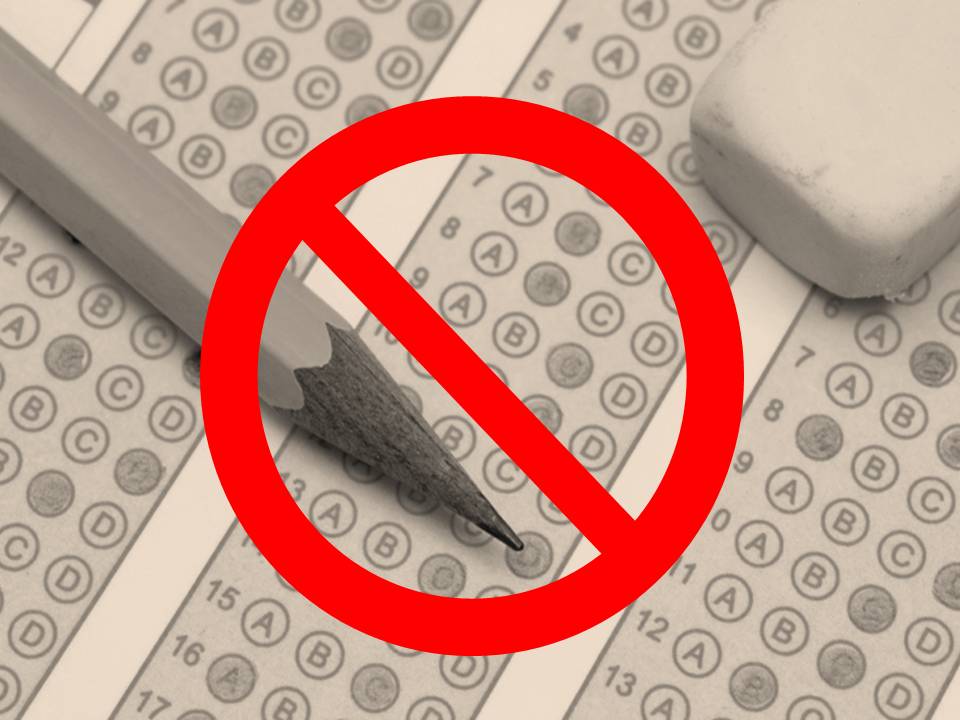
It’s hard to envision schools without the ubiquitous multiple choice and true/false tests, but the examinations that Grandma took WERE NOT multiple choice tests. Multiple choice items were invented in 1915. And the exams probably did not include true/false, matching or fill in the blank items. All of these question types were popularized during the 1920s by educational psychologists who promoted the concept of scientific testing.

Grandma’s exams probably included arithmetic tests that contained math problems which students copied off the blackboard. Portions of the exam were probably oral since mental math was valued prior to the development of calculators.

The examinations that Grandma took probably included recitations and oral responses. For example, a student might be required to recite a poem that he or she memorized. Or the teacher may ask a student questions about material that has been covered in class.

Discussion tests gave students the opportunity for free, organized, and individualized expression on the topics involved.

Martin Stormzand

In other subjects there probably were essay or ‘discussion’ tests. Sometimes students were directed to merely outline their response rather than write a polished essay.

McEwensville High School

Friday, January 6, 1911:  Missing entry: Diary resumes on January 12

Her middle-aged granddaughter’s comments 100 years later: 

Since there is no diary entry again today, I’ll tell you a little  about the high school that Grandma attended.

Grandma attended McEwensville High School.  The school building is next to the cemetery at the edge of McEwensville. She generally walked the mile and a half or so from her home to school.

Recent photo of the building that once housed McEwensville High School.

 The high school contained only one classroom and it was located on the second floor of the school building—the elementary class was on the first floor. It was a three-year classical high school where students learned Latin, poetry, literature, history, and arithmetic.

In 1911 Rachel Oakes—a friend of Grandma and her sister Ruth—was the elementary teacher.

After they graduated from McEwensville High School some students continued their education by taking a fourth year of high school at Milton or Watsontown. For example, my grandfather went to Milton High School after he graduated from McEwensville.

Milton had a more comprehensive curriculum than McEwensville—and included business courses and other classes that would more directly prepare students for a career.

The last high school class to graduate from McEwensville High School was in 1921. The high school closed because it had few students since most students in the area wanted to attend a comprehensive high school for all four years.  

Twenty or so years after my grandmother wrote her diary, my father attended the school. At that time it was an elementary school. One teacher taught grades 1-4 in the room on the first floor. Another teacher taught grades 4-8 in a classroom on the second floor. 

After the school completely closed in the late 1950s, the building was converted into a fire station. But the fire station is now gone, and in recent years the building has sat vacant and abandoned.

My friends have expressed surprise that my grandmother attended high school. In the early 1900s about half of the children in the United States ended their school careers with an 8th grade education or less.   

However, according to Benjamin Andrews in a 1911 book he wrote about girls’ education, there were more female high school graduates in the early 1900s than male because men could easily get jobs without a degree. A key role of high schools at that time was to prepare students to become teachers.

I don’t know why Grandma’s parents decided to send her to high school. I don’t think that she ever became a teacher.