16-year-old Helena Muffly wrote exactly 100 years ago today:
Friday, May 12, 1911: Just about the same things which I did yesterday. Ruth went up to Turbotville this evening to attend the commencement. I’ll surely have some peace tonight because she won’t be here to disturb it.
Recent photo of Turbotville Community Hall. The commencement probably was held here.
Her middle-aged granddaughter’s comments 100 years later:
I’m surprised that the school year apparently was more than a month longer in the neighboring town of Turbotville than it was in McEwensville.
McEwensville High School had held it’s commencement on April 6. That day was also the last school day. In general the school year was very short a hundred years ago since children were needed at home during the spring planting season—but it sure seems like the school year was exceptionally short in McEwensville. I wonder what the community thought about this—Did they worry that their children might be learning less than students in neighboring communities? Or were they glad school ended early so their kids could help with the farm chores?
16-year-old Helena Muffly wrote exactly 100 years ago today:
Sunday, May 7, 1911: Went to Sunday school this afternoon. Saw M.C.R. I went over to Stout’s this evening. Carrie wanted me to try their new telephone but I wouldn’t do it. Besse and Curt were out this evening.
Her middle-aged granddaughter’s comments 100 years later:
Today feels like a milestone was reached in the diary. So many days Grandma’s life moves forward in rather routine, predictable ways—but a hundred years ago today Grandma apparently had her first opportunity to use a telephone—though she declined because the new technology evidently intimidated her.
I’m surprised that Grandma had never previously used a phone. According to George Wesner in his 1976 History of ‘McEwensville:
“Around the turn of the century there were two telephones in the town. The Bell was at Watson’s Store and at the home of Armstrong’s. Later phones were installed at the Gearhart Foundry, A. & C. Mauser’s carriage works and the J.G. Smith’s residence. A number of years later, the West Branch Bell Telephone Company began operations and built lines throughout the area.”
I love how phones came into the McEwensville area so slowly that Mr. Wesner could name exactly who had the first ones when he wrote his history almost two-thirds of a century later. It must have been very prestigious to own a phone in that era.
Initials
Throughout the diary Grandma often used initials rather than names to identify guys she liked, so I assume that M.C.R. was someone who Grandma thought was cute. She apparently was concerned that her mother or sister would read her diary, so often tried to mask the names—though it seems to me that if family members were reading the diary that they would have been able to decipher the initials.
16-year-old Helena Muffly wrote exactly 100 years ago today:
Saturday, May 6, 1911: Ruth and I went to Milton this afternoon. I wanted to get my teeth filled but as the dentist was absent I was forced to wait until another day. While there we went into the theatre on Broadway.
Her middle-aged granddaughter’s comments 100 years later:
I get caught up in the story of Grandma’s life—and have worried that she has had a toothache since April 11 (and again mentions the pain on April 15 and 18), but has not treated it.
I feel relieved that Grandma finally tried to visit the dentist—and disappointed that he wasn’t there. (I guess this was the era before appointments.) Hopefully she’ll goon get the tooth fixed.
The Movies
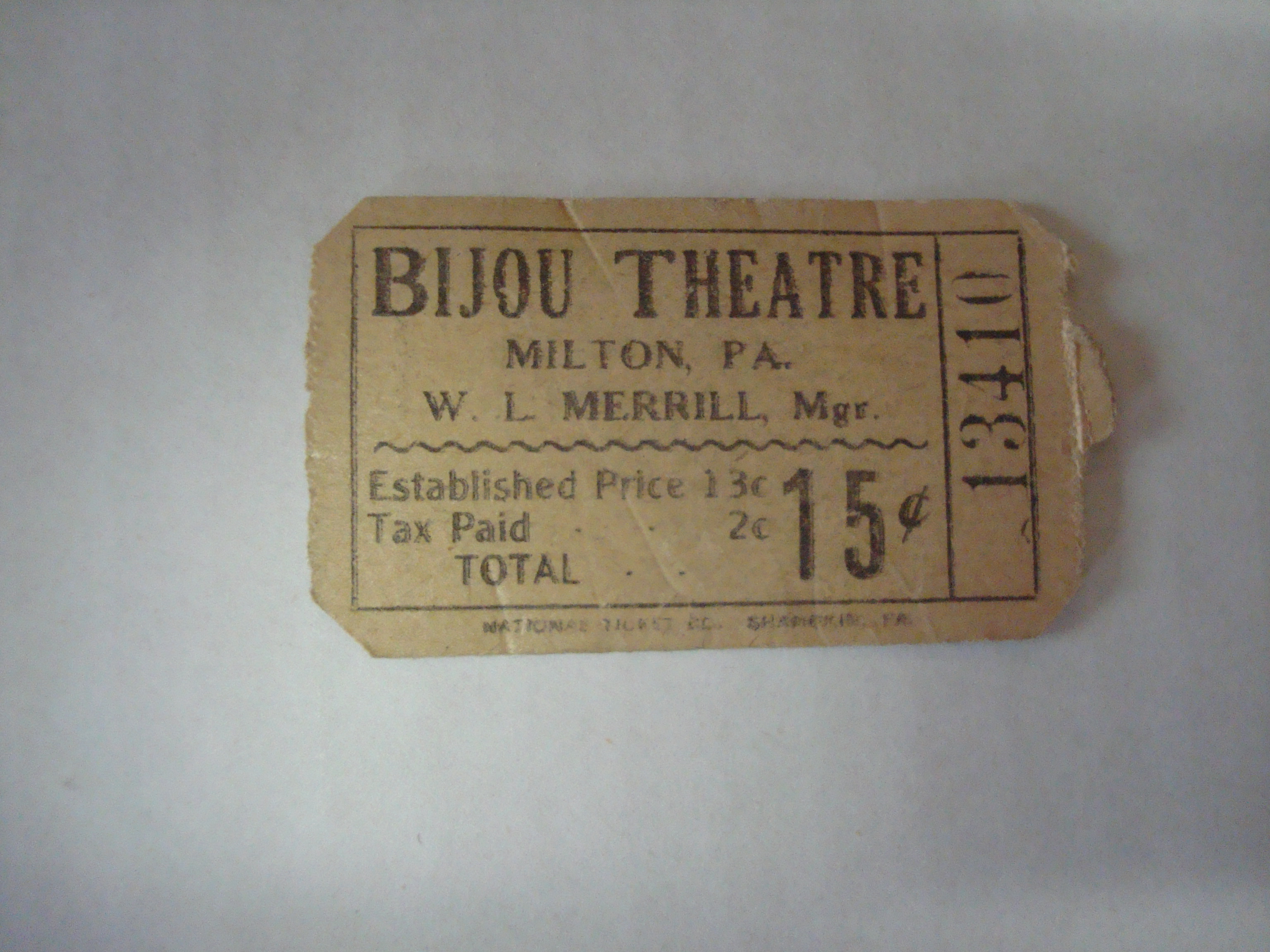
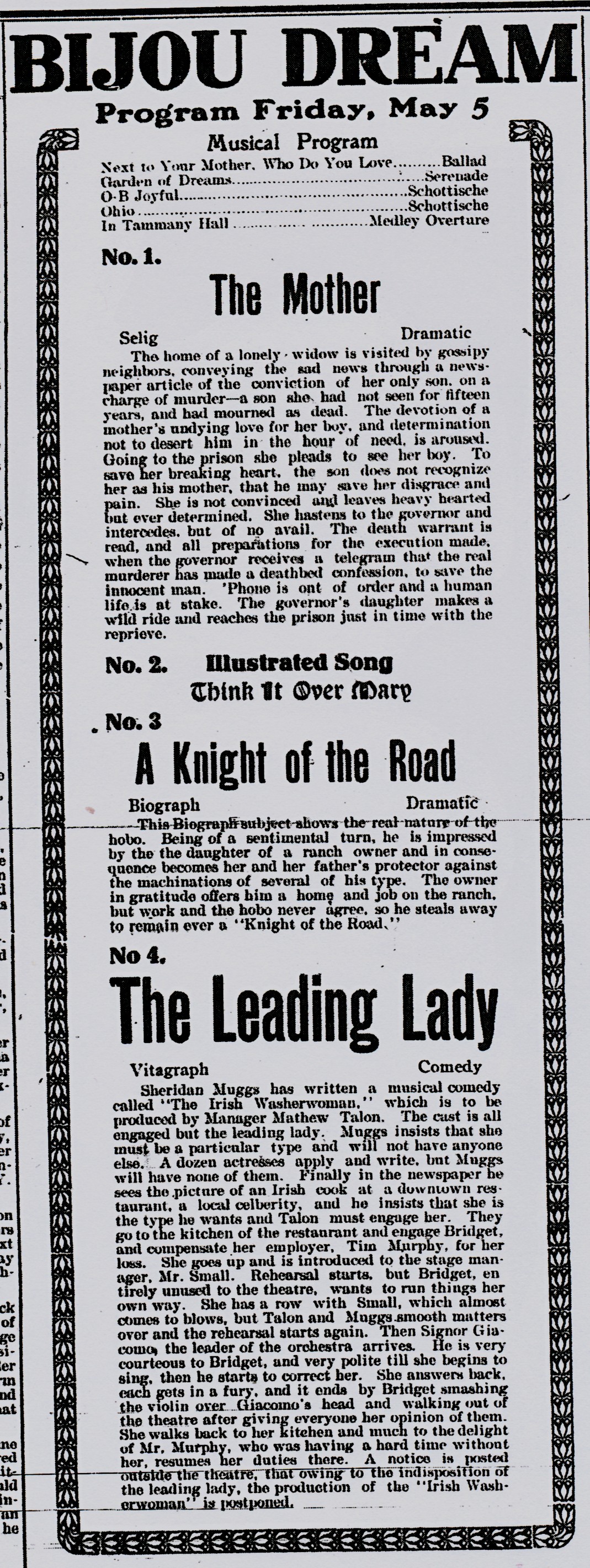
In 1911 Milton had a movie theater on Broadway called the Bijou Dream that showed silent movies.
Advertisement in Milton Evening Standard, May 5, 1911
It looks like four short films were being shown in May 1911. In case it’s difficult to read the description of the movies in the photo above, I’ll reprint the description for the first movie.
No. 1. The Mother—
The home of a lonely widow is visited by gossipy neighbors, conveying the sad news of the conviction of her only son on a charge of murder—a son she had not seen for fifteen years, and had mourned as dead. The devotion of a mother’s undying love for her boy, and determination not to desert him in the hour of need, is aroused. Going to the prison she pleads to see her boy. To save her breaking heart, the son does not recognize her as his mother, that he may save her disgrace and pain. She is not convinced and leaves heavy hearted, but ever determined. She hastens to the governor and intercedes, but of no avail. The death warrant is read, and all preparation for the execution made, when the governor receives a telegram that the real murderer has made a deathbed confession to save the innocent man. Phone is out of order and a human life is at stake. The governor’s daughter makes a wild ride and reaches the prison just in time with the reprieve.
Whew, what melodrama in the old silent films. I can almost hear dramatic music (played by a live pianist) reaching a crescendo as the governor’s daughter makes the wild ride trying to reach the prison before the execution.
16-year-old Helena Muffly wrote exactly 100 years ago today:
Tuesday, May 2, 1911: Ruth and I went to Milton this morning. Her highness got a dress and a pair of pumps. Don’t know when I will get mine, perhaps next winter.
Postcard showing Marsh Shoe Store in Milton a hundred years ago (postally used December, 1910).Advertisement in Milton Evening Standard, May 4, 1911
Her middle-aged granddaughter’s comments 100 years later:
We’re five months into the diary–and even though Milton is probably only about 5 miles from the Muffly farm–this is the first time that it is mentioned in the diary. The only towns previously mentioned were McEwensville, Watsontown, and Turbotville. Whew, by today’s standards, Grandma never got very far from her home.
A trip to Milton probably felt like a trip to the big city.
A hundred years ago Milton had a humming downtown with lots of wonderful stores. Back then there were trolley tracks that ran between Watsontown and Milton, so Grandma and her sister Ruth probably walked to Watsontown and then took the trolley to Milton.
Milton Postcard, circa 1911 (Source: Milton Historical Society)
The trolley system was dismantled a few years after the diary was written:
With the automobile came on the scene in the early years of the twentieth century, the trolley business began to slack. After a sharp decline in business, the L.M. & W. trolley company changed to gasoline buses in 1922. Even the buses couldn’t complete with the automobile and service ended in the early 1930s.
George Venios in Chronicles and Legends of Milton (2002)
An aside: I had a wonderful visit with George Venios, Deb Owens, and Joan Nunn at the Milton Historical Society yesterday. I enjoyed learning more about Milton, and they shared many wonderful artifacts with me including the early postcard in today’s posting. Additional Milton pictures from the historical society will illustrate future posts. Thank you!
I’d also like to thank the Milton Public Library and the Montgomery House Library for their awesome assistance with finding and navigating my way through old issues of the Milton Evening Standard and the Watsontown Record and Star. I’ll be periodically sharing materials from those newspapers.
16-year-old Helena Muffly wrote exactly 100 years ago today:
Tuesday, April 4, 1911:Not very much for today. It still continues to be so chilly and so dreary. To increase these conditions it had to rain this afternoon. I have to write about the weather, when I have nothing else to write. I don’t believe Thursday is going to be the beautiful day I want it to be!
Her middle-aged granddaughter’s comments 100 years later:
Grandma was hoping for nice weather on Thursday because it would be the last day of school. The commencement ceremony for her sister and other seniors at McEwensville High School will also take place that day.
——-
McEwensville in the Early 1900s. Source: Watsontown, McEwensville, and Delaware Township: A Real Photo Postcard History. (Used with Permission)
Today I’d like to tell you about the best source of information about McEwensville and the surrounding area that I’ve found:
Watsontown, McEwensville, and Delaware Township: A Real Photo Postcard History by Robert Swope Jr. (2006; Publisher: Heritage Trails, PO Box 184, New Hope VA 24469; phone: 540-363-4537).
They say that a picture is worth a thousand words—and this book is a wonderful example of the power of photos. I keep my copy on a shelf next to the reclining chair in my den. Often I flop into the chair after a long day and find myself reaching for this book—even though I’ve previously looked at every page many times before. The photos pull me back to the simpler days a hundred years ago and I feel like I can almost sense what it was like in McEwensville when Grandma was writing this diary.
This book contains lots of post cards from the early 20th century and is absolutely the best resource that I’ve found on the McEwenville of Grandma’s day. There are descriptive captions for all of the post cards in the book, and it also contains an interesting and informative history of McEwensville.
In the early 1900s real picture post cards were very popular. Back then people were very interested in sharing the sites and activities of their towns with others.
This blog has given me the opportunity to meet via technology many wonderful people. One such person is Robert Swope Jr., the author of this book. I contacted Bob and he very generously allowed me to reproduce a few photos from the book. Most of them are on the Setting page. (I updated the page last night—so if you haven’t looked at it recently be sure to check it out.)
I would encourage anyone who is interested in what McEwensville was like in the early part of the 20th century to read this book. I purchased my copy at the Packwood Museum Gift Shop in Lewisburg. It is also available at other stores in central Pennsylvania.
The book can also be purchased by calling the phone number listed above or from Bob’s Ebay store. Just go to Ebay and search using the word “McEwensville”. The listing for the book will pop up.
16-year-old Helena Muffly wrote exactly 100 years ago today:
Wednesday, March 29, 1911: Nothing of importance, not one thing. Ruth gave me a piece of her mind tonight. She wants me to keep my mouth shut, not that I say too much, for I am rather bashful, but I’m to breathe though my mouth instead of through my–Darn it, I don’t mean that, I mean vice versa.
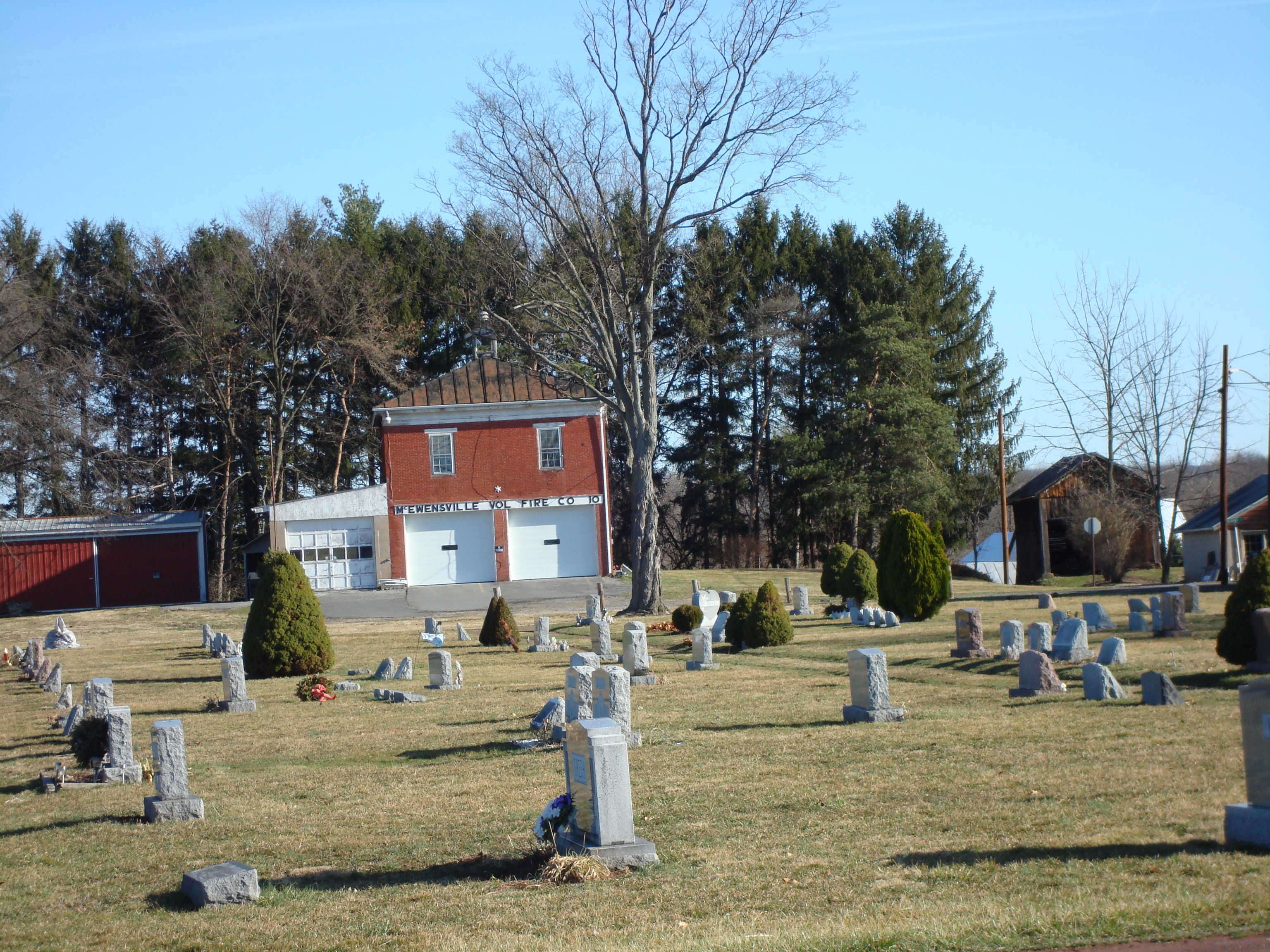
McEwensville Cemetery with old McEwensville High School building in background
Her middle-aged granddaughter’s comments 100 years later:
My son and I visited McEwensville over the week-end. We stopped by the abandoned building that once housed McEwensville High School. Now—just as it did a hundred years ago—the school sits next to a cemetery that is filled with the stories of the past. Each marker has its own story to tell . . .
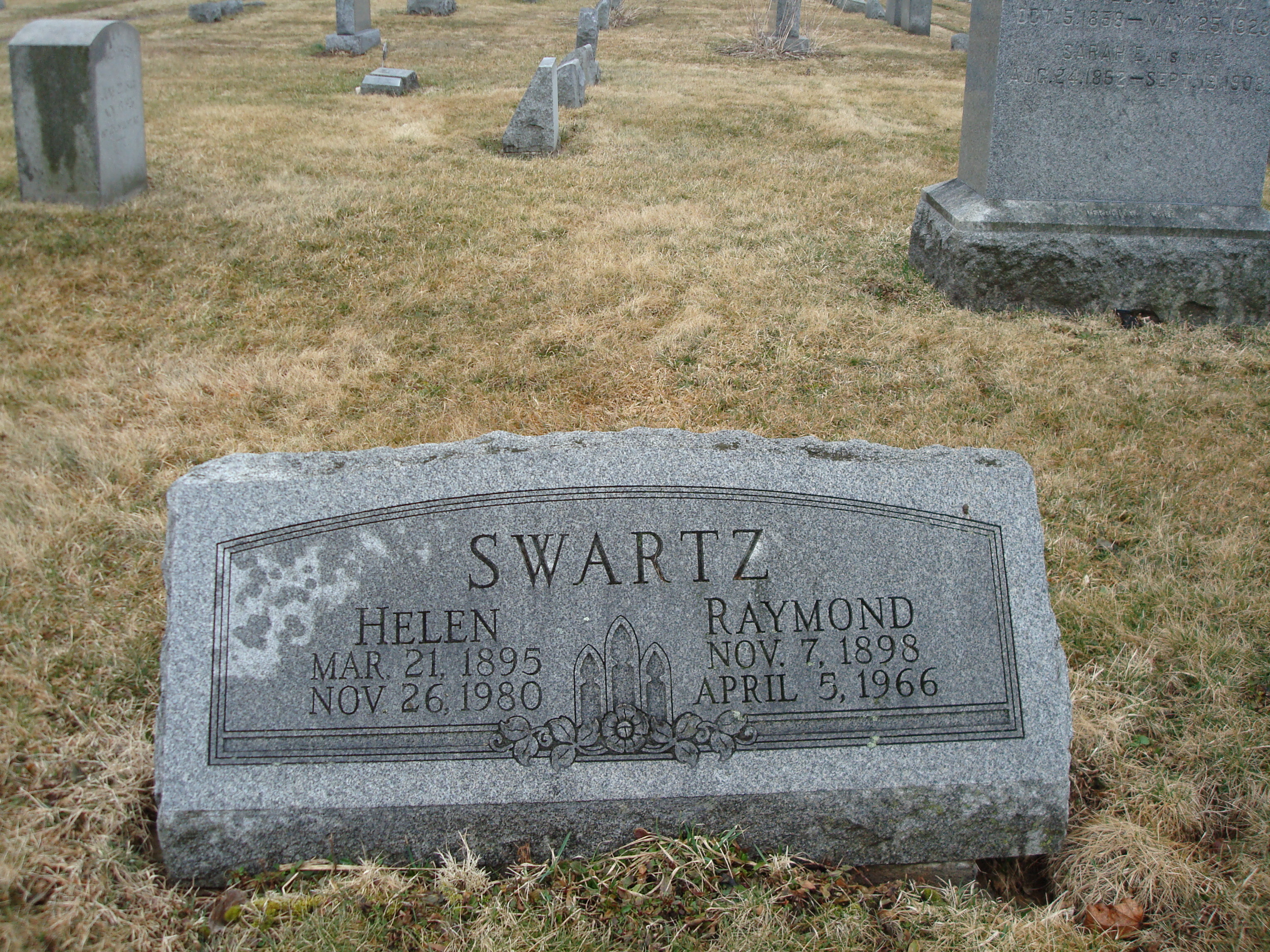
Tombstone of Helen(a) Muffly Swartz and Raymond Swartz
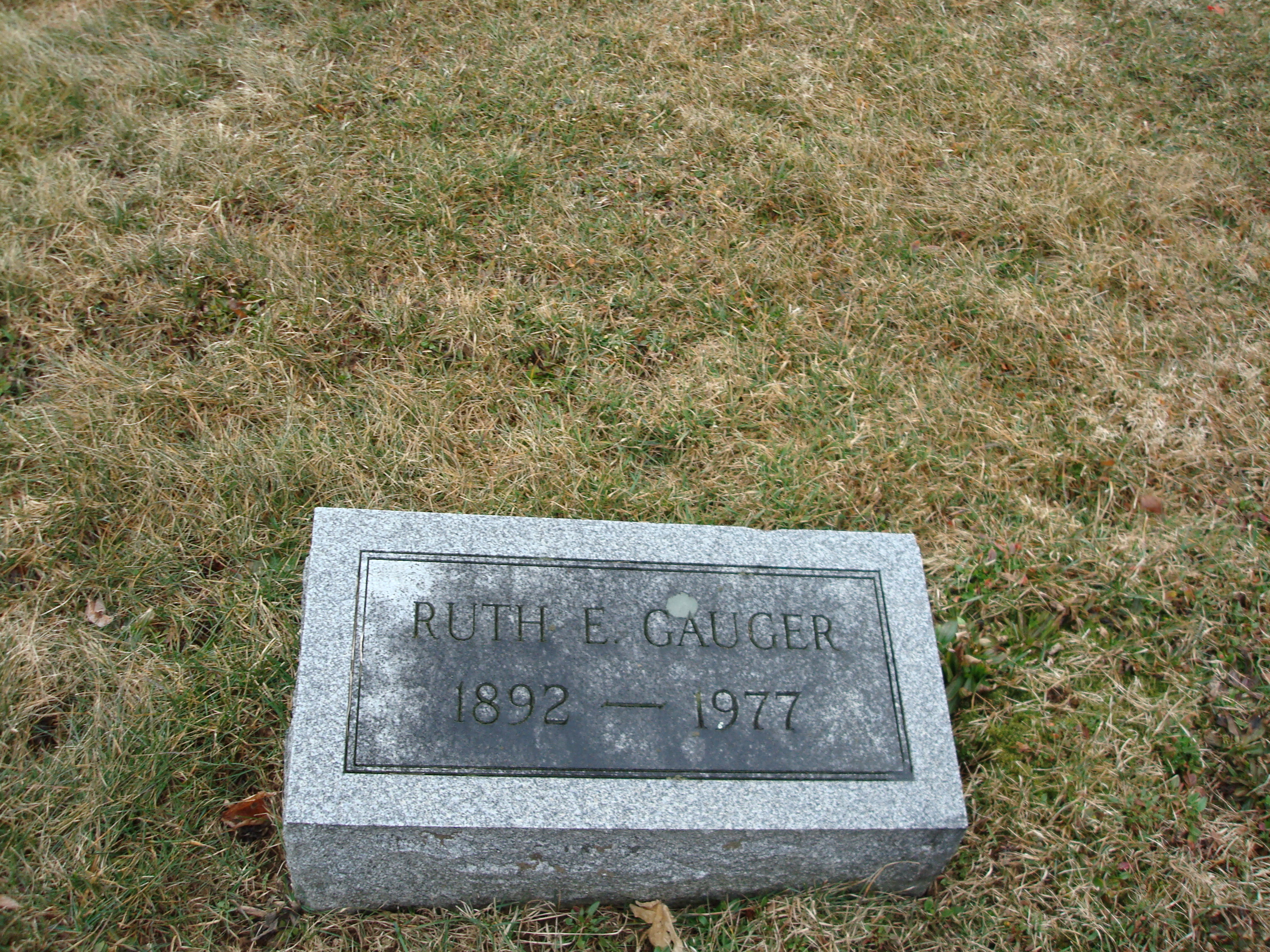
Earlier in the diary I mentioned that Grandma lived her entire life within a 5 mile radius of the farm her family lived on when she kept this diary. The same probably could be said for her sister Ruth. I find it even more amazing how close together they are buried.
Grandma and Ruth are buried within 50 feet of each other in McEwensville Cemetery–and within a few hundred yards of the school they attended when they were young. Both sisters married men who also attended McEwensville High school (and who are also buried in the same cemetery).
Tombstone of Ruth (Muffly) Gauger
Over the years there were times when Grandma and Ruth were close confidants and other times when they were less close; there were “spats” and reconciliations—but for perpetuity in McEwensville Cemetery they will remain close.
15-year-old Helena Muffly wrote exactly 100 years ago today:
Friday, March 10, 1911: Pulled a girl’s ears at school. It was her birthday. Will be glad when mine comes along. Hope tomorrow will prove more stirring than what today had been.
Her middle-aged granddaughter’s comments 100 years later:
Grandma’s sixteenth birthday will be on the first day of spring—March 21. It sounds like she’s already looking forward to it. This is the second time that pulling ears on someone’s birthday has been mentioned in the diary.
____________________
On days when Grandma writes little of interest, I always wish that she’d described her daily routines more. For example, what time did school start each morning? And when Grandma walked to school each morning were there men going in the opposite direction towards jobs in Watsontown?
The road Grandma walked to school each morning. It would have been dirt (or mud) in 1911.
Raymond Swartz, Grandma’s classmate at McEwensville High School and future husband, wrote a short family history many years later. He mentioned working in the Watsontown Brick Plant a few years after he graduated from McEwensville High School.
The next five years I spent working for father on the farm with the exception of three months in the winter of 1918 when I worked at the Watsontown Brick Plant. To do that, it was necessary to get up at four o’clock in the morning in order to get some of the morning chores done on the farm and then leave home to drive a horse and buggy to work about six-fifteen. Work at the plant started at seven o’clock and lasted until five o’clock. Then I drove home and helped with some of the chores in the evening. We worked five hours on Saturdays. For the three months work I received $228.00 which was good wages in those days.
Raymond Swartz
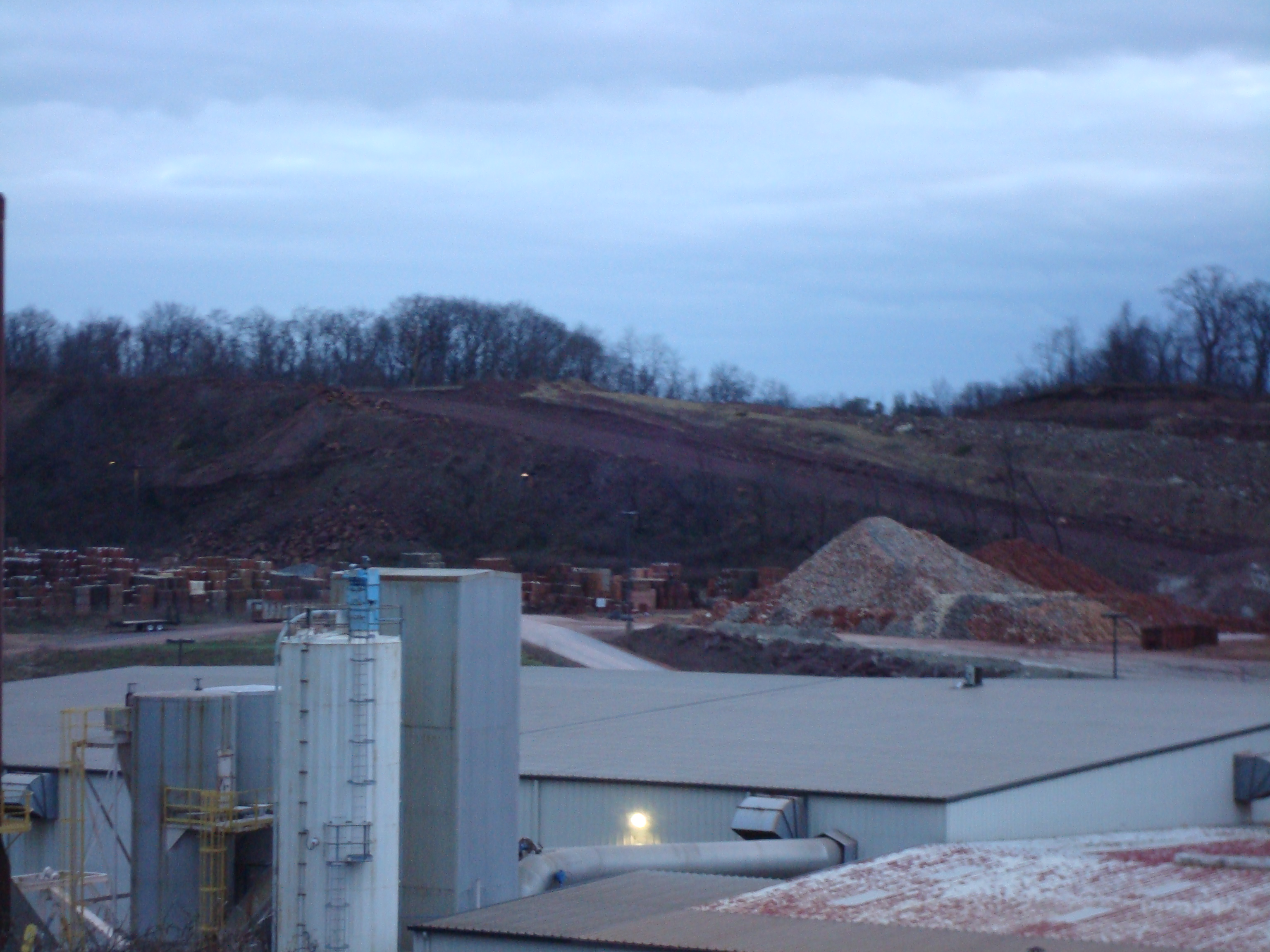
Watsontown Brick Company was founded in 1908, and a hundred years ago other strong young men were probably making the daily trip on the road from McEwensville to Watsontown to earn a good wage for a hard day’s work.
Bricks are still produced in Watsontown and sold nationally. The town is famous for its clay soils that make excellent bricks.