
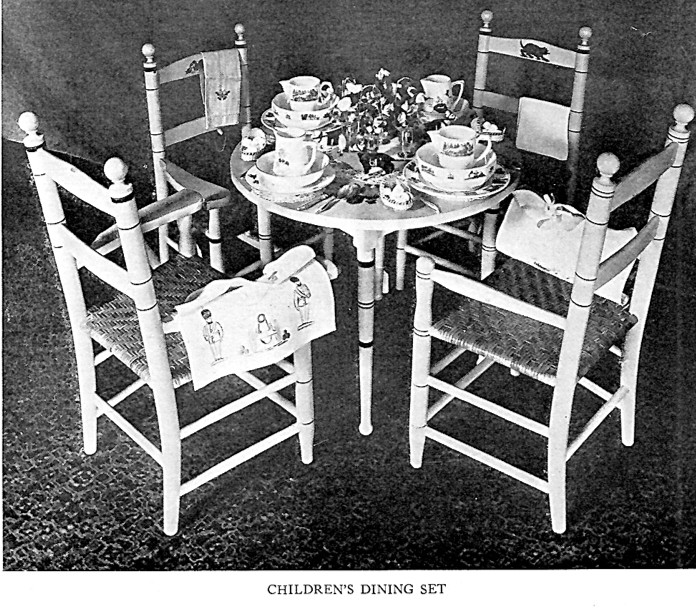
My grandson has lots of play dishes, pots and pans, and foods. He loves to make and serve “pizza,” “fruits,” and other foods. A hundred years ago, children also enjoyed play dining sets. Both then and now, children like to role-play and use their imaginations.
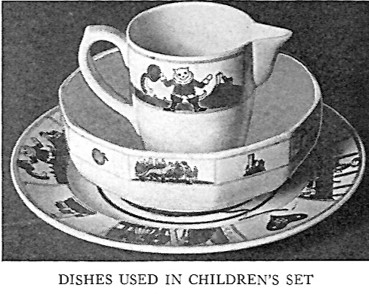
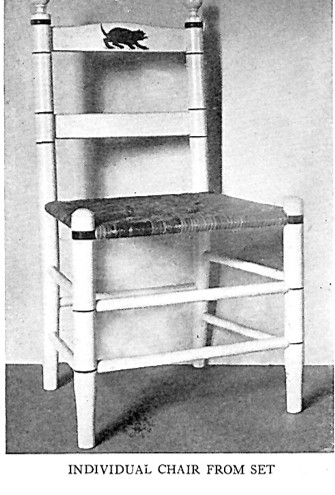
A 1926 issue of American Cookery had an article titled, “Treat the Nursery from an Educational Point of View” that encouraged parents to provide their children with toys that “excite his little mind.”
(I was pleasantly surprised that the old magazine referred to “his mind.” Some argue that toys today are too gendered. In 2026, I think that tea sets and many cooking-related toys are sometimes considered “girl” toys. It’s nice that the author in 1926 thought boys – and I assume girls – both would enjoy playing with children’s dining sets.)
Source: American Cookery (December, 1926)

The family still have our mother’s little tea set from when she was a child right around 1930. It was glass, thick glass, and withstood the tests of time and many little fingers.
Similarly, I had a little China tea set when I was a child. I used to enjoy serving “tea” to friends and relatives. I worried that I would chip or break a piece, and was very careful when I used it. Unfortunately, I have no idea whatever happened to it. It has just become a vague memory, and I struggle to remember what it looked like.
One of these days, when you are not thinking about it, you will browse through a flea market and there will be the same little tea set and the memory will sharpen. This I wish for you!
Good suggestion – I’m often surprised how totally unexpected items pop up when I’m going through a flea market.
I have my mother’s tea set, which was probably late 1920s or early 30s. As a child, I did not like traditional girls’ toys and found my brothers’ toys much more interesting than a baby that urinated and a real working iron. My grandsons enjoy their kitchen.
I can’t remember what I thought about dolls that went potty when I was a child – but I definitely was really into those dolls when I toilet trained my children. I’d fill them with water and then carefully carry them in a horizontal position to the potty, where they reliably went potty – and hopefully helped the child get the right idea.
(Whew, sometimes I’m amazed how my comments end up going in a very different direction from my original post. It’s one of the things I enjoy about the conversations, and hopefully I’m not going too far afield.)
I had three girly girls, and yes, I got them a kitchen. I also got them a truck, and they would not touch it.
It’s always fascinating to see which toys a child gravitates to.
All my children, boy and girls, played house with their friends for really quite a good few years. I loved baking salt-dough foodstuffs for them, and these days, for their children. They seem to last for ages!
what a cool idea. I never thought about using salt dough for that.
I liked it. Baked, painted and varnished they’re very durable. Fruit, veg. fish and chips, cakes all work well!
I think that I once made a landscape for my kids out of salt dough, but like Clubschadenfreude, I never thought of making “food” out of salt dough.
“He” was considered the generic masculine pronoun that also included females. Writing from the 17th century used he ‘generically’ because it was considered grammatically correct. It did not fall out of favor until the late 20th century with the women’s movement when the terms “he or she” were introduced. Alas, that was so cumbersome apparently, that the use of “they” rather than he or she began to be used more often, though technically incorrect as it is not a singular pronoun. They/them is now once again considered appropriate when one does not know the gender. Language is fluid and ever evolving.
It’s fascinating how language evolves over time.
Like many of the others have posted, I too have my mother’s tea sets from when she was little girl; it’s so charming!
You are so fortunate to have your mother’s childhood tea sets.
It is very treasured!
Sweet furniture!
Agree! I can picture 3 or 4 children wearing fashionable,1920’s-style clothing sitting around the lovely table having a tea party.
My goodness! How this did sweep me back to my childhood. What a pleasure
It’s nice to hear that this post brought back some warm memories.