
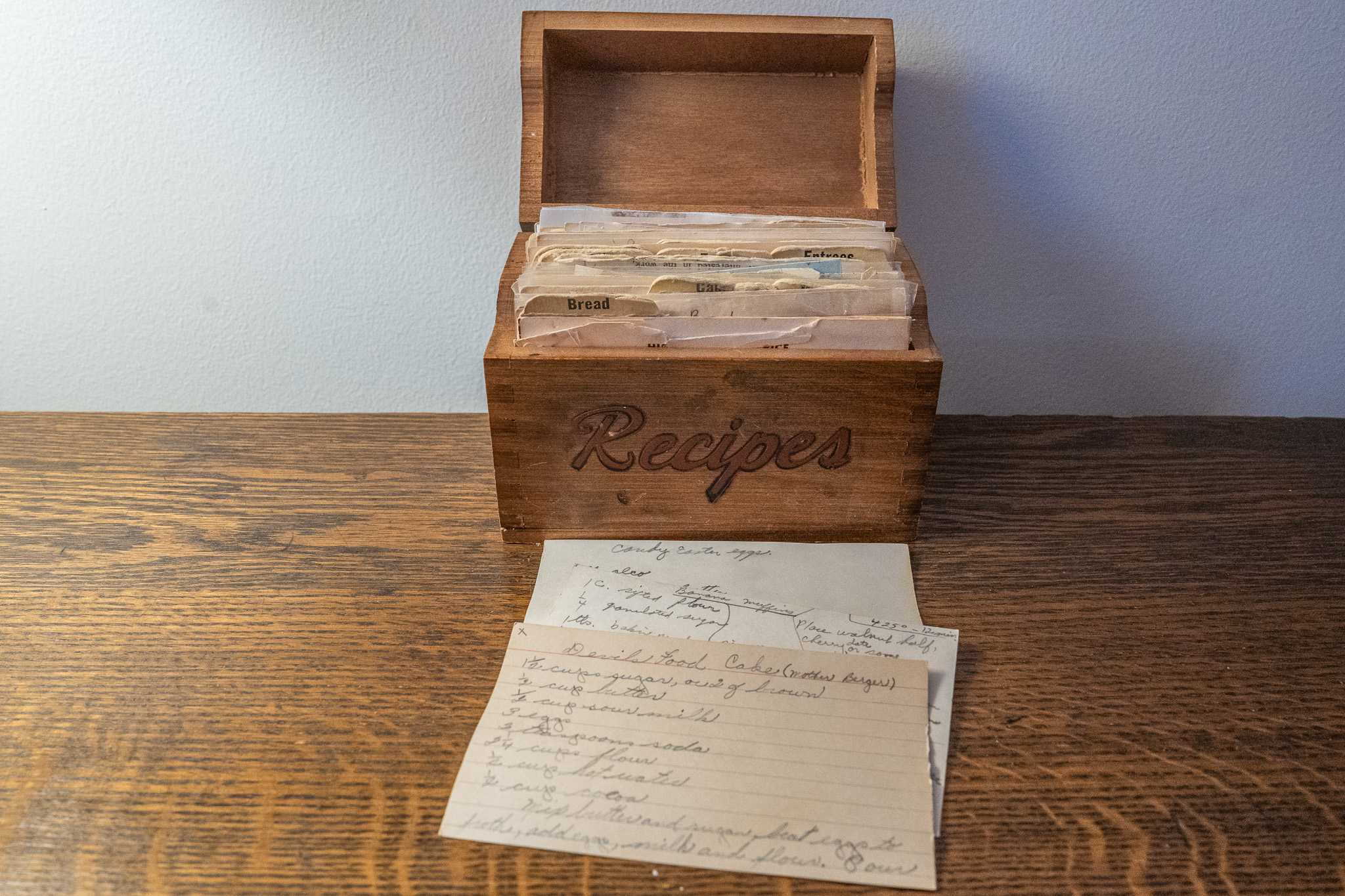
 Many dishes on the holiday dinner menu are the same year after year, and there can be complaints if a dish vanishes or is “different” from how Grandma used to make it. So, I was surprised when a friend said, “Grandma’s recipes have been ghosted.”
My first reaction was “No way. ”
I know from comments I get on this blog that many people are looking for old-recipes that they have vague memories of ancestors making years ago. I regularly get comments like, “Thanks! I’ve been looking for this recipe for years. It is almost exactly like the recipe my grandmother made when I was a child.”
But, the more I thought about whether old family recipes are being ignored, the more I think that my friend was right. Grandma’s recipes are frequently ghosted.
My own efforts to create a cookbook to preserve family recipes ended up resulting in the beginnings of A Hundred Years Ago. In 2009, I compiled a family cookbook. I included some family photos in the book. One of them was a photo of a surprised-looking me walking through a doorway at my bridal shower. Sitting on the couch in the photo’s foreground was my 82-year-old paternal grandmother.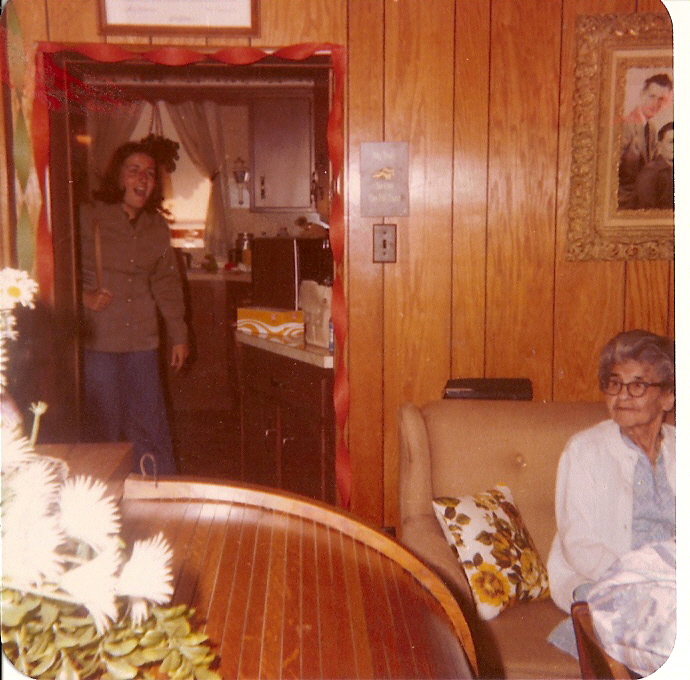
A much younger me arriving at my bridal shower with my grandmother sitting near the doorway.
When I gave the cookbook to my children, my daughter asked, ” Who’s that old lady.”
I told her that it was her great-grandmother. But her question jogged my memory about a copy of an old diary of my grandmother’s that I had. I dug it out of a cupboard and discovered that Grandma kept the diary from 1911 – 1914. She was a teen-ager at the time.
I realized that it would be exactly one hundred years since Grandma wrote the first diary entries very soon. I decided to post Grandma’s diary entries a hundred years to the day after she wrote them on a blog I called A Hundred Years Ago. I originally did it for family, but soon others were also enjoying the diary entries. However, after four years the diary ended. I briefly quit blogging, then re-invented A Hundred Years Ago as a cooking blog.
Over the many years that I’ve done this blog, I’ve learned a lot from my readers about the value of preserving family recipes as well as the challenges. Here is a summary of what I’ve learned.
Understanding the Challenges
Cursive Writing is Difficult to Read. Old recipe cards often were written in cursive and are extremely difficult to read. Younger cooks never learned to read or write cursive text, and older people often don’t interact much with cursive anymore and now find it hard to read.
I recently spoke with a graphic designer who said that she advises clients to avoid the use of script-style fonts when laying out promotional materials or an advertisement. She said, “People just can’t read it.” This suggests that if people struggle to even read typed script fonts that old handwritten recipe cards are almost impossible for them to decipher.
Old Recipes Lack Directions. Another challenge for modern cooks is that old recipes often have few, or confusing, directions. Many cooks just throw up their hands and give up on a recipe when it says things like “add enough flour so that the dough can easily be rolled” or “bake in a quick oven.”
Dirty, Worn Recipe Cards and Cookbooks Are a Nonstarter. Cooks today often find the old recipe cards and books that their Grandma once used to be unappealing. Old cookbook pages are yellowed, often there are loose pages, and the book spine may be torn. Many of the pages may have food stains, which can be considered badges of honor that indicate which pages contained Grandma’s favorite recipes; but, more often, just seem like dirty (and perhaps germy) pages.
It’s Hard to Know What a Dish Will Look Like When There is No Photo. Cooks today regularly use online recipe sources (as well as modern cookbooks) that show vibrant recipe photos that help them decide which foods to make, while old recipe boxes and cookbook pages are crammed with recipes, but contain few or no pictures. This can make it difficult for a cook to envision what the dish would look like.
Sharing Family Memories
Dishes that once were common foods may now be considered old-fashioned, not appealing, or not very healthy; however, they become part of family lore and traditions. I want to think that old family recipes pull families together at holiday gatherings by becoming the basis for stories and memories. But, I also know that they can create challenges.
When a family sticks rigidly to the traditional menu for a holiday gathering, family members who do not eat animal products, have food allergies, or have environmental concerns about certain foods can feel frustrated or hurt that their needs are not met.
Yet, who can’t smile when a family matriarch remembers a great aunt who has been gone for forty years, and tells the story (for the 39th year) about the time Great Aunt Emma’s molded, canned fruit gelatin collapsed into a mushy mess when she was unmolding it right before dinner.
Discussing Grandma’s Recipes
Family members can have different opinions regarding how much (or if) their grandmother’s recipes can be adapted or modified without changing them so much that they are no longer her recipe. There probably would be general agreement that it is okay to cook a stew in a crock pot rather than in a pan on the stove as described in an old recipe.
However, if an old recipe for apple pie called for using shortening when making the pie shell and Northern Spy apples for the filling, some family members may think that it is okay to substitute butter for the shortening for the crust and to use another apple variety in the filling, while others might say that the pie no longer tastes like Grandma’s. Still others might chime in that it would be nice if Grandma’s old recipe was updated so it was gluten-free and vegan so that everyone could enjoy it.
Some might worry that “Grandma won’t approve of us changing her apple pie recipe,” while others might note that Grandma herself may have “modernized” the recipe when she updated her grandmother’s recipe so that it used shortening instead of lard. This could lead to a discussion about whether the recipe should be converted back to using lard for the pie pastry now that research suggests some possible health issues related to the use of shortening.
Preserving Grandma’s Recipes
Everyone seems stressed this year, and worried that discussions at the holiday dinner table may go sideways with one disagreement or another. Maybe it would be a good time, when everyone is there, to discuss how to preserve their Grandma’s recipes and make them more accessible.
What it means to save Grandma’s recipes will differ from family to family. In some cases, it might mean developing a plan for typing them up and creating a family hard-bound or electronic cookbook. In other families, it might mean making videos that show how to prepare favorite recipes; while, still others might have discussions about how to update the recipes to make them more user friendly, or how much a recipe can be updated without destroying it.
Let’s not ghost old family recipes, but rather use them as connectors that bring families together. Those old recipes can be a powerful tool that engages family members across generations.

Such an interesting post! You’ve given me so much to think about.
One issue that I have is that many of the “recipes” my grandmother cooked weren’t written down, or, if they were, I couldn’t find them. I have a metal 3×5 box filled with index cards on which my grandmother wrote recipes, as well as some clipped from newspapers, but the dishes that I associate with her aren’t there. I suspect that they were recipes she had made so often, she knew them by heart. The only exceptions are her cookie recipes.
Before I got married, I went through my mother’s recipe box and copied a number of favorites. Yet I can’t think of the last time I went into my own little file box when planning our weekly menu. Now you’ve spurred me to pull it out and look back through it. Thanks!
Similarly, to your grandmother, my mother clipped lots of recipes from newspapers and magazines, but never actually made most of those recipes. So far I’ve kept all the recipes that are in her recipe box, but sometimes I think that I should winnow the number of recipes down, and only keep ones that I think she actually made.
I encountered this problem recently when my granddaughter asked for a recipe for cornbread. I copied my grandmother’s recipe and sent it to her. She had many questions about how much, how long etc. that I had never thought about because the general directions had been clear to me. Probably because I grew up making cornbread while I lived at home. I tried to add more information so she would continue to make the recipe. I think she will because it turned out tasty.
What a lovely story! It’s so special when grandparents and grandchildren collaboratively figure things out. In my opinion, she’ll continue to make the recipe and think of you each time she makes it.
What an interesting post. Many of my recipe cards are handwritten by my mother; her cursive was so clear and beautiful it’s only the fact that they’re written in pencil that led me to make copies of them. It’s funny — even though the basics of our Christmas festivities are gone for me now, since they were labor intensive and Swedish (sausages, jellied meats, etc.) I still make my grandmother’s and mother’s cookies, and some of the ‘everyday’ recipes we used still are part of my repertoire.
I also regularly make some of my mother (and mother-in-laws) recipes. Many of those recipes are for dishes that I consider comfort foods.
What a wonderful article Sheryl! Thank you so much for all these little insights.
You’re welcome. It’s nice to hear that you enjoyed this post.
I agree, you wrote a great article. I have a note in my Christmas recipe file to compile my parents’ recipes; there are some I have already passed to my children. I scanned my husband’s grandmother’s recipes and passed them out on a thumb drive. We put some of our family recipes on a Google
Drive. I also like how you are able to update old recipes, and I have some that you just need to know the missing pieces. I absolutely loved your grandmother’s diary, as I am from the same area.
I’ve really enjoyed getting to know you via our blogs across the years. It wonderful to hear that you enjoyed (and remember) my grandmother’s dairy. It’s hard to believe how quickly the years have flown by.
What a marvelous post! I knew about your grandmother’s diary and that you continued the 100 year old theme with recipes. I’ve enjoyed that for years. Thank you for this wonderful fallout.
I’m not concerned about passing on family recipes. My daughters do not cook, and my son wouldn’t be interested. Makes it easy for me!
It’s wonderful to hear that you enjoy this blog. You’re one of my long-term readers. I really appreciate you support over the years that I’ve been doing this blog.
I started reading your blog when you were writing about your grandmother’s diary. I was disappointed when the entries ran out from the diary, but have enjoyed your food blog also. I tried to interest my family in a cookbook of family favorites, but the family had zero interest.
I also was disappointed when the dairy entries ran out. When I first started posting the dairy entries, I wasn’t sure if I do it for more than I few weeks. Then I discovered how much I enjoyed learning about my grandmother more deeply as I posted her dairy entries and background information one day at a time. I am so glad that I figured out a way to reinvent A Hundred Years Ago, and have really enjoyed food blogging. Over the years, I have enjoyed getting to know you and the other thoughtful readers who write comments.
The comment about “cursive” writing struck home… even when it is my cursive I am trying to read. Add to this the age and condition of the card and it gets real iffy!
Thank you for the pleasure of your company. I enjoy your post each week and look forward to what you share
It’s wonderful to hear that you enjoy this blog. I have a lot of fun pulling the posts together, and I appreciate your kind words. I still write grocery lists in cursive. Sometimes when I’m at the store, I struggle to read what I wrote a few days earlier. I blame it on the fact that I don’t handwrite much anymore, and, as a result, my handwriting is going downhill.
Your post made me stop and look at my favorite cookbooks. Black and white pictures. Food stains on my favorite recipes. Broken bindings and loose pages. Hmm. Okay then. My grandmothers cooked meals from memory. They only used recipes for sweets and maybe not even then. My mom also cooked from memory, except for sweets. They were all great Southern cooks and just knew how to cook.
I was a lot more adventurous in my cooking, wanting to try many different types of food. I had to follow recipes.
Many of the old-time foods my mother made had relatively few ingredients. She used to make some foods where she knew the ratios for the various ingredients. It might be 1:1:1 or 1 part sugar to 2 parts flour to 3 parts milk, etc.
I’m lucky to have several old recipe books from my mother and grandmother. The main problem for me is that they used pounds and ounces, whereas we use kilograms and grams. But at least they didn’t use the dreaded ‘cups’ which I find way too difficult!
🙂 It’s challenging when different units are used in a recipe than what you normally use. My daughter has a food scale and often cooks using weights. She says my cooking would be more consistent if I cooked using weights, but so far I’m still attached to measuring ingredients by volume rather than weight.
We all like what we’re used to and no harm in that!
You can easily find a chart online (such as this one: https://www.kingarthurbaking.com/learn/ingredient-weight-chart) to convert between grams, ounces, cups, etc,. I typically bake using grams as well, and often convert the volume amount to grams.
Thanks for the link.
Thanks so much. That’s really helpful.
Fantastic write up. Contrasting and comparing, these times to then, is thought provoking. It doesn’t just apply to recipes, but so many other things that have changed with the times.
Thanks for the expansion and expounding….helpful for my brain, thank you.
David
Cypress, CA
It’s wonderful to hear that you enjoyed this post. You’re absolutely right that many things have changed with the times. I sometimes struggle to keep up with things.
Great post, Sheryl. You’ve touched on a multi-generational gift of family history with excellent points. My warmest thanks.
You’re welcome. It’s wonderful to hear that you enjoyed this post. You’re absolutely right. The foods a family eats, as well as the context of when and how food is prepared, and the role of food at family gatherings, etc. are important components of family history.
This is so good and so important, “Maybe it would be a good time, when everyone is there, to discuss how to preserve their grandma’s recipes and make them more accessible.”
It’s a great opportunity to tap into the wisdom of other family members about how to preserve (and possibly adapt) key family recipes.
Thanks for the post.
I love soul food, old recipes, and learned I needed to know what a quick oven wad, among other things. In my own cooking, when scratching food to eat, I measure my heaping handful for dry ingredients as a 1/4C and my closed fist as 1/8th. That won’t help if I write it down as a fistful or handful, without US customary measuring equivalents.
May the forks be with you.
Works for me. 🙂
So much to think about, Sheryl. My grandmother was one of those country women who stored her knowledge in her mind. My mother was the same – her cooking, though, was much simpler. Today I rely on recipes from followed friends here on WP, and Mrs Google…
I tend to think that back in the day, women who cooked 3 times a day, 365 days a year tended to make tasty, but simple foods and were able to store the knowledge in their mind. As wider varieties of food became available (and some people cooked less frequently), they shifted toward recipes.
Sheryl, you know me since the (near) beginning of your original blog, and you continue to remind me what kindred spirits we are, with archiving family history. I have my food-spattered original recipes for such odd ball things as ketchup and pickled eggs (from Mammaw AND Pappaw Watts) in plastic sleeves hanging on the inside of my kitchen cabinets. My 94-year old mom still sends me requests of dishes I recall now, in her perfect cursive. The food itself, for me, is second to the paper ephemera: the index cards and ink flow. Personal memory is the best seasoning for any family recipe! And that is what you add, with your archiving for all of us to share in. Happy holidays!
It’s been wonderful getting to know you over the years. I think that you’re right that we’re kindred spirits. We both hail from central PA and have so many similar interests.
Great Blog Sheryl! Something that most of us across the world share is our our love for our grandmother’s recipes and the magic of recipes passed through generations. Every recipe of theirs’s is a journey back in time. Absolutely enjoyed your blog and could relate to it, as I have been passed down my grandmother’s cookbook, which I keep as my most prized possession.
I have a lot of fun doing this blog, and it’s wonderful to hear that you enjoy it. As you noted, across the globe, food and food traditions go across generations, and become the basis for warm memories. You are so fortunate to have your grandmother’s cookbook.
Hooray Sheryl. I did the recipe book started by my aunt and added photos. I sent copies to the female great grandchildren. I am writing a book about family history now.
It’s wonderful that you finished the recipe book started by your aunt. I really like how you added photos. It sounds lovely. I want to write a book about family history, but haven’t yet done it. I’m impressed that you’re actually getting a book pulled together.
Do not hold your breath!
It is an adventure in progress.
Working title The Pearson Women.
Five generations