
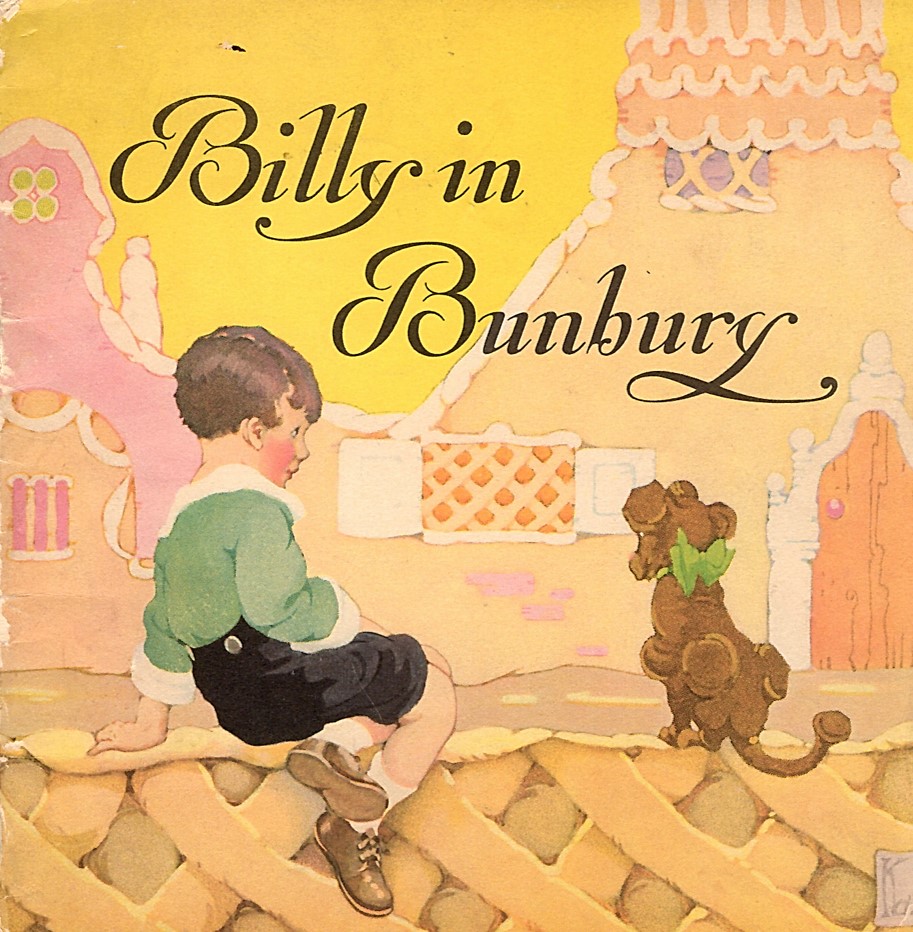
I am always energized when we ring in a new year. For my blog posts I use recipes from cookbooks that are exactly a hundred years old. I bought several 1925 cookbooks off eBay and am looking forward to exploring them. One of the books I purchased is unique. Billy in Bunbury was published by the Price Baking Powder Company. It is a combination children’s picture book and cookbook.
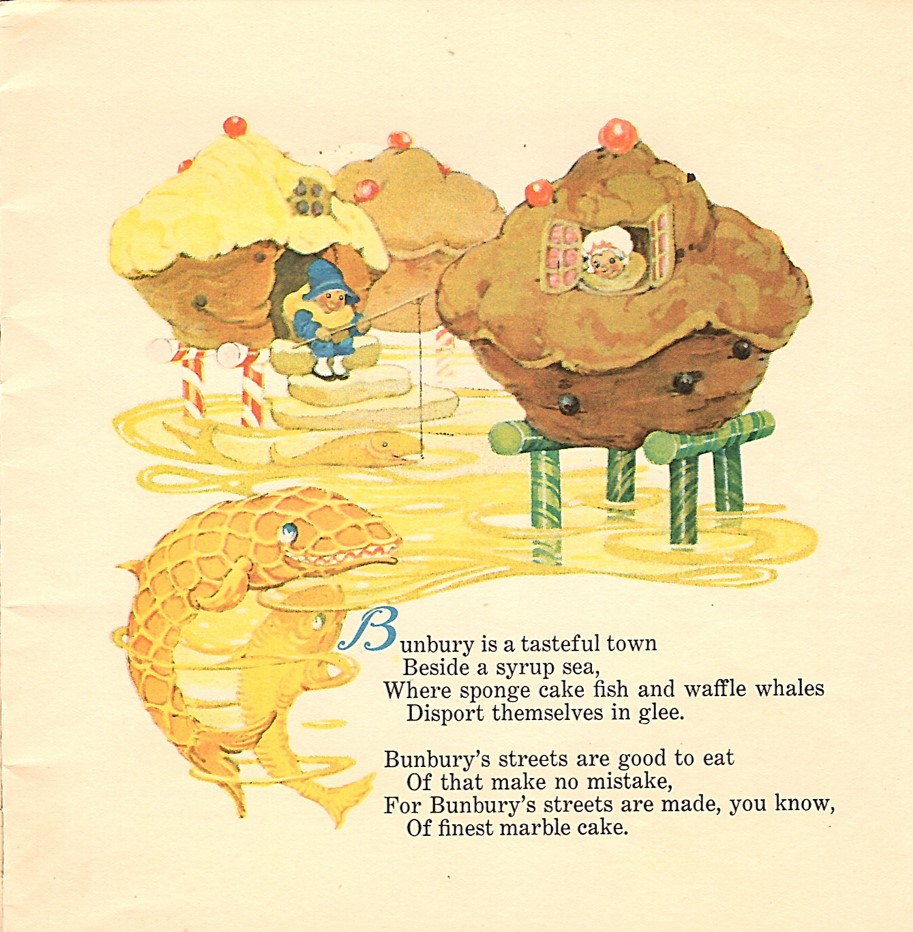
Billy in Bunbury is an enchanting and whimsical story about a town where everything is made of wonderful foods. The streets are made of marble cake and the fences of pie crust. King Hun Bun learns that there is a boy named Billy who lives nearby who is very skinny because he will not eat his meals. Hun Bun tells Billy’s mother to give him “cookies, buns, and cake. And the other things that mothers make.” He also gives her a book with recipes that use Dr. Price’s Baking Powder. He then takes Billy to Bunbury. Billy is awed by the town and the foods in it. Later they return to Billy’s home. Billy’s mother has read the book and will make sure that he gets a treat at each meal. Interspersed throughout the story are recipes for cookies, cakes, doughnuts, and other sweets.
The book is colorful and well written. I feel certain that children a hundred years ago begged their parents to read the story to them repeatedly. That said, I have mixed feelings about this book. I may be looking at it through a modern lens, but it concerns me that children are being encouraged to eat so many sweets. King Hun Bun tells Billy’s mother:
And Madam, ‘stead of coaxing
Boys and girls to eat, ’tis wiser
To add a cake or cooky
As a little appetizer.
The book concludes that Billy (now referred to as Bill) is strong after eating treats with meals, and that readers should also tell their mothers to make treats:
He eats his lunch and breakfast
Each meal he finds a treat
The other fellows watch their step
When Bill comes down the street.Cakes like he met in Bunbury
His mother makes him now
And if YOU want some too, this book
Will tell YOUR MOTHER how!
If you would like to read this book, it is available online via the Project Gutenberg at Billy in Bunbury.

I love the little poems! What a cute book for kids and mothers alike!
It’s a fun book.
It sounds enchanting. I know several people in the generation before mine who feel any everyday meal is not complete without a dessert. For us, we only think of having dessert for special meals, like birthdays and holidays.
When I was a child my mother always served dessert at lunch and dinner; but like you, I only serve desserts at meals on special occasions.
Well, at least the treats got him to eat his meals!
The illustrations are lovely.
It’s a very nicely done book. The Price Baking Powder Company clearly prioritized the creation a high-quality children’s book.
I have one of the Rumford cook books and it is not nearly so nice to behold!
I agree- I actually recently bought the 1925 Rumford cookbook off eBay. Lots of good recipes, but not a very fancy presentation.
The one I have is quite plain as well.
These illustrations are beautiful. They remind me of the illustrations from the My Book House series of children’s books that were my mother’s. (I have three of the set of six; my mother had no idea what happened to the others.) It’s interesting to reflect on how attitudes toward food have changed. My mother thought nothing of throwing a pie together for an evening’s dessert. Now, the number of times I bake in a year is probably in the single digits!
The company must have hired a very talented artist to do the illustrations. Attitudes towards desserts have definitely changed over the years. I wasn’t familiar with the My Book House series until I read your comment. I just did a search on them and saw the beautiful illustrations on the covers.
The book has wonderful illustrations. I think that back then people were much thinner and food was really pushed. The Great Depression has not even begun yet. I remember growing up in the late 50s early 60s, parents were always trying to get us to eat more. A local children’s TV show (Hatchy Milatchy) had the Clean Plate Award. My parents also always had dessert and cupcakes for after school snack. Somehow, I never gained any weight. I also never make dessert except for holidays.
I have similar memories. I can remember teachers telling us that we should eat all of the food that we were served at lunch in the cafeteria because there were poor children starving in other countries. It never was clear how eating my lunch would help those children.
I would have a very difficult time in that town.
I’m guessing that you’d struggle not to overeat.
Perhaps a bit sceptic, but the book suggests his mother should bake every day. If not, Billy would not get his treats and would remain very skinny. Poor mothers and poor Billy, thinking treats are an incentive to eat meals.
I agree – I love to bake because it’s fun and encourages my creativity. If it was something that I was required to do every day to provide an incentive for others to eat meals it would lose much of its joy.
Absolutely! Baking and cooking is very much about love, creativity and fun.
Thank you for the link to the Project Gutenberg copy. I read the entire book, primarily to see what it said of course, but the illustrations and the rhymes are catchy. I read through the recipes as well, and many of them seem quite typical. Since the likely purpose of the booklet was to sell Dr. Price’s Baking Powder, I don’t see how one could do anything other than promote sweets or breads since nothing else would require baking powder.
It makes sense that since the book was designed to encourage the sale of baking powder that the recipes would be for sweets that contain baking powder; however, it still bothers me a little that the book promotes the serving of sweets at meals (including breakfast). I think that I’d feel better if the story about about afterschool treats or something similar.
Interesting.
It’s fascinating how the baking powder company created a children’s story and recipe book to sell their product.
Yes.
What a sweet book!
It is a sweet book. The author and illustrator did a really nice job of pulling everything together to create a lovely book.
What a great historic find and so very sweet!
It’s nice to hear that you enjoyed this post.
I had forgotten about project gutenberg. Must check it out again. I have a children’s cookbook written by a French chef who lives here in australia. Very fun!
cheers
sherry
Over the years I’ve read a lot good older book on the Project Gutenberg site.
There are some really fun children’s cookbooks. It’s not as fanciful as some children’s cookbooks, but from a practical standpoint I always especially liked the Betty Crocker Children’s Cookbook. I made lots of recipes out of it when my children were young.