
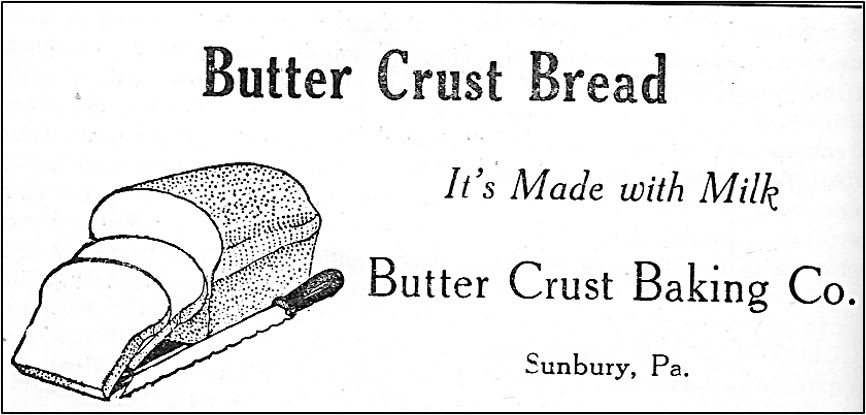
When I saw an advertisement for Butter Crust bread in a 1924 cookbook, it brought back very vague memories of bread my family sometimes bought when I was a child. Butter Crust was a soft white bread, and I can’t say whether I particularly liked it or not. I think that it was fairly nondescript and about like other white bread. But, as I worked on this post, I ended up being surprised that I found this bread and the company that made it more interesting now than back when I ate it.
Let me back up for a moment. I recently bought a hundred-year-old cookbook off eBay that was published by the Susquehanna Valley Country Club which was located in Sunbury, Pennsylvania. Sunbury is the county seat of Northumberland County. I was really excited to get this cookbook because I grew up on a farm in Northumberland County, and looked forward to getting a cookbook from my “home turf.” I’ll be making some recipes from the cookbook over the next few months, but I decided to first post this advertisement from the cookbook.
I googled “Butter Crust Bread” so I could add a little context to this post and was surprised when nothing came up with that exact spelling. Instead a bread company called Butter Krust Bread Company popped up. It also was located in Sunbury. I assume that it is the same company, but that the spelling was changed years ago. Is a “k” cooler than a “c” when spelling “crust”? In various articles that I found about the company Butter Krust is sometimes hyphenated; other times not. The name of this company sure seemed to have a lot of variations!
I found an article about a president of the Butter Krust Bread Company on the American Society of Baking website which said that Butter Krust was the first baker east of the Mississippi River to offer sliced bread and to wrap bread in cellophane. Who would have guessed that a very innovative baker was located in Sunbury?
The company was sold to Sara Lee in 2006 for $72 million. According to a 2010 article in the Sunbury Daily Item, Butter-Krust as well as other Sara Lee bakeries were then sold to Grupo Bimbo. At that time there were 200 employees at the Sunbury plant. A later Sunbury Daily Item article said that the plant was closed in 2017.

Thanks for investigating the Butter Crust/Krust story! I am not certain I ever heard of it–it was certainly not one of the standards in the part of Texas where I grew up. It will be fun to see what the recipes are!
Texas probably had its own regional bakeries. There weren’t nearly as many national and international companies a hundred years ago as what there are now.
They did; Mead’s Fine Bread in the north part toward the Panhandle, and Mrs. Baird’s in the mid central northwest. Mrs. Baird’s was based in Fort Worth, but had a plant in Abilene and you could smell the bread baking from where we lived.
It sounds lovely to be able to smell the bread baking – though on second throught: Was it wonderful (or not so great) to be able to smell bread baking from your house? When I’ve driven by bread factories, I’ve always loved the smell of the baking bread. But, I could see that it might possibly get annoying to smell baking bread day in and day out.
So many companies get swallowed up like this.
Agree – there has been so much consolidation across the years.
I loved hearing some of the history of this bread company, Sheryl. Your new book sounds like an exciting find, I look forward to seeing more.
I’m having a lot of fun looking at it, and am trying to decide which recipes to make.
Sliced white bread? How did we get by before it happened? :=)
sherry
🙂
It’s certainly an appetising name for what I suspect to be a not particularly appetising loaf!
I’m not currently a fan of soft white breads – but when I was a child, that was just what we ate and I never gave it a thought as to whether it was appetizing or not.
We could be fairly undiscriminating as children, couldn’t we?
I grew up a little further up the road from you. We had Stroehmann’s Sunbeam bread and enjoyed driving by the plant and inhaling the aromas. I always thought the Sunbeam girl was the owners’ daughter. My daughter worked in Bimbo’s national office for a few years. I was surprised at how many of our baking companies the Mexican company had bought.
Like you, I can remember the wonderful aroma when driving by the Stroehmann factory on Route 15. It always made me hungry. It’s interesting how consolidated the bakery industry has become in recent years.
We have a Bimbo plant nearby. I think they make bread for lots of bakeries – the bread is the same but the wrappers are different. Kind of like the pickle factory. They do a batch and it is Aunt Jane on the label and then the change the jars and lids and the next run is Spartan or Meijer brand!
It’s fascinating how the one factory makes numerous brands of bread but differentiates the product by packaging it under different brand labels. I’m sure there is some marketing concept about differentiating the branding and product packaging to appeal to different segments of the market, but I don’t understand it.
I remember Sunbeam bread!!!! I also remember when dad brought home the first loaf of Roman Meal Bread ( 60+years ago) because the white bread had no nutritional value…. Trust me it was a hard sell to us kids…. Now I seldom buy white bread. Sour dough does not count as white bread I am sure.
I remember the image of an adorable little girl eating a buttered slice of bread on the Sunbeam wrappers. We also always ate white bread when I was a kid. It wasn’t until after I got married that I realized that whole wheat bread was more nutritious and tasted better.
I remember eating a bread as a child that was a called buttercrust bread loaf. It was cut lengthwise down the middle and supposedly butter was poured down the cut. I was fascinated and read the packaging very carefully. I was also disappointed it didn’t taste like butter. It is amusing that I can’t remember the name of the bread after having spent all that time reading the packaging.
Wow, the packaging sure made the bread sound like it would be tasty – too bad you couldn’t actually taste the butter. All of the info on the bread wrapper makes we think about how we always read all the interesting things on the back of cereal boxes.