
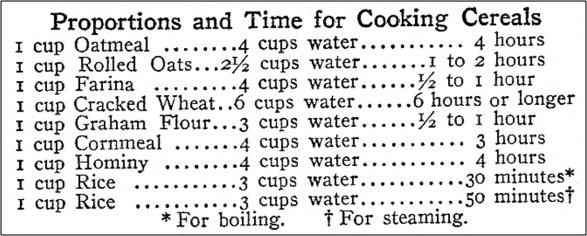
Here’s some excerpts from a hundred-year-old cookbook about how to cook hot cereals:
Cooking Breakfast Cereals
Cereals are made from hard grains and contain much starch, so require long cooking to make them easily digested. Do not be deceived by directions on the box which say that the contents can be cooked in 15 or 20 minutes. This is never long enough to cook thoroughly and make them fit food for young children.
When the coal range is used, a very convenient way to cook the cereal is to start it cooking at supper time and leave closely covered on the back of the range all night. In the morning it will be found to be well done.
All of the cereals named above may be served hot as mush with cream or milk with or without sugar. Mush may also be served with syrup instead of milk. Cornmeal mush is much liked in this way.
Low Cost Cooking by Florence Nesbitt (1924)

I was amused that the supposition was using a wood stove. Steel cut oats is a winter dish that I enjoy. I always bring it to a boil, cover it, and reheat it the next morning. My parents were nine and ten years old in 1924.
I use the same process you do to make steel cut oats. It works really well to let them sit overnight. It’s interesting to think about what things were like when our parents were young.
like Anne I too love Steelcase oats.I let mine sit over night with a plop of buttermilk stored in. It is easier to cook a full 1 cup and save some for the next day than only cooking for one meal.Ñow they are telling us oats are not good for us because if toxic spray before harvest…wish “they” would leave our food supply alone.
Oh dear – I hadn’t heard that about oatmeal.
That’s a lot of cooking time!
It sure is. Four hours for oatmeal!
I agree!
‘Mush’ sounds just plain nasty, whereas hot cereals are a great winter comfort.
It’s all in the name. It’s interesting how what we call something affects how we think about it.
Indeed! And it must seem less negative in the US. Mush is just plain derogatory over here.
Another difference across the two sides of the Atlantic.. I tend to think of “mush” as more of an old-fashioned term than as a derogatory one.
Aha! If I tell you that you have served me mush, you are entitled to be extremely insulted!
I learned something new. I hope that no one ever tells me that I’ve be served mush. 🙂
Mush sounds like what you would get with a 4 hour cooking time… The rice is the only thing that looks close to todays cooking times.
For some reason, it seems like many foods were cooked for very long times a hundred years ago.
All these grains (less so with rice) were coarser and much less refined than their counterparts today. The extended cooking times (a byproduct of the heat sources) and, to an extent, the addition of salt were necessary to make the much both palatable and more easily digestible. I learned this firsthand from spending summers in a very rural (little electricity, no running water, almost exclusively dirt roads) community in the former Yugoslavia in the 1960s and 1970s. Personally gristing grains manually on centuries-old mills and seeing foods prepared over open hearths and on wood-burning stoves gave me a sense of what these long-ago cooks were using. The texture was much like a porridge which, in the vernacular of the time, was called mush. As with all things culinary, if the cook knows her or his stuff, the end product is delicious. Some of my most memorable meals were made on that Adriatic island.
What an awesome experience! It sounds absolutely fascinating. It makes sense that the grains were coarser and less refined than today. Your comment makes we want to find some grains that were gristed manually on an old mill. The “mush” sounds wonderful.
Though Bob’s Red Mill, Arrowhead, and Shiloh’s have a various times labelled their grains as “coarse”, relative to what I enjoyed in my youth, these are still much more refined. After commenting yesterday, I began wondering if the tiny gristmills I wrote about still exist in what is now Croatia. Think it’s time to tap into some of my foodie contacts from around the world to see if less modern communities still create grains using these traditional grindstones.
I’m looking forward to hearing what you find out. I hope that there’s still some gristmills that use traditional grindstones.
I can’t imagine leaving something to cook overnight! But of course, I don’t use a coal stove either! 😂
Times have changed. 🙂
I agree with comments above – mush is not really a complimentary term. I imagine cooking times were longer due to the unstable temps. of wood fires 🙂
cheers