
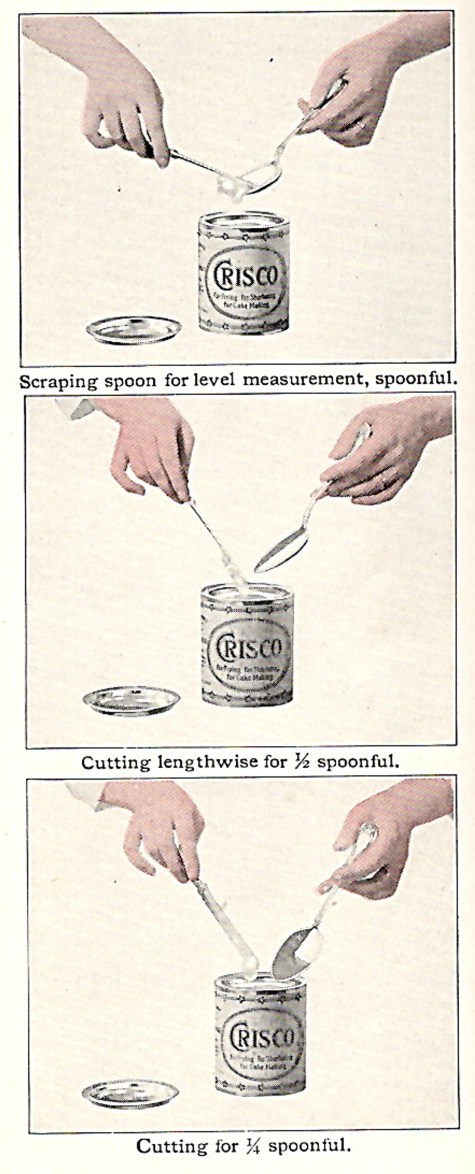
A hundred-year-old promotional cookbook for Crisco shortening had drawings showing how to measure a spoonful (or a half- or quarter-spoonful) of shortening. I knew that the spoon should be scaped to accurately measure a spoonful of shortening. I never would have thought of cutting lengthwise for 1/2 spoonful.
It was expensive to print color pages in a book in 1924. Apparently the cookbook publisher thought that directions for measuring a spoonful of shortening was a high-interest topic. Who would have guessed?

That was interesting. You find lots of good things in old cookbooks.
Agree- there are lots of interesting things in old cookbooks. I clearly enjoy browsing through old cookbooks. 🙂
That looks like a spoon from a silverware set. Was everyone’s the same size? Fannie Farmer had standardized measuring spoons by then. I would guess they were not widely used.
I guess they used the “tea spoon” literally!
I’m guessing that they did. Maybe I shouldn’t admit it, but I often use a regular teaspoon when measuring spices or other small amounts. It somehow seems easier than digging out my measuring spoons. A regular teaspoon seems to work okay and is “accurate enough.”
I imagine many of us have used a regular teaspoon!
I also think that it looks like a spoon from a silverware set. I noticed that the captions did not indicate whether the spoon was a teaspoon or a tablespoon. It just refers to “spoonful”, “1/2 spoonful”, and so on.
My mom always used a teaspoon from the flatware drawer, I guess it was accurate enough because her baked goods always turned out great!
Works for me.
I like vintage photos too.. nice post!
I would use Crisco if it had the same ingredients as it did 100 years ago..
Thanks! It’s nice to hear that you enjoyed this post. I think that the ingredients in Crisco have changed several times over the past hundred years.
This is exactly why I don’t use recipes calling for cupsful and so on! If a recipe doesn’t show the weight required I just find a different one.
Another difference between the two sides of the Atlantic. 🙂 Some modern cookbooks in the U.S. list weights for ingredients, but most still call for teaspoons, cups, etc. A more sophisticated cook would have a food scale, but that’s the exception.
Oh, yeah, I am “sophisticated!” I do have a scale, but truthfully, I bought it when I started making pour-over coffee and the water amount really matters to get the best cup!
🙂 Maybe I should buy one. My daughter cooks using a scale, and thinks I’d like one if I had it.
It has definitely come in handy on occasion, besides making coffee.
These photos are so elegant, aren’t they? Something about the way the hands are positioned. Either way, I do think it’s clever the way they cut the shortening in the spoon to get the partial spoonfuls. I have lots of these kinds of promotional pamphlets, they are so fun. 🙂
I agree – they are elegent pictures. There are some really skilled graphic artists. I also enjoy looking at old promotional pamphlets.
Hmmm. We were taught in Home Economics to measure butter, lard, Crisco etc. by putting 1 cup of water in a 2 cup measure then dropping chunks into the water until the level reached the the desired mark… The benefit was that you never left any of it in the cup because you couldn’t scrape it out completely. Works for peanut butter too!
What a great suggestion! I’ll have to try this. I hate cleaning measuring cups after measuring shortening.
My grandmother taught me this for shortening.
That is how we were taught in Home Ec too. I wonder how many young people get Home Ec in school now.
I think that most students get at least a semester of home ec in the school district where I live. Around here they now call home ec Family and Consumer Science. When I took home ec years ago, just the girls took it. Now everyone does.