
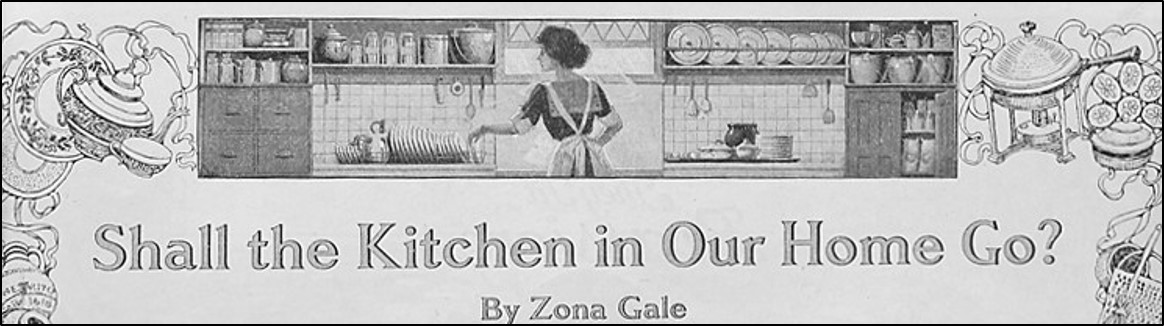
Sometimes I come across hundred-year-old magazine articles which absolutely stun me. They take positions which in some ways seem very forward thinking (or perhaps forward mis-thinking) – even by today’s standards.
Here’s some excerpts from a 1919 article which argues that there is no need for kitchens – and that cooking should be done in centralized locations:
Shall the private kitchen be abolished? It has a revolutionary sound, just as once upon a time there were revolutionary sounds in such propositions as these: Shall private wells be abolished? Shall private kerosene lamps be abolished? Shall we use ready-to-wear garments and factory-canned vegetables?
There must have been thousands upon thousands of men and women who said that these changes could never come to pass. But now we are not only reconciled to these, but delighted with city water, gas and electricity, and factory products.
And now why not get rid of the private kitchen?
The one who has not thought about it will almost invariably give the reply: “Oh, that will never be practicable.”
So now, when these very objections present themselves one after another before the proposition to abolish cooking in the home, it may be that we know how to meet them.
In a small town, it means the establishment of a central kitchen, or in a city the opening of many neighborhood kitchens. It means the preparation there of breakfast, lunch and dinner just as in a hotel or cafe. But the main industry would be the taking of telephone orders and the delivery of cooked food, hot, at the doors. Delivery would be made by auto; and, closed vans, with openings at the sides and filled with small electric ovens, heated by the power which supplies the car, are not such a far cry.
In the kitchen alone the primitive, solitary, unorganized labor of our ancestors continues to be maintained. When one thinks in terms of a whole town of, say, a thousand homes, a thousand stoves going, and the unpaid labor of wives and mothers who are themselves cooks, it is to be seen that the centralized system is exactly as logical in its certainty of economy as the centralized system any other business.
Source: Ladies Home Journal (March, 1919)
