Average Height for Males and Females in 1912 and 2012
16-year-old Helena Muffly wrote exactly 100 years ago today:
Tuesday, February 6, 1912: Am trying to get ready for monthly exams. They come tomorrow and the day after. I have sad hopes and misgivings for one study especially.
Source: Durrell’s School Algebra (1912)
Her middle-aged granddaughter’s comments 100 years later:
I’ve recently posted many of Grandma’s diary recent entries which indicated that she was working very hard on her algebra.
And, I’ve provided a lot of background information about algebra a hundred years ago. When I got ready to write this post, I wondered what else I might write about algebra.
To get inspiration, I flipped through a 1912 algebra textbook —and I happened to notice that one of the problems in the book was about the average height of males and females.—and it included a data table with heights for selected ages between 3 and 21.
This reminded me that I’ve heard that on average people are taller now than they were a hundred years ago—and the next thing I knew I was headed off on a tangent.
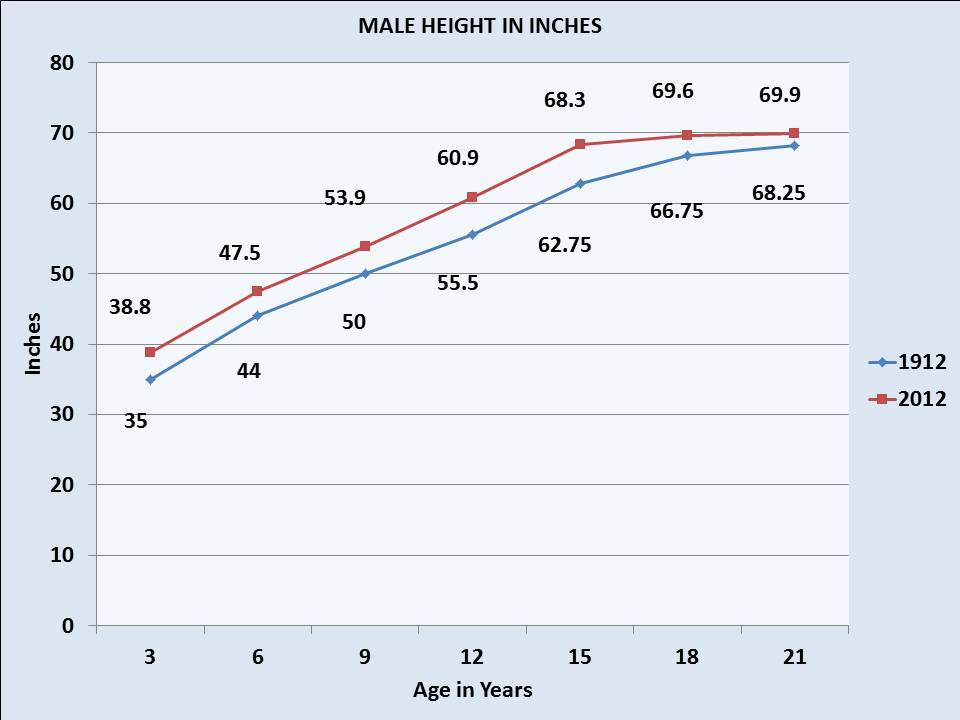
Average Height by Age and Gender, 1912 and 2012
Click on graph to enlarge.Click on graph to enlarge.
I found recent Centers for Disease Control data on average heights in the US. Since 2012 data are not yet available, I assumed that it is the same as it was in recent years. I also assumed that the data in the algebra book was correct for 1912.
On average, three-year-old children are much taller now than they were 100 years ago. Three-year-old boys are almost 4 inches taller; girls about 3 and 1/2 inches.
By age, 21, males now are, on average, more than 1 1/2 inches taller than they were a hundred years ago. In 1912 the average 21-year-old male was 68.25 inches (5 feet 8.25 inches) tall. Now the average male in the US is 69.9 inches (5 feet 9.9 inches) tall.
Females are about 1/2 inch taller now than they were a hundred years ago. In 1912 the average 21-year-old female was 63 .75 inches (5 feet, 3.75 inches) tall. Now the average 21-year-old female in the US is 64.3 inches (5 feet 4.3 inches) tall.
141 thoughts on “Average Height for Males and Females in 1912 and 2012”
I know that some of my ancestors were shorter than those averages and a few were taller. Thinking of my grown children, I both the boys are over 6 feet. One is 6 feet 4. Nobody else in the family to my knowledge has been that tall. One of my daughters is 5 ft. 7 in, as I was before i started shrinking. My female ancestor were all shorter, except for one tall aunt. Wish I had the exact height of my grandmothers and great grandmothers. I just heard the ones I never met were short. Interesting the 3 years olds are so much bigger.
I’m surprised at the more recent heights. The majority of our family are well above these heights not it’s now, but as long ago as grandparents. not sure how tall my 5 yr old grandaon is, but head and shoulders aove his class.
Maybe Aussie sunshine breeds ’em tall? Will have to see idmI can find some stats.
From NE OHIO? Happened onto this topic while watching a PBS documentary about the Statue of Liberty where a commenter of the day said, “she must’ve been modeled after some Ohio girl—her ears are 6 feet long.” Well, if I were 151 feet 1 inch tall my ears (2.75 inches not moderated for a couple of centuries extra growth approx 3 inches) would be just a little over 6 ft long. Must’ve been jealous—Hahaha. Having lived all over the USA, I’ve noticed that people from NE Ohio seem to be tall.
I’ve read that it’s because of better nutrition and better overall health since there are fewer endemic diseases now. I also was really surprised that the largest differences in height were in young children–but many small children may have been sickly years ago and not have thrived in the early years.
Yes, for some reason, everyone in our family thought of my grandfather as being tall but on his passenger list he is only 5’9″. Then I looked at my grandmother standing next to him and thought “Wow, she must have only been 5′. Of course, everyone seems tall when you’re a kid. My mom used to always say “It’s those vitamins they give you girls nowadays!” lol
One of my common thoughts as I research is ” How did these women ever survive the deaths of their children?” Almost all the women in my family lost one if not more. It is just so hard to conceive. An child’s death, infant or not is a real calamity today!
Many of those deaths are avoided now by the fact that corsets, (and the damage they did to muscles of the torso) have fallen out of favor. Add to that the knowledge of germ theory…..
Interesting. . . I’d previously heard that corsets were bad for women, but I hadn’t realized that they may have been a cause for some of the deaths from childbirth.
Corsets actually caused major damage and warping of the ribs, and weakened the muscles in the abdomen. If you look at a woman who has worn a corset for years, she will have a very thin waist– this is really just the lower ribs that were forced, slowly, into a different position.
Thanks to X-ray technology and advances in medicine, we know this and know that corsets are so damaging. However back then sometimes they were even worn by pregnant women in the early months.. And you can imagine what that did to the child.
Long story short, a lot of deaths in childbirth were caused by those blasted corsets.
P.S. Kids are getting smarter faster, too. I graphed stuff like that when I was 10/11.. And at 13 I’m studying microbiology. 🙂
But remember these are averages. I went to an exhibition at the Museum of London called London Bodies. People in Tudor times were short – HenryVII was deemed a giant at about 5 ft 8 inches, but some of the Normans were well over 6 foot tall. I think the first few generations in america were really strong and healthy – when families in European cities were struggling to maintain their numbers, recent emigrants were having huge numbers of children reaching adulthood. Bring on the fresh air and sunshine. Also, there is a thing called the milk generation. In Britain and I think in Japan, average height has peaked because until about 2 decades ago there was an emphasis on high milk diet. In England, shcools provided it free. Brits are shinking agaiin.
I’ve also heard that some people were very tall in the past. At least two early US presidents were quite tall. George Washington was 6 feet, 2 inches; and, Abraham Lincoln was 6 feet, 4 inches.
It’s interesting that heights in England peaked several decades ago. I wonder if a similar phenomenon is occurring in other countries.
With economic problems, I am sure the children born now will be smaller and weaker than their parents. There is a problem in Ethiopia that the women born during the famine had poor bones, so pelvic problems in childbirth now. Averages ignore the huge infant mortality rates – some families in English cities failed to produce a single adult. From the 16th century till proper water supplies in the late 19th century, English cities failed to maintain their population – that was done by inward migration from the countryside. Tehre are all kinds of myths about family sizes etc. Monasteries used to act as a check on population, then to an extent that was taken over by large estates. There was one case of a single aristocrat having 50 servants, all local people, very few of whom would have kids/marry. Hence populations were cotrolled before the cities became so filthy. The risks in childbirth were often due to stupid practices – the birthing room was sealed off to prevent bad humours getting in, and nothign was washed for the same reason, so this is why so many women died. Then there were sailors – problems with fresh water, so they added rum to it, they lived on salt bef & dry biscuits. They also had open fermented beer which in the tropics bred salmonella so they got food poisoning. How did anyone survive at sea?
It is suspected that Lincoln suffered from Marfan’s syndrome, though, and that may mean his height was the result of disease process, not normal growth patterns.
My Mom’s side of the family was very short but my Dad’s mom was a Giant at 6’4’…. no really all her cousins etc were small, even her sisters. Dad and his brothers were all tall.
I would like to but a link to your page on mine if you do not mind.
I am short by both standards…but closer to the average 100 years ago. At 5’0″ I’m taller than my mom and sisters! Thanks, Sheryl for the research and for an intersting post!
I’m taller than my mother; and my daughter is taller than me (though my husband is quite tall so that might explain why my daughter is taller than me).
Well I feel tall here! Lol! at 17 years old I’m 5’7 3/4 — although my dad (of German decent) is easily 6’4 now having been 6’6 at the age of 18. His whole family aside from his mother and sister are very tall, where as everyone on my moms side of the family seems average (which I always thought was short!) now that I’ve read this chart! My grandfather comes in at 5’8 (back in the day) my grandmother 5’5 (now 5’2) and my mother 5’3.5. I’m the giant! Lol. Even taller than my moms brother! Jeesh do I feel out of place LOL! Good thing I wasn’t born in 1912 😉
What about all the hormones in foods? Look at the abilities of our athletes, the size AND WEIGHT of people, earlier puberty, larger (un-augmented) breasts…
I think it’s mostly about having a reliable source of good food that makes us taller now. If people were tall in the past, it suggests they were doing very well.
Christine. I am 58 yrs. Old and in junior high about age 14 or going into my freshman year at high school, I am 5’10 and a half. Ihated in school in the 1960’s. But my mother said one day you will love your height. She was right and I’m comfortable ” in my own skin ” so to speak since my mid to late twenties I began to love being tall and carried myself differently when I accepted and began loving my height. I never had a problem with guys asking me out AFTER high school and many were 5’6 to 5’10 but never cared about the height difference. All adults in my family are at least 5’6″ . A tall woman or teem or girl can wear just about anything and look so much better than our shorter sisters. I wouldn’t trade it for anything now. But in Jr. High and high school it was very very difficult. I was really bullied ( I realize now) and made fun of. I am so glad you like being tall. Don’t ever slouch and walk with pride and style. It makes a huge difference when you ” show” that you are confident and comfortable with a not average height Still for women. So I have been 5’10 and a half since age 14. And I was very thin and willowy. About 115 lbs. Not so now 🙂 150lbs. But I look great between 150 and 160. Just doesn’t show. My granddaughter is 13 and 5’8″ . Doc. Says she’ll maybe hit 5’10. She loves it too. I hope tall girls aren’t getting picked on constantly in school now. My granddaughter says she isn’t picked on but kids can be mean as hell. Anyway just happened onto this website and felt compelled and am interested in how taller teens and women 5’9″ and over REALLY feel about their height these days? Any replys from tall med short? I’m genuinely interested. I wonder because my sisters in law all 4 are between 4’11″s and 5’3″ and they compliant all the time that I can spare some of my height for them kiddingly but really they hate being shorter and all say they would love to be 5’8″ and taller. Surprised me. B.
To Bonnay and Sheryl: here is a short lady signing in! I am 5′ 1.25″, thank you, and am quite petite as well. It bothered me as a child, because I have always been shorter than my peers, especially when I stopped growing around 11 or 12 ( I still wear a skirt my mother made me at that time, it fits perfectly!). Now I love it…until I stood with my 6 (or 7th) graders in class and a guest asked where the teacher was! I’ve also been called every age from 13 to 20; it’s so funny to watch people’s faces when I tell them I’m 24. I’ve learned to love my height as it makes me feel dainty and lady-like. In crowds I can get just about anywhere I want to–by ducking under and between where others’ can’t fit. I also am blessed with daily puzzles, “What can I jump on/stand on/ climb on to reach x,y,z,” that I find really fun. I never had to worry about dating men shorter than me, and my 5’9″ husband feels tall.
But my whole family is short, on both sides. Mother is 5’2″, Dad is 5′ 7″ or 8″, and my “tall” brother is 5′ 8″. My dad’s side were farmers and ranchers from Denmark, Switzerland, and England; my mother’s side were farmers from England and Scotland. There were instances of “tall” people (usually men) on both sides, but I doubt they were too far over 6′.
I am 5’11” and have been since I was about 15! I have always loved it. I was teased in the lower grades but I never thought it was anything to do with my height…
Sometimes I feel a bit like a giant when it comes to dating as I feel some men are intimidated. But I still wouldn’t trade it!
Being 4’9″, I can only bring the perspective of a below-average person, but will say that teasing (intentional, or otherwise) does tend to be dependant on the average in the individual peer group, as much as the wider averages. I have a sister who is 4’4″, and a brother who is 5’2″; despite being the tallest of us, my brother received by far the most height-related bullying, while growing up (though I suspect my sister would have been subject to more, had she not gone to a selective gymnastics-based school – she did get teased for being mute, though).
There are positives, and negatives, to being short (some can be either, depending on your mood, and context. Many of the difficulties present in professional environments are a stumbling block, but it is far worse for those in wheelchairs, who cannot just stand on something, and don’t have the ability to approach something as closely. I have found it more difficult to get people to accept/allow things which permit you to do a task, than it is to find ways to do something.
Socially, low stature often leads to being ignored (both in terms of being overlooked, and in terms of people not paying attention to what you say – which applies professionally, also, and seems, from my observation, to play as much a part as gender, in that context, if not more). My sister has far more problems here, than I do, and is often treated as if a child, even when people know she’s an adult (despite being short, she has “normal” proportions, so is less obviously an adult than many of her height). This has a knock-on effect, in that her husband can often get as much negative attention as she does; he actually has to be careful about how he behaves around her, in public, as he has been assaulted in the past, when someone was under the impression he was kissing a child, and often puts up with verbal abuse.
Positives often come from having a different perspective, and ability to do things which giant (normal) people cannot. While you don’t get noticed, you do notice other people who get ignored, and can often make good friends through that mutual experience. I get to wear exactly what I like, as I have resorted to making my own clothes in my spare time (which I also make for my sister, and a few others).
It can also be amusing when you hear someone much taller than you complaining about being short, and you can usually make them feel better about it, and have useful tips.
I hope your granddaughter found good friends, in school, and hasn’t faced difficulties due to her height; by now, it may well be that the advantages are more apparent, and it proves a boost to her confidence.
Apologies for replying so late :- Hopefully it is still a useful perspective.
Interesting comments here! I live the discussion. I feel compelled, however, to dispell two common myths. First, shorter doorframes and lower ceilings were not due to shorter heights. Rather, the very practical consideration of cost was the culprit. The price (and sometimes scarcity) of building materials coupled with the cost of heating a home were the primary reasons for lower ceilings and doorframes. Particularly costly fuels in remote, less-forested areas (or the Northeast US after 1800, which had been almost denuded of trees from generations of settlement and construction, along with the longstanding mast trade and use of wood fuel) resulted in the need to conserve resources. Fireplaces and small stoves are not terribly efficient, so lower ceilings serve to keep heat in. In general, only those wealthy enough (and house-proud enough) to have unused space in their homes had tall ceilings and large, infrequently-utilized rooms. A fancy parlor or high ceiling meant you were well-off, as did having extra chairs or spare beds. It is hard for us to conceive of it, but most people shared a bed with someone their entire life from toddlerhood through the death of their spouse. Almost no one lived alone, either, regardless of age. These luxuries of space are modern conventions which few people prior to the mid-20th Century experienced.
The second myth is that if the corset. I have been presenting first-person history for several years and have studied historic clothing of the last several centuries for several years as part of my programming. I wear custom-made historic reproductions and am on my third corset. (I portray 1890s). Corsets in and of themselves are not nearly as uncomfortable as you may think, and, duebtobthe nature of lacing the entire length of the back, are very much adjustable. Women wore them for centuries to protect their ribcage and back as well as support their breasts while working. It is only after the Civil War that tight lacing became a fad and (thanks to images in Godey’s and other fashion plates) women of high income and high fashion began lacing to extremes. There is ample evidence that consistently excessive tight lacing will cause damage to anyone’s body, but most women did not do this daily. The few who did could be equated to women who today wear six-inch heels…they find very quickly how impractical and uncomfortable such garb is for regular life and either restrict the habit to occasional practice or abandon it altogether. In the case of corsets it is important to note that the tight lacing fad was brief and largely anecdotal.
Regular corsets were supportive garments that no woman could generally forego entirely; some manner of support was necessary and worn daily. The lacing was NOT usually done with anyone’s help. Just as everyone learns to tie their own shoes or wash their own hair, every woman could lace her own corset. The tightest lacing can be done by then wearer herself, but this requires a lot of extra time (30 minutes or so if you don’t usually lace very tightly but want to try it). Most women probably didn’t see much benefit in the practice and kept to lacing at whatever level felt right to them. Lacing any corset changes then wearer’s breathing pattern and very tight lacing will make for difficulty in breathing and digestion. Pregnant women sometimes wore specially-designed “mother’s corsets” which had adjustable gussets at each side to accommodate a burgeoning belly and of course supported the belly while relieving the strain on her back. Such a garment was probably very useful when sleeping in the last trimester! But overall, I do not think corsets had much to do with maternal death or infant mortality. Multiple in-depth studies have demonstrated that 19th Century birthing practices became more deadly when the shift to male MDs (who had only brief instruction on labor & delivery) began replacing experienced midwives and more women went to hospitals…hotbeds of germs for some time after the introduction of germ theory!…the rate leveled off and declined to more normal levels after obstetrics became a specialty.
Working women often wore homemade stays during heavy tasks around the home and farm, and whale or steel boned corsets per se were often reserved for social occasions, church, visiting, and other “dressy” times.
When properly sized, a corset supports the body and prevents or lessens potential injury when lifting heavy objects. Because it restricts the waist’s angle of motion, it forces the wearer to bend at the knee with one foot forward and the other a few inches back, thus encouraging the kind of “lift with your legs” action that modern workers in manual labor jobs are reminded of in every training video!
The information about corsets is very interesting. I can remember my mother telling me similar things about them when I was a child.
And, I knew that there was a lot of concern about the destruction of forests in the US in the early 1900s–and that there was an interest in environmentalism, but I hadn’t thought about how that translated the lower ceilings due to the high cost of wood.
Well, the environmental concerns of the forest destruction took a long time to kick in, but at least they did finally happen in rheb20th Century…but the high cost of wood was a problem for centuries. England was deforested so badly in the 16th and 17th centuries that one of the major exports in the American colonies was trees for shipbuilding. Shipyards sprang up along the Atlantic coast and the mast trade was vital to keeping up the British Navy…many colonial governors including my own New Hampshire’s Benning Wentworth found ways to satisfy the demands of the King while making friends in New England by skimming off the top and letting their local friends have some of the tallest, straightest, highest-quality trees for their own use regardless of royal decree. The King didn’t necessarily know what he wasn’t getting and Wentworth’s pals around here kept his secret in exchange for various land grants and the like.
So…even by 1800, wood was scarce. And, as our population moved into the frontier, the trees were different and of fewer number in the more western regions.
No matter, the construction cost was always a factor, and even if lumber was abundant, people didn’t want to be wasting their fuel of any kind to heat several feet of dead space near the ceiling. It made little sense to most ordinary people to expend the money and time and labor to construct something with such extravagance. Remember too there were few who could hire a professional house builder and his crew, and trading labor was an obligation to be met as seriously as any monetary debt…so people didn’t just take on laborers with vague promises or a couple of meals. Everyone kept account books and knew who was owed what for their work. It is easy to buy into a myth that everybody just threw a work party when a house or barn had to be built but the reality was much more complicated. Ultimately, if ten people came to help you build the barn or thresh the wheat and you didn’t have cash to pay wages, then you owed each man the equivalent in your own labor for the work he performed for you…no matter how great your wife’s cooking!
So…would you really want to build a house with 10′ (+) ceilings and a bedroom for each person? And if you did, who was going to chop, haul, and/or pay for all the wood? And who was going to tend all the fires? Or maintain the chimneys and douse the flames when the sparks ignite the roof? You’ll notice too that many early homes and businesses (especially those which predate heating stoves and more modern fireplaces) had a door on every room…helps to keep heat in just the rooms you’re using at the moment.
Us modern folk with our central heating and readily-available fuels hardly ever think about the size of our living space and probably take it for granted. Many of us envy the neighbors with the bigger better everything (as did any previous generation) but we forget how spoiled most of us in modern “first-world” cultures are today, even when compared with our own grandparents. My last grandparent died in early 2012, just 6 months shy of her 100th birthday…and she grew up sharing a bed with at least of one her three sisters until the day she married! So much has, indeed, changed drastically in just a century. And getting back to trees…many parts of New England have exponentially more trees growing today than were left in 1913. So even if we’re very spoiled in the modern age, we have done *something* right. 🙂
My dad is 6 ft 1 and my mom is 5 ft 4. I am 18 and i am like 5 ft 10.5 i wish i was at least 6 ft tall. My brother is the tallest in my family. He is 16 years old and he is 6 ft 2 and still growing. He is suppose to be 6 ft 4 or 6 ft 5 when he is done growing.
Children are born BIGGER, they are developing faster as well due to different diet ingredients, etc. However, fact is that people were indeed TALLER back in the history if they were given just a more decent diet containing enough meat and proteins that even poor folks consume today. Why is that so? Because children definitely enter puberty EARLIER in our modern times, and that is affecting both sexes, though it might affect females a bit more than males.
When you compare yourself with your ancestors, you should know that they didn’t have proper diet at all, their lives were much more stressful with wars and much more serious dieseases, they often had to work as early as 5 years old, believe it or not… and working conditions were horrible. Pregnancy during the time that your body grows also counts in, and you should also add famines… plus they didn’t have any treatment for their body to avoid not only general health problems, but the deteriorating of their height as well, due to certain habitual and health issues. When you watch your mother and father, you should add at least a few inches to their height, that’s their prime height at the age of puberty if no other health condition affected it even more. If you had a grandfather who is 175cm tall (69 in), you should add about three inches to his height loss form mere aging to get his height when he was in his 20s, without any other health factors included, or taking environmental influences. Lots of old folks indeed get affected by various conditions that will lower then height even further.
During middle ages, an age for adult person was 10 years old in many places and you were considered as a man/woman at the age of 15. In fact, females were considered to stop being children very soon after their first menstruation. Pay notice how absurd it is, when we know that they would just be entering puberty at that moment… and boys with 15 years old will still be in a time period when their beard didn’t start to grow and will not start for a few more years. This is why beard and menstruation were the symbol of age/adulthood at the time, NOT the height or even age itself. It was culturally and socially acceptable display of adulthood.
I’m a researcher on this topic, I’ve participated in research of height of people in middle ages (among other things) and it’s relationship to nutrition, biology and even other things such as wars, poverty and life conditions in general, etc. There is a network of researches which still continues to do this research and it spans across several countries in Europe and I’m just a piece of that network.
Most of the things that we “found” are well known and obvious reasons that no sane person will dispute, however there is one breakthrough discovery that certain people still try to dispute.. and that is the fact that females and males weren’t really dwarfs during middle ages, main reason being that females entered puberty at average of 14-16 years, while males entered even later than that.
There is a noticeable correlation with DELAYED PUBERTY and height, not just the height at certain age. It was believed that children who are taller will stay taller after puberty, regardless of the time they enter puberty. But this apparently isn’t true and with more than two decades of research I’m 99,9% certain of this – earlier puberty results in shorter stature and it’s universal for both genders.
Children who enter puberty later tend to stay in prolonged period of growth during their growth sprout, because the bones form at much slower rate! This is often enough to catch up and outgrow other children who were taller even before they entered their early puberty. Most probable reasons for earlier puberty are genetic food modifiers and additives in food such as milk, growth hormones, etc, and this is why some people tend to sabotage our findings which are very consistent, because it may cause panic in minds of some other people regarding “food safety”, which our research never contested at all. However, this finding has gained some momentum worldwide and it’s been taken as a fact by many researchers in recent years, due to the extent of research and comprehensive work of many people that was invested to know more about lives of our ancestors during middle ages.
What could be the cause of earlier puberty? For now, it’s more of a guess, but they claim it’s “female hormones” that people consume in their food.
“Female hormone” estrogen (actually both males and females have it) is known to help the girls to grow faster than boys due to inner body composition. I’m not a biologist but that’s how i was told by biologist experts who participated in our research. You may ask why do females tend to be shorter… it’s because estrogen also tends to “form” the bones much faster, so the growth tends to stop afterwards. It makes more sense when you listen to biologists though, I’m historian. But this is why girls tend to have sharper growth during puberty while boys tend to enter puberty later and have delayed growth over longer time. Since estrogen is connected with fertility in women, this is why women with more estrogen tend to be more fertile and have much less problems with fertility than those who lack it, but also tend to be shorter than average due to entering puberty earlier.
Oh and by the way. Tall normans is a myth. In fact, it is a myth that stems from roman interpretation of invaders in most cases. Each time you fight an opponent, you tend to claim there were more enemies than there were, you claim that they were bigger and taller than usual, more cunning and bloodthirsty, more horrible than what others can imagine. It’s similar with how greeks described their first contact with whale, claiming it to be 80 meters in today’s measurements. Then the scholars of their time tended to discuss their findings and concluded that it couldn’t have been longer than 50 meters with the way they described it, with mere claim of “being as long as from one ship up to the other”. Nordic people tended to be average or even shorter than other people measured, while tallest people in 19th century were thought to be American Indian natives, by confirmed measurements. Pay attention that only a few Western European, Nordic and American societies measured their people, and standardized measurements started with obligatory military conscription. Determining height wasn’t easy in every day’s life because men were supposed to wear some sort of hat or headcover in almost every culture. You’d be surprised to know that almost every male wore a hat just 100 years ago, or that even vast majority of western women wore headscarfs or hats, something that you can mostly see only in exotic societies in the middle east or far east and india in today’s world.
I liked your detailed comment here on Sheryl’s interesting post on height and you were wise to mention the wearing of hats and scarves a hundred years ago. It might seem common sense that nobody would have their height measured without doffing those, but I believe they likely did. A coworker of mine, a very bright engineer no less, once claimed to be 6 feet tall and I could tell from simple observation he was shorter than that. I couldn’t help but ask whether that was with or without shoes and he readily admitted the shoes, as though that were the common practice. It was, for him.
My own height is 6′ 2″, which I’ve always taken for granted. My sons are shorter and have often wished aloud that they were taller. Moral of the story: without an enforced standard of accuracy, height data are likely to be subjectively skewed.
P.S. One indication that the data in the graphs are skewed, for whatever reason, is that the two sets converge at age 21. It looks as if they might even have merged if the age were extended a few years.
Interesting. . . This probably isn’t right, but it crossed my mind that maybe people matured later years ago, and therefore were shorter at younger ages, but eventually reached full height.
Excellent comparisons! If you really want an eye-opening set of measurements, take a class in Historical Perspectives On The Standard and Control of Female Beauty. I took the class years ago as part of a graduate program, and there I learned the techniques developed to keep female feet small (binding), “form” their bodies to keep the waists tiny (night corsets), etc. Measurements and statistics reveal so much of cultural attitudes.
I believe the bigger difference in size of children 100 yrs ago is likely because of growth hormones. As far as the difference in the height of adults, I believe that is because of selective breeding. When I was dating, I found the most frequent criteria women indicated for an acceptable partner was height – taller being preferred. Many women who were well under average height, yet required that men they date be well above average height for a man. So taller men are more likely to procreate than shorter men. Men on the other hand don’t seem nearly as concerned with the height of women they date, though many prefer their woman be their own height or shorter, it doesn’t make up for the number of woman rejecting men of below average height.
My sons are a perfect example of this statistic. One is 6’5″ and his younger brother probably will be, my others sons are 6’1 or more. One of my grandfathers was listed on his Civil War records as 5’5″.
interesting that most of the blogggers here talk about their own heights or famiiles’.
More pertinent to this discussion is averages for populations and how they have (or haven’t) changed. Actually thought that heights of Americans had increased more than an inch, so these facts are interesting. Prob. the result of better nutrition.
Clear example of this effect is Asians. While don’t know exact heights, it’s very clear that there has been a dramatic difference in heights
with this group over just 1-2 generations. (my high school soc. studies teacher taught us that the Chinese were “genetically short people”.
However as anyone with Asian friends can tell, those raised in the U.S., or in Asia starting in the 60’s, are at least as tall as Americans!
No doubt in their case there was a lack of protein in their diets before which when rectified produces people of similar stature proving that Asians aren’t :”genetically short”!
Well, that puts things into perspective. It hadn’t occurred to me that my grandmothers were tall for their generation. Hazel (born 1896) was 5’6″ and May (born 1902) was the same.
Isn’t that amazing. I wonder how my family got so tall before their time. Grandpa was barely taller than Grandma, but my dad and his sister towered over both. We women have just stayed the same for three generations.
Very interesting article I used to tower over my grandson ,pat him on the head and say “My little Maxwell” . Now 6 foot 3 Maxwell pats me on the head and says “My little Bubbi”. Kids are definitely growing taller and It doesn’t help that we shrink as we age.
Hi Sheryl. I think it is a wonderful project that you undertook. kudos to you. I wrote my memoirs “Why Me” to entertain and also to leave a legacy for my offspring and future generations. I hope to inspire others to also keep a journal or write their memoirs. Our kids and grandkids often don’t think to ask questions until it is too late.
Incidentally this blogging business is new to me, but i have to admit it is addictive.
Thanks for the nice note. I have a lot of fun doing this blog. When I first started it more than two and a half yours ago I didn’t know how long I’d stick with it, but I find that I keep enjoying it more and more.
Well, I guess at 5ft. 3in. I’d still have been short even in 1912, but I’d have been closer to average back then. Cool post, I really enjoyed reading it. 🙂
How interesting! If you go back to prehistoric America there were giants of nearly 7′ tall. Seems this height thing must go in waves as today’s young men especially are on the whole much taller than their ancestors. My grandson is 6’11” tall while his dad is 6’5″. Think it definitely has something to do with nutrition.
Yes, his mom was about 5’8″. We often thought my son married her for her height so he could have a tall son to play basketball. Her dad was about 6’6″ and that was really tall for someone born in the 1920’s. So it appears that a good set of genes also helps…as well as good nutrition.
This was very interesting! I would never have thought of subject, & yet, interesting. One of my son’s friends is “short”. I wonder what would have been his ancestors.
Very interesting post. I agree with Bonnay. By seventh grade I reached the height I would keep the rest of my life. It’s fine now and average. But at that age, it felt like I was a giant among tiny’s. My first kiss, I remember having to bend down to kiss the boy. (laughing to myself now.) Like Bonnay after high school was a whole different world. One where guys thought tall girls we’re sexy. My brother actually utilized his height making it work for him. After he joined the Marines, he was given the chance to try out for an elite group, (Color Guard). His height being the major factor. He’s 6’4″. So he passed and was stationed in Washington D.C. during Carters presidency. Color Guards are the marines you see holding the flags in front of the White House. Standing in a line when foriegn dignitaries are welcomed. Pretty amazing what his height helped to get him the honorary status in the military.
Thank goodness people are here debunking the myth that “people were shorter back then.” Generalizations from one bit of data in one specific time frame are always sketchy at best. I am glad that you only presented it in somewhat less general context – one specific year compared to another specific year. It is too bad that folks tend to take things and run with them. Interesting commentary though! In case anyone is interested, I recommend this blog for good information about historic myth in general: http://historymyths.wordpress.com/
the only explanation I’ve ever found is that females hit puberty sooner, so switching off growth. That still begs the question why this happens, which is said to be linked to survival of the species. As puberty gets sooner in Western societies, this should mean kids are getting shorter. But this seems to be countered by better nutrition in the same group. Hope this helps.
My grandfather born in 1910 was 6’6. My grandmother was 5’0. My father is 6’2 and his brother is 6’5 and all 3 of his sisters are 6ft-6’2. My mother is 5’3 and I am 5’9. My 13 year old is 5’11. My sixteen year old is 6’3 and my 20 year old is 6’1. I am of Norwegian decent. My Mothers father who was american indian was 6’6. I know that my kids are very tall compared to others boys or men. I believe my height comes from my genes. My kids father is also 6’0 but his brothers are shorter than him, the shortest being 5’7. I do believe nutrition is a huge factor, but my ancestors were very tall and that was 100 years ago.
This was really interesting I am short I come from a family of short people but we are not dwarfs just short I am 4’11” this is just we are I have three daughters ranging in height from 4’7″ to 5′ my husband is only 5’2″ so as I said we are all short
I don’t see any comments regarding a potential scientific explanation, that being hybrid vigor, I think the correct term is ‘heterosis’, whereby any species that has been geographically separated for long periods of time comes together and reproduces offspring with characteristics and traits that generally exceed both parents. Well known if you are a farmer, especially livestock (cattle, hogs etc) producer.
Fascinating report. If the global population keeps rising, we may want to find a way to become smaller again. Maybe we can all shrink to the size of nanobots so we’ll all have plenty of elbow room. Have you heard that North Koreans are on average six inches shorter than South Koreans? I’m about 5’10” (I used to be 5’11” but my posture has deteriorated), and I have a few friends from England (I’m from the US) who are well over six feet tall. They make me feel like a munchkin.
To be perfectly honest, I think that table may even be overestimating the average heights. If you take a look at the table from this link: http://eh.net/encyclopedia/a-history-of-the-standard-of-living-in-the-united-states/, you can see that average height has changed a lot more than thought. Three things to note about Table 3 on that link:
1) Before 1960 (when height was then on measured through health studies), all heights were taken from military muster rolls, consisting mostly of young/young-middle aged men.
2) These are listed by birth cohorts, meaning that the average height in 1910 was NOT 67.8 inches, but the average man BORN in that year was that height.
3) America was at least 80% non-hispanic white until the 1980s thereabouts, so the average heights listed don’t reflect ethnic diversity as much as today’s does.
“This PDF is a selection from an out-of-print volume from the National Bureauof Economic Research
Volume Title: Health and Welfare during Industrialization
Volume Author/Editor: Richard H. Steckel and Roderick Floud, Eds.
Volume Publisher: University of Chicago Press
Volume ISBN: 0-226-77156-3
Volume URL: http://www.nber.org/books/stec97-1
Publication Date: January 1997
Chapter Title: Heights and Living Standards in Germany, 1850-1939: The Case of Wurttemberg
Chapter Author: Sophia Twarog
Chapter URL: http://www.nber.org/chapters/c7434
Chapter pages in book: (p. 285 – 330)”
This is a post after my own heart. I was born in Italy to an Italian father but grew up in the UK. I was always considered short as a teenager, and eventually reached the glorious height of 5′ 6 1/2”. A few years ago, I moved back to Italy and one day I was having a conversation with an Italian man and I said, ‘Of course, as a short person …’ He looked at me quizzically and said, ‘But you’re not short.’ I looked at him and then looked around and thought. ‘Wow! For the first time in my life, I’m average height.’ I’ve since encountered many, many men shorter than me here. But visiting the UK and USA I feel like a child.
Living in Australia, my theory is that people consume a lot more chicken (in general) and most consume commercially raised chickens (with ‘growth hormone’ among other things). Ordinary chicken are raised to mature in 6 weeks from chick to point of sale these days. Not the average growth cycle of 3-4 months as produced in organic free-range farms.
I was considered tall at 5’6″ back in the 1960s. My nieces (18, 35 yrs old) and nephew (32) tower over me now. I wonder if the intake of growth hormones through chicken consumption has any bearing on this. Secondly, in Australia at least, we have a much higher intake of healthy food and exercise that might build strong bones and/or height 20-30 years ago. Or is this theory too far-fetched to consider.
(BTW now, with modern technology being all the rage in the last 15-20 years there is a substantial increase in sedentary behaviour amongst young school children and 40% of Australian school children are considered obese. This is a worry for the future generations).
I don’t think chicken growth hormones do the same to humans. Fast growth means the chickens are less nutritious. I think part of the difference is we eat more fruit & veg than previous generations, and don’t work as hard. Even walking – they did a lot more of it, so they should have been healthier. One theory was school milk made that generation taller. Scandinavians have a high dairy intake & are generally taller and fitter than other Europeans.
Hi Sheryl, I am a science writer in Illinois working on a story about human growth and would love to reference your charts above. Can you tell me who/what is the source of those nice charts? I’ve hunted around the internet but only see them on your site. Thanks so much!
I made the charts using data that I got from two sources. As described in the post, the 1912 data was in an appendix table in Durrell’s School Algebra (1912). The 2012 data is from the Center for Disease Control (CDC).
Oh I get it now! I didn’t pick up on the fact that you had put together the charts yourself. They look terrific, but alas I would need a graphic from an “official” source, like UNICEF, CDC or whathaveyou. Many thanks for your response, and your site is a fun one — I enjoy history, and especially historical recipes. I’m going to browse your recipe section a bit more. Take care.
I’m 5’7 1/2…at 68…was 5’8….scoliosis probably cost me an inch or so…The present generations are taller because of the growth hormones in the meat and milk..! men now have longer spines then 50 years ago.
It’s mostly about diet. For most of human history there have been food shortages so the poor have been stunted. In Britain they introduced free milk to schools and the height of that generation was taller than their parents. I think the reduction now is that puberty is starting younger so kids have less time to grow before their bones stop.
Yeah, I am a 57 y/o man. Had scoliosis and wore a back brace as a teenager. I was always one of the shortest boys in my class. I ended up 5’10 but probably 5′-9 1/2 now. I kept having residual growth into my mid 20’s but it took me a while to begin my growth spurt.
Hi folks! As well as improved nutrition, especially dairy, meat protein and added vitamins (and maybe growth hormone in the meat), people are now taller also because of these: central heating; fewer childhood illnesses; more sleep; and no child labour (labor).
With the central heating factor, it is believed cold rooms/homes stunted stature. And as children no longer are forced to work they get more sleep and less physical hardship altogether.
With Medieval England, in the earlier Dark Ages men were only slightly shorter than now. Women are believed to have been taller!
Then after the Black Death, heights shrank and then very slowly increased until refrigeration from the 1880s.
Two sets of data for the readers being for World War 1 and World War 2. British men were around 5 ft 6.5 in, albeit an inch taller for the Kitchener Army volunteers before general conscription. In the Second World War they were a much healthier 5 ft 7.75 in. Americans in WW1 were 5 ft 8.25 in and in WW2 5 ft 8.5 in. Very different patterns between our two countries.
Hi again! Just more detail on the two world wars. During the First World War there were many young men not fit enough to join up. Common reasons being TB and flat feet. Yes! The very poor children then did not have footwear, often resulting in dropped arches.
Therefore the average British man, especifically English, was 5ft 6.5in, but from a 1930 encylopedia of mine, throughout the war the average was 5ft 7.55in. I know that for many of the Kitchener volunteers, and the artilery and guards whatever, the minimum requirement was 5ft 8in. So when general conscription came in, the shorter men slightly lowered the average.
Another interesting point being that the Scottish especially, the Irish some and also the Australians, were significantly taller than the English and Welsh. The Scots servicemen in WW1 were 5ft 8.75in and were nicknamed “The Five Eighters”. The tallest Scots then being in the Borders, with an average just over 5ft 10.5in. Taller than the present Scottish/British average.
While this is a late reply, I hope it will lend more information.
During the First World War, many young men (boys, really), at least in the UK, were recruited based on height, and chest size, as part of the “health checks”. I know from the ages of family members, and those of some friends, that there were more under-age soldiers recruited, in at least the area they resided, than is publicly acknowledged (this is largely due to the boys lying about their ages, in order to be considered). My grandfather joined up at 14, along with some of his friends, who were of a similar age; there were two who were turned down, and told to wait for a year, in order to grow, but the rest were accepted. Most were given non-combat roles, such as in stores, or tending horses, which suggests that it was realised (at least by some) that they were young, and some attempt was made to keep them relatively out of harm.
Given such boys would have been recorded as the ages they gave, on enlistment, it would possibly be a contributing factor in skewing the statistics.
Thanks for the information. This makes a lot of sense. I’ve also heard that boys in their mid-teens joined the military during WWI and other wars in the past.
Posts are more interesting than the facts in the blog. I’m 18+ and 5’6″. The most wonderful thing is I began to grow taller rapidly when I was 16 (then was 4’11”) and now it’s almost stopped. Doc says that my pitutary is normal.
Interesting, this doesn’t play out the way I suspected. All in all, people’s final heights aren’ that much different, but their early years are. This may tie into some other physical trends we read about, but the common assumption that we’re much taller doesn’t appear to be correct.
I wonder that as well, and I think it has to be clear that nutritional conditions and environment (keep in mind that the average dwelling was not kept nearly as warm during the winter, and even public buildings were fairly cool in the winter) were playing a real part there. But what I also think this suggests is that people basically nearly caught up, or perhaps if we consider variance in human populations completely caught up, by adulthood. That might make quite a bit of sense as diet was probably not quite as poor overall as we imagine, even if the average American was consuming fewer calories overall, such that people were perhaps generally reaching the maximum of their genetic heights.
Hi Sheryl! It’s been many months since I have posted on my own blog (I just did!) and even longer since I have visited other blogs. Hope you are well and managing this “new normal” that we are all experiencing.
Interesting data from the CDC!
I always wondered how my grandmothers dealt with losing children. I cried for them. I saw my mother after one of her adult children died in a car accident. She was never the same woman.
My great grandfather was born in 1834 and served in the 36th Alabama Infantry at 6-3, whew what a target! His last son was my grandfather who was 5-8 born in 1897. He had nine children, 7 boys only two landed at around 6-1 and the rest were of 5-10 to maybe 6 foot. My mom and her sister were around 5-7. Of my many cousins the females seem to be around 5-4 to 5-7. The boys from maybe 5-10 to 6 foot but mostly where I am at 5-11 except only one younger cousin who stands 6-3 at age 60. I have always thought that it was mainly in our genetics, somewhat of a hit and miss on height provided the diet is adequate and of course quality of life. This would pertain to the generations listed and not to the younger ones who had all the hormones added to their meats whom are towering over me. The high school kids look 23. My linage is Scotch-Irish, Native American with a pinch of Nordic. The latter is of course the height factor which keeps most of us above the average mark. I have enjoyed all of your reads.




I know that some of my ancestors were shorter than those averages and a few were taller. Thinking of my grown children, I both the boys are over 6 feet. One is 6 feet 4. Nobody else in the family to my knowledge has been that tall. One of my daughters is 5 ft. 7 in, as I was before i started shrinking. My female ancestor were all shorter, except for one tall aunt. Wish I had the exact height of my grandmothers and great grandmothers. I just heard the ones I never met were short. Interesting the 3 years olds are so much bigger.
I’m surprised at the more recent heights. The majority of our family are well above these heights not it’s now, but as long ago as grandparents. not sure how tall my 5 yr old grandaon is, but head and shoulders aove his class.
Maybe Aussie sunshine breeds ’em tall? Will have to see idmI can find some stats.
From NE OHIO? Happened onto this topic while watching a PBS documentary about the Statue of Liberty where a commenter of the day said, “she must’ve been modeled after some Ohio girl—her ears are 6 feet long.” Well, if I were 151 feet 1 inch tall my ears (2.75 inches not moderated for a couple of centuries extra growth approx 3 inches) would be just a little over 6 ft long. Must’ve been jealous—Hahaha. Having lived all over the USA, I’ve noticed that people from NE Ohio seem to be tall.
I wonder if what we are eating has anything to do with it.
I’ve read that it’s because of better nutrition and better overall health since there are fewer endemic diseases now. I also was really surprised that the largest differences in height were in young children–but many small children may have been sickly years ago and not have thrived in the early years.
Yes, for some reason, everyone in our family thought of my grandfather as being tall but on his passenger list he is only 5’9″. Then I looked at my grandmother standing next to him and thought “Wow, she must have only been 5′. Of course, everyone seems tall when you’re a kid. My mom used to always say “It’s those vitamins they give you girls nowadays!” lol
Maybe it is the vitamins!
One of my common thoughts as I research is ” How did these women ever survive the deaths of their children?” Almost all the women in my family lost one if not more. It is just so hard to conceive. An child’s death, infant or not is a real calamity today!
These women also needed to worry about whether they would die in childbirth. I couldn’t do it. They must have been tough.
Many of those deaths are avoided now by the fact that corsets, (and the damage they did to muscles of the torso) have fallen out of favor. Add to that the knowledge of germ theory…..
Interesting. . . I’d previously heard that corsets were bad for women, but I hadn’t realized that they may have been a cause for some of the deaths from childbirth.
Corsets actually caused major damage and warping of the ribs, and weakened the muscles in the abdomen. If you look at a woman who has worn a corset for years, she will have a very thin waist– this is really just the lower ribs that were forced, slowly, into a different position.
Thanks to X-ray technology and advances in medicine, we know this and know that corsets are so damaging. However back then sometimes they were even worn by pregnant women in the early months.. And you can imagine what that did to the child.
Long story short, a lot of deaths in childbirth were caused by those blasted corsets.
P.S. Kids are getting smarter faster, too. I graphed stuff like that when I was 10/11.. And at 13 I’m studying microbiology. 🙂
But remember these are averages. I went to an exhibition at the Museum of London called London Bodies. People in Tudor times were short – HenryVII was deemed a giant at about 5 ft 8 inches, but some of the Normans were well over 6 foot tall. I think the first few generations in america were really strong and healthy – when families in European cities were struggling to maintain their numbers, recent emigrants were having huge numbers of children reaching adulthood. Bring on the fresh air and sunshine. Also, there is a thing called the milk generation. In Britain and I think in Japan, average height has peaked because until about 2 decades ago there was an emphasis on high milk diet. In England, shcools provided it free. Brits are shinking agaiin.
I’ve also heard that some people were very tall in the past. At least two early US presidents were quite tall. George Washington was 6 feet, 2 inches; and, Abraham Lincoln was 6 feet, 4 inches.
It’s interesting that heights in England peaked several decades ago. I wonder if a similar phenomenon is occurring in other countries.
With economic problems, I am sure the children born now will be smaller and weaker than their parents. There is a problem in Ethiopia that the women born during the famine had poor bones, so pelvic problems in childbirth now. Averages ignore the huge infant mortality rates – some families in English cities failed to produce a single adult. From the 16th century till proper water supplies in the late 19th century, English cities failed to maintain their population – that was done by inward migration from the countryside. Tehre are all kinds of myths about family sizes etc. Monasteries used to act as a check on population, then to an extent that was taken over by large estates. There was one case of a single aristocrat having 50 servants, all local people, very few of whom would have kids/marry. Hence populations were cotrolled before the cities became so filthy. The risks in childbirth were often due to stupid practices – the birthing room was sealed off to prevent bad humours getting in, and nothign was washed for the same reason, so this is why so many women died. Then there were sailors – problems with fresh water, so they added rum to it, they lived on salt bef & dry biscuits. They also had open fermented beer which in the tropics bred salmonella so they got food poisoning. How did anyone survive at sea?
Whew, there are lots of things to consider when thinking about factors that affect height and infant/child health in general.
People tend to only see as far back as the 19th century, when big, ofen extended families, were the norm. Before that, things were very different.
It is suspected that Lincoln suffered from Marfan’s syndrome, though, and that may mean his height was the result of disease process, not normal growth patterns.
Wait until I show this to my kids!
We’re getting taller over time!
My Mom’s side of the family was very short but my Dad’s mom was a Giant at 6’4’…. no really all her cousins etc were small, even her sisters. Dad and his brothers were all tall.
I would like to but a link to your page on mine if you do not mind.
I also had some tall ancestors. My grandfather was 6 ft. tall. None of his children were that tall.
You’re welcome to link to my page. It’s always wonderful to hear when someone enjoys this blog.
I am short by both standards…but closer to the average 100 years ago. At 5’0″ I’m taller than my mom and sisters! Thanks, Sheryl for the research and for an intersting post!
I’m taller than my mother; and my daughter is taller than me (though my husband is quite tall so that might explain why my daughter is taller than me).
Well I feel tall here! Lol! at 17 years old I’m 5’7 3/4 — although my dad (of German decent) is easily 6’4 now having been 6’6 at the age of 18. His whole family aside from his mother and sister are very tall, where as everyone on my moms side of the family seems average (which I always thought was short!) now that I’ve read this chart! My grandfather comes in at 5’8 (back in the day) my grandmother 5’5 (now 5’2) and my mother 5’3.5. I’m the giant! Lol. Even taller than my moms brother! Jeesh do I feel out of place LOL! Good thing I wasn’t born in 1912 😉
Interesting how people get shorter as they get older. I don’t think that I’ve started to shrink yet–but probably will any day.:)
What about all the hormones in foods? Look at the abilities of our athletes, the size AND WEIGHT of people, earlier puberty, larger (un-augmented) breasts…
I think it’s mostly about having a reliable source of good food that makes us taller now. If people were tall in the past, it suggests they were doing very well.
Interesting info. Seems logical it’s related to diet and general health of people today. No telling what’s coming though- too much McDonalds!
Could be–Is there a relationship between height and weight?
I’m 15 and I am 5′ 9.5″ (still growing)… This makes me feel like I am way too tall. Haha. Good thing I love it!
Tall women have more fun. 🙂
Christine. I am 58 yrs. Old and in junior high about age 14 or going into my freshman year at high school, I am 5’10 and a half. Ihated in school in the 1960’s. But my mother said one day you will love your height. She was right and I’m comfortable ” in my own skin ” so to speak since my mid to late twenties I began to love being tall and carried myself differently when I accepted and began loving my height. I never had a problem with guys asking me out AFTER high school and many were 5’6 to 5’10 but never cared about the height difference. All adults in my family are at least 5’6″ . A tall woman or teem or girl can wear just about anything and look so much better than our shorter sisters. I wouldn’t trade it for anything now. But in Jr. High and high school it was very very difficult. I was really bullied ( I realize now) and made fun of. I am so glad you like being tall. Don’t ever slouch and walk with pride and style. It makes a huge difference when you ” show” that you are confident and comfortable with a not average height Still for women. So I have been 5’10 and a half since age 14. And I was very thin and willowy. About 115 lbs. Not so now 🙂 150lbs. But I look great between 150 and 160. Just doesn’t show. My granddaughter is 13 and 5’8″ . Doc. Says she’ll maybe hit 5’10. She loves it too. I hope tall girls aren’t getting picked on constantly in school now. My granddaughter says she isn’t picked on but kids can be mean as hell. Anyway just happened onto this website and felt compelled and am interested in how taller teens and women 5’9″ and over REALLY feel about their height these days? Any replys from tall med short? I’m genuinely interested. I wonder because my sisters in law all 4 are between 4’11″s and 5’3″ and they compliant all the time that I can spare some of my height for them kiddingly but really they hate being shorter and all say they would love to be 5’8″ and taller. Surprised me. B.
Thanks for your very helpful and thoughtful comments.
I don’t think that any of the people who have written comments have mentioned that they are very short–I wonder why.
To Bonnay and Sheryl: here is a short lady signing in! I am 5′ 1.25″, thank you, and am quite petite as well. It bothered me as a child, because I have always been shorter than my peers, especially when I stopped growing around 11 or 12 ( I still wear a skirt my mother made me at that time, it fits perfectly!). Now I love it…until I stood with my 6 (or 7th) graders in class and a guest asked where the teacher was! I’ve also been called every age from 13 to 20; it’s so funny to watch people’s faces when I tell them I’m 24. I’ve learned to love my height as it makes me feel dainty and lady-like. In crowds I can get just about anywhere I want to–by ducking under and between where others’ can’t fit. I also am blessed with daily puzzles, “What can I jump on/stand on/ climb on to reach x,y,z,” that I find really fun. I never had to worry about dating men shorter than me, and my 5’9″ husband feels tall.
But my whole family is short, on both sides. Mother is 5’2″, Dad is 5′ 7″ or 8″, and my “tall” brother is 5′ 8″. My dad’s side were farmers and ranchers from Denmark, Switzerland, and England; my mother’s side were farmers from England and Scotland. There were instances of “tall” people (usually men) on both sides, but I doubt they were too far over 6′.
Thanks for taking a moment to add a note. It’s wonderful to have the perspective of someone who is short.
I am 5’11” and have been since I was about 15! I have always loved it. I was teased in the lower grades but I never thought it was anything to do with my height…
Sometimes I feel a bit like a giant when it comes to dating as I feel some men are intimidated. But I still wouldn’t trade it!
Being 4’9″, I can only bring the perspective of a below-average person, but will say that teasing (intentional, or otherwise) does tend to be dependant on the average in the individual peer group, as much as the wider averages. I have a sister who is 4’4″, and a brother who is 5’2″; despite being the tallest of us, my brother received by far the most height-related bullying, while growing up (though I suspect my sister would have been subject to more, had she not gone to a selective gymnastics-based school – she did get teased for being mute, though).
There are positives, and negatives, to being short (some can be either, depending on your mood, and context. Many of the difficulties present in professional environments are a stumbling block, but it is far worse for those in wheelchairs, who cannot just stand on something, and don’t have the ability to approach something as closely. I have found it more difficult to get people to accept/allow things which permit you to do a task, than it is to find ways to do something.
Socially, low stature often leads to being ignored (both in terms of being overlooked, and in terms of people not paying attention to what you say – which applies professionally, also, and seems, from my observation, to play as much a part as gender, in that context, if not more). My sister has far more problems here, than I do, and is often treated as if a child, even when people know she’s an adult (despite being short, she has “normal” proportions, so is less obviously an adult than many of her height). This has a knock-on effect, in that her husband can often get as much negative attention as she does; he actually has to be careful about how he behaves around her, in public, as he has been assaulted in the past, when someone was under the impression he was kissing a child, and often puts up with verbal abuse.
Positives often come from having a different perspective, and ability to do things which giant (normal) people cannot. While you don’t get noticed, you do notice other people who get ignored, and can often make good friends through that mutual experience. I get to wear exactly what I like, as I have resorted to making my own clothes in my spare time (which I also make for my sister, and a few others).
It can also be amusing when you hear someone much taller than you complaining about being short, and you can usually make them feel better about it, and have useful tips.
I hope your granddaughter found good friends, in school, and hasn’t faced difficulties due to her height; by now, it may well be that the advantages are more apparent, and it proves a boost to her confidence.
Apologies for replying so late :- Hopefully it is still a useful perspective.
Women with good posture are beautiful, so be proud and stand tall!
Must be all the good food and vitamins. Or growth hormones in food. Yikes! My boys are 6’5″ and 6’4″
Kids do seem to be getting taller! My children are tall, too.
I’ve noticed that the door frames in older houses are much lower than they are now and thought this was to accommodate shorter people.
I’ve also noticed this. My husband is fairly tall and he often has to stoop to get through doorways in old houses.
I think my son is going to have the same affliction.
Interesting comments here! I live the discussion. I feel compelled, however, to dispell two common myths. First, shorter doorframes and lower ceilings were not due to shorter heights. Rather, the very practical consideration of cost was the culprit. The price (and sometimes scarcity) of building materials coupled with the cost of heating a home were the primary reasons for lower ceilings and doorframes. Particularly costly fuels in remote, less-forested areas (or the Northeast US after 1800, which had been almost denuded of trees from generations of settlement and construction, along with the longstanding mast trade and use of wood fuel) resulted in the need to conserve resources. Fireplaces and small stoves are not terribly efficient, so lower ceilings serve to keep heat in. In general, only those wealthy enough (and house-proud enough) to have unused space in their homes had tall ceilings and large, infrequently-utilized rooms. A fancy parlor or high ceiling meant you were well-off, as did having extra chairs or spare beds. It is hard for us to conceive of it, but most people shared a bed with someone their entire life from toddlerhood through the death of their spouse. Almost no one lived alone, either, regardless of age. These luxuries of space are modern conventions which few people prior to the mid-20th Century experienced.
The second myth is that if the corset. I have been presenting first-person history for several years and have studied historic clothing of the last several centuries for several years as part of my programming. I wear custom-made historic reproductions and am on my third corset. (I portray 1890s). Corsets in and of themselves are not nearly as uncomfortable as you may think, and, duebtobthe nature of lacing the entire length of the back, are very much adjustable. Women wore them for centuries to protect their ribcage and back as well as support their breasts while working. It is only after the Civil War that tight lacing became a fad and (thanks to images in Godey’s and other fashion plates) women of high income and high fashion began lacing to extremes. There is ample evidence that consistently excessive tight lacing will cause damage to anyone’s body, but most women did not do this daily. The few who did could be equated to women who today wear six-inch heels…they find very quickly how impractical and uncomfortable such garb is for regular life and either restrict the habit to occasional practice or abandon it altogether. In the case of corsets it is important to note that the tight lacing fad was brief and largely anecdotal.
Regular corsets were supportive garments that no woman could generally forego entirely; some manner of support was necessary and worn daily. The lacing was NOT usually done with anyone’s help. Just as everyone learns to tie their own shoes or wash their own hair, every woman could lace her own corset. The tightest lacing can be done by then wearer herself, but this requires a lot of extra time (30 minutes or so if you don’t usually lace very tightly but want to try it). Most women probably didn’t see much benefit in the practice and kept to lacing at whatever level felt right to them. Lacing any corset changes then wearer’s breathing pattern and very tight lacing will make for difficulty in breathing and digestion. Pregnant women sometimes wore specially-designed “mother’s corsets” which had adjustable gussets at each side to accommodate a burgeoning belly and of course supported the belly while relieving the strain on her back. Such a garment was probably very useful when sleeping in the last trimester! But overall, I do not think corsets had much to do with maternal death or infant mortality. Multiple in-depth studies have demonstrated that 19th Century birthing practices became more deadly when the shift to male MDs (who had only brief instruction on labor & delivery) began replacing experienced midwives and more women went to hospitals…hotbeds of germs for some time after the introduction of germ theory!…the rate leveled off and declined to more normal levels after obstetrics became a specialty.
Working women often wore homemade stays during heavy tasks around the home and farm, and whale or steel boned corsets per se were often reserved for social occasions, church, visiting, and other “dressy” times.
When properly sized, a corset supports the body and prevents or lessens potential injury when lifting heavy objects. Because it restricts the waist’s angle of motion, it forces the wearer to bend at the knee with one foot forward and the other a few inches back, thus encouraging the kind of “lift with your legs” action that modern workers in manual labor jobs are reminded of in every training video!
The information about corsets is very interesting. I can remember my mother telling me similar things about them when I was a child.
And, I knew that there was a lot of concern about the destruction of forests in the US in the early 1900s–and that there was an interest in environmentalism, but I hadn’t thought about how that translated the lower ceilings due to the high cost of wood.
Thanks for sharing this information with us.
Well, the environmental concerns of the forest destruction took a long time to kick in, but at least they did finally happen in rheb20th Century…but the high cost of wood was a problem for centuries. England was deforested so badly in the 16th and 17th centuries that one of the major exports in the American colonies was trees for shipbuilding. Shipyards sprang up along the Atlantic coast and the mast trade was vital to keeping up the British Navy…many colonial governors including my own New Hampshire’s Benning Wentworth found ways to satisfy the demands of the King while making friends in New England by skimming off the top and letting their local friends have some of the tallest, straightest, highest-quality trees for their own use regardless of royal decree. The King didn’t necessarily know what he wasn’t getting and Wentworth’s pals around here kept his secret in exchange for various land grants and the like.
So…even by 1800, wood was scarce. And, as our population moved into the frontier, the trees were different and of fewer number in the more western regions.
No matter, the construction cost was always a factor, and even if lumber was abundant, people didn’t want to be wasting their fuel of any kind to heat several feet of dead space near the ceiling. It made little sense to most ordinary people to expend the money and time and labor to construct something with such extravagance. Remember too there were few who could hire a professional house builder and his crew, and trading labor was an obligation to be met as seriously as any monetary debt…so people didn’t just take on laborers with vague promises or a couple of meals. Everyone kept account books and knew who was owed what for their work. It is easy to buy into a myth that everybody just threw a work party when a house or barn had to be built but the reality was much more complicated. Ultimately, if ten people came to help you build the barn or thresh the wheat and you didn’t have cash to pay wages, then you owed each man the equivalent in your own labor for the work he performed for you…no matter how great your wife’s cooking!
So…would you really want to build a house with 10′ (+) ceilings and a bedroom for each person? And if you did, who was going to chop, haul, and/or pay for all the wood? And who was going to tend all the fires? Or maintain the chimneys and douse the flames when the sparks ignite the roof? You’ll notice too that many early homes and businesses (especially those which predate heating stoves and more modern fireplaces) had a door on every room…helps to keep heat in just the rooms you’re using at the moment.
Us modern folk with our central heating and readily-available fuels hardly ever think about the size of our living space and probably take it for granted. Many of us envy the neighbors with the bigger better everything (as did any previous generation) but we forget how spoiled most of us in modern “first-world” cultures are today, even when compared with our own grandparents. My last grandparent died in early 2012, just 6 months shy of her 100th birthday…and she grew up sharing a bed with at least of one her three sisters until the day she married! So much has, indeed, changed drastically in just a century. And getting back to trees…many parts of New England have exponentially more trees growing today than were left in 1913. So even if we’re very spoiled in the modern age, we have done *something* right. 🙂
Thank you. I was going to reply, but you are much more informed on the subject.
I have only been doing Living History for 2 years and I am amazed at how much, of what we “know”, we got from movies.
Thank you for dispelling the many myths surrounding corsets.
Great info and website! I would like to go back 100 years sometimes, a simpler vanished time.
My genes must be 100 years old.
Sadly, I am short and my poor kids didn’t fare any better!
😉
My dad is 6 ft 1 and my mom is 5 ft 4. I am 18 and i am like 5 ft 10.5 i wish i was at least 6 ft tall. My brother is the tallest in my family. He is 16 years old and he is 6 ft 2 and still growing. He is suppose to be 6 ft 4 or 6 ft 5 when he is done growing.
There are advantages and challenges of all heights–whether short, average, or tall. 🙂
Terribly interesting. I love these sorts of facts and charts.
I also enjoy looking at data and statistics.
Children are born BIGGER, they are developing faster as well due to different diet ingredients, etc. However, fact is that people were indeed TALLER back in the history if they were given just a more decent diet containing enough meat and proteins that even poor folks consume today. Why is that so? Because children definitely enter puberty EARLIER in our modern times, and that is affecting both sexes, though it might affect females a bit more than males.
When you compare yourself with your ancestors, you should know that they didn’t have proper diet at all, their lives were much more stressful with wars and much more serious dieseases, they often had to work as early as 5 years old, believe it or not… and working conditions were horrible. Pregnancy during the time that your body grows also counts in, and you should also add famines… plus they didn’t have any treatment for their body to avoid not only general health problems, but the deteriorating of their height as well, due to certain habitual and health issues. When you watch your mother and father, you should add at least a few inches to their height, that’s their prime height at the age of puberty if no other health condition affected it even more. If you had a grandfather who is 175cm tall (69 in), you should add about three inches to his height loss form mere aging to get his height when he was in his 20s, without any other health factors included, or taking environmental influences. Lots of old folks indeed get affected by various conditions that will lower then height even further.
During middle ages, an age for adult person was 10 years old in many places and you were considered as a man/woman at the age of 15. In fact, females were considered to stop being children very soon after their first menstruation. Pay notice how absurd it is, when we know that they would just be entering puberty at that moment… and boys with 15 years old will still be in a time period when their beard didn’t start to grow and will not start for a few more years. This is why beard and menstruation were the symbol of age/adulthood at the time, NOT the height or even age itself. It was culturally and socially acceptable display of adulthood.
I’m a researcher on this topic, I’ve participated in research of height of people in middle ages (among other things) and it’s relationship to nutrition, biology and even other things such as wars, poverty and life conditions in general, etc. There is a network of researches which still continues to do this research and it spans across several countries in Europe and I’m just a piece of that network.
Most of the things that we “found” are well known and obvious reasons that no sane person will dispute, however there is one breakthrough discovery that certain people still try to dispute.. and that is the fact that females and males weren’t really dwarfs during middle ages, main reason being that females entered puberty at average of 14-16 years, while males entered even later than that.
There is a noticeable correlation with DELAYED PUBERTY and height, not just the height at certain age. It was believed that children who are taller will stay taller after puberty, regardless of the time they enter puberty. But this apparently isn’t true and with more than two decades of research I’m 99,9% certain of this – earlier puberty results in shorter stature and it’s universal for both genders.
Children who enter puberty later tend to stay in prolonged period of growth during their growth sprout, because the bones form at much slower rate! This is often enough to catch up and outgrow other children who were taller even before they entered their early puberty. Most probable reasons for earlier puberty are genetic food modifiers and additives in food such as milk, growth hormones, etc, and this is why some people tend to sabotage our findings which are very consistent, because it may cause panic in minds of some other people regarding “food safety”, which our research never contested at all. However, this finding has gained some momentum worldwide and it’s been taken as a fact by many researchers in recent years, due to the extent of research and comprehensive work of many people that was invested to know more about lives of our ancestors during middle ages.
What could be the cause of earlier puberty? For now, it’s more of a guess, but they claim it’s “female hormones” that people consume in their food.
“Female hormone” estrogen (actually both males and females have it) is known to help the girls to grow faster than boys due to inner body composition. I’m not a biologist but that’s how i was told by biologist experts who participated in our research. You may ask why do females tend to be shorter… it’s because estrogen also tends to “form” the bones much faster, so the growth tends to stop afterwards. It makes more sense when you listen to biologists though, I’m historian. But this is why girls tend to have sharper growth during puberty while boys tend to enter puberty later and have delayed growth over longer time. Since estrogen is connected with fertility in women, this is why women with more estrogen tend to be more fertile and have much less problems with fertility than those who lack it, but also tend to be shorter than average due to entering puberty earlier.
Oh and by the way. Tall normans is a myth. In fact, it is a myth that stems from roman interpretation of invaders in most cases. Each time you fight an opponent, you tend to claim there were more enemies than there were, you claim that they were bigger and taller than usual, more cunning and bloodthirsty, more horrible than what others can imagine. It’s similar with how greeks described their first contact with whale, claiming it to be 80 meters in today’s measurements. Then the scholars of their time tended to discuss their findings and concluded that it couldn’t have been longer than 50 meters with the way they described it, with mere claim of “being as long as from one ship up to the other”. Nordic people tended to be average or even shorter than other people measured, while tallest people in 19th century were thought to be American Indian natives, by confirmed measurements. Pay attention that only a few Western European, Nordic and American societies measured their people, and standardized measurements started with obligatory military conscription. Determining height wasn’t easy in every day’s life because men were supposed to wear some sort of hat or headcover in almost every culture. You’d be surprised to know that almost every male wore a hat just 100 years ago, or that even vast majority of western women wore headscarfs or hats, something that you can mostly see only in exotic societies in the middle east or far east and india in today’s world.
@ H.G.
I liked your detailed comment here on Sheryl’s interesting post on height and you were wise to mention the wearing of hats and scarves a hundred years ago. It might seem common sense that nobody would have their height measured without doffing those, but I believe they likely did. A coworker of mine, a very bright engineer no less, once claimed to be 6 feet tall and I could tell from simple observation he was shorter than that. I couldn’t help but ask whether that was with or without shoes and he readily admitted the shoes, as though that were the common practice. It was, for him.
My own height is 6′ 2″, which I’ve always taken for granted. My sons are shorter and have often wished aloud that they were taller. Moral of the story: without an enforced standard of accuracy, height data are likely to be subjectively skewed.
P.S. One indication that the data in the graphs are skewed, for whatever reason, is that the two sets converge at age 21. It looks as if they might even have merged if the age were extended a few years.
Interesting. . . This probably isn’t right, but it crossed my mind that maybe people matured later years ago, and therefore were shorter at younger ages, but eventually reached full height.
Sounds like a logical hypothesis to me, Sheryl.
Sheryl, what an interesting study, and the comments generated are just as intriguing as your work!
Excellent comparisons! If you really want an eye-opening set of measurements, take a class in Historical Perspectives On The Standard and Control of Female Beauty. I took the class years ago as part of a graduate program, and there I learned the techniques developed to keep female feet small (binding), “form” their bodies to keep the waists tiny (night corsets), etc. Measurements and statistics reveal so much of cultural attitudes.
Very interesting; going to the shoe store I wonder if their feet are getting bigger as well?
I believe the bigger difference in size of children 100 yrs ago is likely because of growth hormones. As far as the difference in the height of adults, I believe that is because of selective breeding. When I was dating, I found the most frequent criteria women indicated for an acceptable partner was height – taller being preferred. Many women who were well under average height, yet required that men they date be well above average height for a man. So taller men are more likely to procreate than shorter men. Men on the other hand don’t seem nearly as concerned with the height of women they date, though many prefer their woman be their own height or shorter, it doesn’t make up for the number of woman rejecting men of below average height.
My sons are a perfect example of this statistic. One is 6’5″ and his younger brother probably will be, my others sons are 6’1 or more. One of my grandfathers was listed on his Civil War records as 5’5″.
interesting that most of the blogggers here talk about their own heights or famiiles’.
More pertinent to this discussion is averages for populations and how they have (or haven’t) changed. Actually thought that heights of Americans had increased more than an inch, so these facts are interesting. Prob. the result of better nutrition.
Clear example of this effect is Asians. While don’t know exact heights, it’s very clear that there has been a dramatic difference in heights
with this group over just 1-2 generations. (my high school soc. studies teacher taught us that the Chinese were “genetically short people”.
However as anyone with Asian friends can tell, those raised in the U.S., or in Asia starting in the 60’s, are at least as tall as Americans!
No doubt in their case there was a lack of protein in their diets before which when rectified produces people of similar stature proving that Asians aren’t :”genetically short”!
Well, that puts things into perspective. It hadn’t occurred to me that my grandmothers were tall for their generation. Hazel (born 1896) was 5’6″ and May (born 1902) was the same.
It does seem like people are generally getting taller. I’m quite a bit taller than either of my grandmothers–as well as taller than my mother.
Isn’t that amazing. I wonder how my family got so tall before their time. Grandpa was barely taller than Grandma, but my dad and his sister towered over both. We women have just stayed the same for three generations.
that’s funny because im 14 and im 5 foot 8 and a half
Very interesting article I used to tower over my grandson ,pat him on the head and say “My little Maxwell” . Now 6 foot 3 Maxwell pats me on the head and says “My little Bubbi”. Kids are definitely growing taller and It doesn’t help that we shrink as we age.
I know the feeling. It just seems like yesterday that my kids were little ones, but now I’m the shortest member of my family.
Hi Sheryl. I think it is a wonderful project that you undertook. kudos to you. I wrote my memoirs “Why Me” to entertain and also to leave a legacy for my offspring and future generations. I hope to inspire others to also keep a journal or write their memoirs. Our kids and grandkids often don’t think to ask questions until it is too late.
Incidentally this blogging business is new to me, but i have to admit it is addictive.
Thanks for the nice note. I have a lot of fun doing this blog. When I first started it more than two and a half yours ago I didn’t know how long I’d stick with it, but I find that I keep enjoying it more and more.
Average height – men 5’10” women 5’7″ the other stats are way off. Hormones in food/milk and genetics are making people much bigger.
Just as I thought, I stopped growing at 15. Kids seem so tall now. I usually feel like a real shorty.
I think that I stopped growing when I was only 12 or 13. I was really tall when I was in elementary school, but now my height is average.
Interesting post and even more interesting comments. Well done.
I’m glad you enjoyed the post and comments. Thanks for taking a moment to write the nice note.
Well, I guess at 5ft. 3in. I’d still have been short even in 1912, but I’d have been closer to average back then. Cool post, I really enjoyed reading it. 🙂
How interesting! If you go back to prehistoric America there were giants of nearly 7′ tall. Seems this height thing must go in waves as today’s young men especially are on the whole much taller than their ancestors. My grandson is 6’11” tall while his dad is 6’5″. Think it definitely has something to do with nutrition.
I’m sure nutrition plays a big role in height. Is his mother also tall?
Yes, his mom was about 5’8″. We often thought my son married her for her height so he could have a tall son to play basketball. Her dad was about 6’6″ and that was really tall for someone born in the 1920’s. So it appears that a good set of genes also helps…as well as good nutrition.
Interesting. . . it does sound like a combination of good genes plus good nutrition.
As a math teacher I love your graphics!
🙂
Thanks! It’s good to know that the graphics clearly display the information.
This was very interesting! I would never have thought of subject, & yet, interesting. One of my son’s friends is “short”. I wonder what would have been his ancestors.
Very interesting post. I agree with Bonnay. By seventh grade I reached the height I would keep the rest of my life. It’s fine now and average. But at that age, it felt like I was a giant among tiny’s. My first kiss, I remember having to bend down to kiss the boy. (laughing to myself now.) Like Bonnay after high school was a whole different world. One where guys thought tall girls we’re sexy. My brother actually utilized his height making it work for him. After he joined the Marines, he was given the chance to try out for an elite group, (Color Guard). His height being the major factor. He’s 6’4″. So he passed and was stationed in Washington D.C. during Carters presidency. Color Guards are the marines you see holding the flags in front of the White House. Standing in a line when foriegn dignitaries are welcomed. Pretty amazing what his height helped to get him the honorary status in the military.
Thank goodness people are here debunking the myth that “people were shorter back then.” Generalizations from one bit of data in one specific time frame are always sketchy at best. I am glad that you only presented it in somewhat less general context – one specific year compared to another specific year. It is too bad that folks tend to take things and run with them. Interesting commentary though! In case anyone is interested, I recommend this blog for good information about historic myth in general: http://historymyths.wordpress.com/
can anyone tell me the genetic reason for being the difference in heights of male and females
the only explanation I’ve ever found is that females hit puberty sooner, so switching off growth. That still begs the question why this happens, which is said to be linked to survival of the species. As puberty gets sooner in Western societies, this should mean kids are getting shorter. But this seems to be countered by better nutrition in the same group. Hope this helps.
My grandfather born in 1910 was 6’6. My grandmother was 5’0. My father is 6’2 and his brother is 6’5 and all 3 of his sisters are 6ft-6’2. My mother is 5’3 and I am 5’9. My 13 year old is 5’11. My sixteen year old is 6’3 and my 20 year old is 6’1. I am of Norwegian decent. My Mothers father who was american indian was 6’6. I know that my kids are very tall compared to others boys or men. I believe my height comes from my genes. My kids father is also 6’0 but his brothers are shorter than him, the shortest being 5’7. I do believe nutrition is a huge factor, but my ancestors were very tall and that was 100 years ago.
This was really interesting I am short I come from a family of short people but we are not dwarfs just short I am 4’11” this is just we are I have three daughters ranging in height from 4’7″ to 5′ my husband is only 5’2″ so as I said we are all short
Interesting. Was Grandma’s algebra book statistics graph also US data?
It appeared in a US textbook, and I think it is US data; however, it would be wise to use the data cautiously since it is not primary source data.
I don’t see any comments regarding a potential scientific explanation, that being hybrid vigor, I think the correct term is ‘heterosis’, whereby any species that has been geographically separated for long periods of time comes together and reproduces offspring with characteristics and traits that generally exceed both parents. Well known if you are a farmer, especially livestock (cattle, hogs etc) producer.
We are also getting “taller” around the waist line.
🙂
Fascinating report. If the global population keeps rising, we may want to find a way to become smaller again. Maybe we can all shrink to the size of nanobots so we’ll all have plenty of elbow room. Have you heard that North Koreans are on average six inches shorter than South Koreans? I’m about 5’10” (I used to be 5’11” but my posture has deteriorated), and I have a few friends from England (I’m from the US) who are well over six feet tall. They make me feel like a munchkin.
To be perfectly honest, I think that table may even be overestimating the average heights. If you take a look at the table from this link: http://eh.net/encyclopedia/a-history-of-the-standard-of-living-in-the-united-states/, you can see that average height has changed a lot more than thought. Three things to note about Table 3 on that link:
1) Before 1960 (when height was then on measured through health studies), all heights were taken from military muster rolls, consisting mostly of young/young-middle aged men.
2) These are listed by birth cohorts, meaning that the average height in 1910 was NOT 67.8 inches, but the average man BORN in that year was that height.
3) America was at least 80% non-hispanic white until the 1980s thereabouts, so the average heights listed don’t reflect ethnic diversity as much as today’s does.
Thank you for your insightful comments and the link. I agree that the old data has many limitations.
A link to a pdf people reading this might be interested in reading
Click to access c7434.pdf
“This PDF is a selection from an out-of-print volume from the National Bureauof Economic Research
Volume Title: Health and Welfare during Industrialization
Volume Author/Editor: Richard H. Steckel and Roderick Floud, Eds.
Volume Publisher: University of Chicago Press
Volume ISBN: 0-226-77156-3
Volume URL: http://www.nber.org/books/stec97-1
Publication Date: January 1997
Chapter Title: Heights and Living Standards in Germany, 1850-1939: The Case of Wurttemberg
Chapter Author: Sophia Twarog
Chapter URL: http://www.nber.org/chapters/c7434
Chapter pages in book: (p. 285 – 330)”
This is a post after my own heart. I was born in Italy to an Italian father but grew up in the UK. I was always considered short as a teenager, and eventually reached the glorious height of 5′ 6 1/2”. A few years ago, I moved back to Italy and one day I was having a conversation with an Italian man and I said, ‘Of course, as a short person …’ He looked at me quizzically and said, ‘But you’re not short.’ I looked at him and then looked around and thought. ‘Wow! For the first time in my life, I’m average height.’ I’ve since encountered many, many men shorter than me here. But visiting the UK and USA I feel like a child.
Try Amsterdam. You will feel like an ant.
What a wonderful story–It’s interesting how heights vary so much from one country to the next.
Trust me I live in the Uk and there are millions of men shorter than you are. You may be under average but you are part of a big minority.
Living in Australia, my theory is that people consume a lot more chicken (in general) and most consume commercially raised chickens (with ‘growth hormone’ among other things). Ordinary chicken are raised to mature in 6 weeks from chick to point of sale these days. Not the average growth cycle of 3-4 months as produced in organic free-range farms.
I was considered tall at 5’6″ back in the 1960s. My nieces (18, 35 yrs old) and nephew (32) tower over me now. I wonder if the intake of growth hormones through chicken consumption has any bearing on this. Secondly, in Australia at least, we have a much higher intake of healthy food and exercise that might build strong bones and/or height 20-30 years ago. Or is this theory too far-fetched to consider.
(BTW now, with modern technology being all the rage in the last 15-20 years there is a substantial increase in sedentary behaviour amongst young school children and 40% of Australian school children are considered obese. This is a worry for the future generations).
Interesting theory. . . it seems like it’s definitely worth considering.
I don’t think chicken growth hormones do the same to humans. Fast growth means the chickens are less nutritious. I think part of the difference is we eat more fruit & veg than previous generations, and don’t work as hard. Even walking – they did a lot more of it, so they should have been healthier. One theory was school milk made that generation taller. Scandinavians have a high dairy intake & are generally taller and fitter than other Europeans.
Hi Sheryl, I am a science writer in Illinois working on a story about human growth and would love to reference your charts above. Can you tell me who/what is the source of those nice charts? I’ve hunted around the internet but only see them on your site. Thanks so much!
I made the charts using data that I got from two sources. As described in the post, the 1912 data was in an appendix table in Durrell’s School Algebra (1912). The 2012 data is from the Center for Disease Control (CDC).
Oh I get it now! I didn’t pick up on the fact that you had put together the charts yourself. They look terrific, but alas I would need a graphic from an “official” source, like UNICEF, CDC or whathaveyou. Many thanks for your response, and your site is a fun one — I enjoy history, and especially historical recipes. I’m going to browse your recipe section a bit more. Take care.
I’m 5’7 1/2…at 68…was 5’8….scoliosis probably cost me an inch or so…The present generations are taller because of the growth hormones in the meat and milk..! men now have longer spines then 50 years ago.
I don’t quite understand the reason why, but it seems like most people get a little shorter over the years.
It’s mostly about diet. For most of human history there have been food shortages so the poor have been stunted. In Britain they introduced free milk to schools and the height of that generation was taller than their parents. I think the reduction now is that puberty is starting younger so kids have less time to grow before their bones stop.
Yeah, I am a 57 y/o man. Had scoliosis and wore a back brace as a teenager. I was always one of the shortest boys in my class. I ended up 5’10 but probably 5′-9 1/2 now. I kept having residual growth into my mid 20’s but it took me a while to begin my growth spurt.
Hi folks! As well as improved nutrition, especially dairy, meat protein and added vitamins (and maybe growth hormone in the meat), people are now taller also because of these: central heating; fewer childhood illnesses; more sleep; and no child labour (labor).
With the central heating factor, it is believed cold rooms/homes stunted stature. And as children no longer are forced to work they get more sleep and less physical hardship altogether.
With Medieval England, in the earlier Dark Ages men were only slightly shorter than now. Women are believed to have been taller!
Then after the Black Death, heights shrank and then very slowly increased until refrigeration from the 1880s.
Two sets of data for the readers being for World War 1 and World War 2. British men were around 5 ft 6.5 in, albeit an inch taller for the Kitchener Army volunteers before general conscription. In the Second World War they were a much healthier 5 ft 7.75 in. Americans in WW1 were 5 ft 8.25 in and in WW2 5 ft 8.5 in. Very different patterns between our two countries.
Hi again! Just more detail on the two world wars. During the First World War there were many young men not fit enough to join up. Common reasons being TB and flat feet. Yes! The very poor children then did not have footwear, often resulting in dropped arches.
Therefore the average British man, especifically English, was 5ft 6.5in, but from a 1930 encylopedia of mine, throughout the war the average was 5ft 7.55in. I know that for many of the Kitchener volunteers, and the artilery and guards whatever, the minimum requirement was 5ft 8in. So when general conscription came in, the shorter men slightly lowered the average.
Another interesting point being that the Scottish especially, the Irish some and also the Australians, were significantly taller than the English and Welsh. The Scots servicemen in WW1 were 5ft 8.75in and were nicknamed “The Five Eighters”. The tallest Scots then being in the Borders, with an average just over 5ft 10.5in. Taller than the present Scottish/British average.
While this is a late reply, I hope it will lend more information.
During the First World War, many young men (boys, really), at least in the UK, were recruited based on height, and chest size, as part of the “health checks”. I know from the ages of family members, and those of some friends, that there were more under-age soldiers recruited, in at least the area they resided, than is publicly acknowledged (this is largely due to the boys lying about their ages, in order to be considered). My grandfather joined up at 14, along with some of his friends, who were of a similar age; there were two who were turned down, and told to wait for a year, in order to grow, but the rest were accepted. Most were given non-combat roles, such as in stores, or tending horses, which suggests that it was realised (at least by some) that they were young, and some attempt was made to keep them relatively out of harm.
Given such boys would have been recorded as the ages they gave, on enlistment, it would possibly be a contributing factor in skewing the statistics.
Thanks for the information. This makes a lot of sense. I’ve also heard that boys in their mid-teens joined the military during WWI and other wars in the past.
Really interesting example of how statistics don’t always show what they might seem to at first!
I liked your comment, Cecilia!
Posts are more interesting than the facts in the blog. I’m 18+ and 5’6″. The most wonderful thing is I began to grow taller rapidly when I was 16 (then was 4’11”) and now it’s almost stopped. Doc says that my pitutary is normal.
Hi! My friend Elizabeth at the Comfortable Coop suggested I stop by. This post was intriguing, and the comments even more so!
Welcome! I am so fortunate to have wonderful readers who make comments that provide additional information and add to the richness of the posts.
Oh yes! I read most of the comments, with rapt attention!
Interesting, this doesn’t play out the way I suspected. All in all, people’s final heights aren’ that much different, but their early years are. This may tie into some other physical trends we read about, but the common assumption that we’re much taller doesn’t appear to be correct.
I wonder if childhood nutrition affects height with younger children – though it seems like nutrition would also affect adult height.
I wonder that as well, and I think it has to be clear that nutritional conditions and environment (keep in mind that the average dwelling was not kept nearly as warm during the winter, and even public buildings were fairly cool in the winter) were playing a real part there. But what I also think this suggests is that people basically nearly caught up, or perhaps if we consider variance in human populations completely caught up, by adulthood. That might make quite a bit of sense as diet was probably not quite as poor overall as we imagine, even if the average American was consuming fewer calories overall, such that people were perhaps generally reaching the maximum of their genetic heights.
Very interesting! Thanks for doing the math, Sheryl.
Hi Sheryl! It’s been many months since I have posted on my own blog (I just did!) and even longer since I have visited other blogs. Hope you are well and managing this “new normal” that we are all experiencing.
Interesting data from the CDC!
I’m doing okay. I hope that you are also safe and well. I’m going over to your blog next to check out your new post.
I always wondered how my grandmothers dealt with losing children. I cried for them. I saw my mother after one of her adult children died in a car accident. She was never the same woman.
It had to have been really rough for them.
My great grandfather was born in 1834 and served in the 36th Alabama Infantry at 6-3, whew what a target! His last son was my grandfather who was 5-8 born in 1897. He had nine children, 7 boys only two landed at around 6-1 and the rest were of 5-10 to maybe 6 foot. My mom and her sister were around 5-7. Of my many cousins the females seem to be around 5-4 to 5-7. The boys from maybe 5-10 to 6 foot but mostly where I am at 5-11 except only one younger cousin who stands 6-3 at age 60. I have always thought that it was mainly in our genetics, somewhat of a hit and miss on height provided the diet is adequate and of course quality of life. This would pertain to the generations listed and not to the younger ones who had all the hormones added to their meats whom are towering over me. The high school kids look 23. My linage is Scotch-Irish, Native American with a pinch of Nordic. The latter is of course the height factor which keeps most of us above the average mark. I have enjoyed all of your reads.
It’s fascinating that you had a great grandfather who was born in 1834 who was 6′ 3.” Even by today’s standards that’s really tall.