Driving Horses to Roll Field

16-year-old Helena Muffly wrote exactly 100 years ago today: 

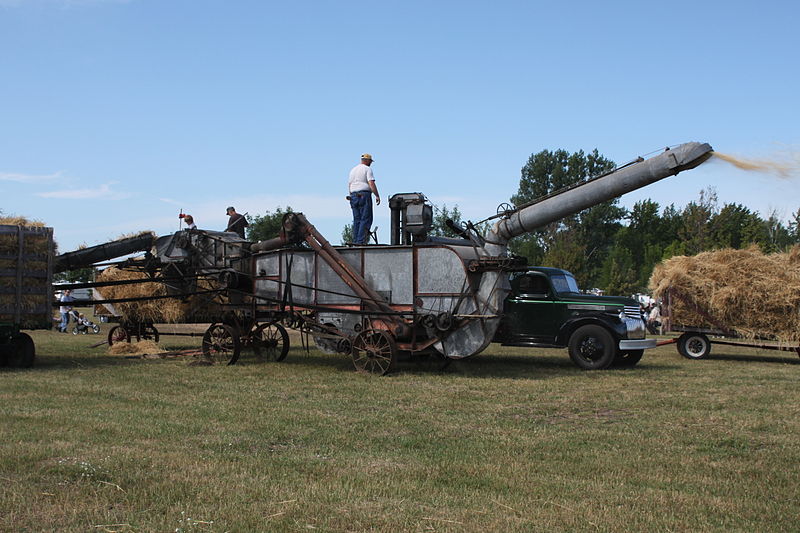
Wednesday, August 2, 1911: Took lessons in driving, but even though I would like to learn to drive, I did not like that kind of lesson for the horses were old and slow, and I had to drive them in the field behind choking clouds of dust.

Horse-drawn roller. Photo source: Wikemedia Commons, German Federal Archives. (Rollers in the U.S. may have looked different, but this is the only photo I could find.)

Her middle-aged granddaughter’s comments 100 years later:

I read this entry to my father and asked him what Grandma was doing. He says that she probably was using a roller on a plowed field. The roller would level the plowed earth in preparation for planting winter wheat seeds.

The horses would have been hitched to the roller and Grandma would have needed to tighten one rein or the other to make the horses go in a straight line.

I can almost picture the clouds of dust stirred up by the roller swirling around Grandma as she drove the horses.

Bucolic Cows or Poor Water Quality?

16-year-old Helena Muffly wrote exactly 100 years ago today: 

Tuesday, July 25, 1911:  Cows got in the corn again, and as I am the cowboy I had to get them out. Tweetkins was here awhile this afternoon to converse with her dear Ruthie.

Advertisement in June 30, 1911 Issue of Farm Implement Magazine

Her middle-aged granddaughter’s comments 100 years later:

This is the second time during July that the cows got into the corn.

Tweetkins refers to Helen Wesner, who often went by the nickname of Tweet. She was a friend of Grandma and her sister Ruth—though it sounds like she came to visit Ruth (rather than both of the Muffly girls) a hundred years ago today—and that Grandma was unhappy about being excluded from the conversation.

I really like the drawing in the 1911 advertisement that I used to illustrate today’s entry. A stream flows through the farm that Grandma grew up on so the cows probably were pastured in a field that looked similar to the field in the drawing.

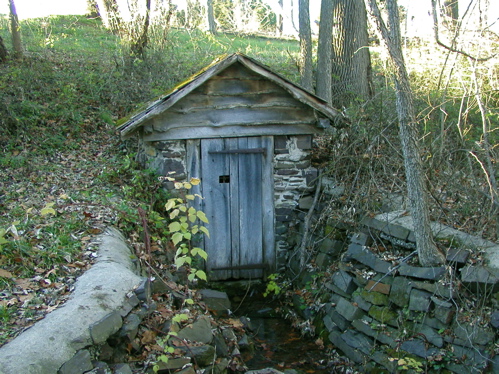
Recent photo of the stream that flows through the farm Grandma grew up on (though obviously it is a different time of the year). The old Muffly barn is in the background--and the cows were probably pastured in this field.

I especially like the juxtaposition of the old (bucolic cows) and the new (airplane and sign for a De Laval Cream Separator).

However, when I showed the picture to my daughter she said, “Those cows are in the stream. That’s bad.” She spent a year as an AmeriCorps volunteer with a water quality organization—and spent part of that year encouraging farmers to build fences (or plant natural barriers) to keep cows out of streams.

It’s interesting how an illustration can evoke different feelings in different people. (Personally I still think it shows a peaceful scene with bucolic cows.)

Cows in the Corn

16-year-old Helena Muffly wrote exactly 100 years ago today: 

Monday, July 10, 1911: Nothing doing. Cows got in the corn, and I had to get them out at the expense of a lot of running.

Photo of a Pennsylvania dairy farm in the July 1911 issues of Farm Journal

Her middle-aged granddaughter’s comments 100 years later:

Cows in a corn field can quickly cause major damage to the crop. I can almost picture Grandma’s father frantically yelling for help—and Grandma running out to chase the cows. And the cows not going where they were supposed to go—but instead running deeper into the corn field destroying even more of the crop. And her father probably yelled even more frantically that they must get the cows out of the corn or there’d be nothing left. And more running . . . until finally the cows were back in the pasture.

Hay Pulleys and Ropes

16-year-old Helena Muffly wrote exactly 100 years ago today: 

Saturday, June 24, 1911:  Mother cut my lawn dress out this afternoon. Am going to see how long it takes her to finish it. I give her till next Sat. evening. Have to carry the hay rope now. Such fun.

Her middle-aged granddaughter’s comments 100 years later:

The Muffly family must have been making hay—always a hot, difficult job. A hundred years ago hay was not baled. Instead dried loose hay was brought into the barn on a wagon and then hoisted into the mow using a rope and pulley system.

I called my father to get help figuring out what “carry the hay rope” meant.  My father guesses that Grandma was half carrying and half dragging the hay rope to keep the horse from inadvertently stepping on it. Let me explain how they used to get hay from the wagon into the haymows.

(Some of you probably know much more about how hay was made in the old days—and please feel free to jump in if I’m not explaining it quite right.)

Dad said that when he was young there were pulleys on a track that ran down the center of the inside of the barn roof. Depending upon where the farmer wanted to pile the hay the pulleys would be moved along the track.  A young man with excellent balance would climb up onto a beam in the barn rafters and move the pulleys along the track as needed.

One end of the rope was attached to a large clamp (hay hook) that was used to pick up a large bunch of loose hay from the wagon.

The rope went then went through the pulley system—and the other end of the rope was attached to a horse. On command the horse walked forward and the pulleys lifted the hay into the mow.

The hay was then released and the rope went limp and a portion of it would fall to the barn floor. The horse would then be walked back to the original position and the process would be repeated.

My father says that when he was a child, the adult men did the heavy work, and the children did the easier jobs. His older sister Marjorie would lead the  horse as it pulled the hay upward—and then circle it back to the original position after the hay was released.

And my father would pick up the rope when it fell to the floor after the hay was released and keep it away from the horse’s feet. Dad says that if a horse stepped on the rope it would damage it by breaking some of the strands. Then there would be the risk of the damaged rope breaking, which might result in dangerous accident if it broke while the hay was being lifted.

Planting Popcorn

16-year-old Helena Muffly wrote exactly 100 years ago today: 

Saturday, May 20, 1911: Oh psh aw, this is hardly worth writing. I planted some popcorn this morning, and was kept busy nearly all afternoon.

Photo source: How to Grow Vegetables (1911)

Her middle-aged granddaughter’s comments 100 years later:

A 1911  book called How to Grow Vegetables by Allen French describes how popcorn (and sweetcorn) were grown a hundred years ago.  The book says that the same methods were used for both types of corn. According to the book :

Being very tender it is not planted till all danger of frost is over. The warmest and “quickest” of all soils should be chosen. The ground should be rich, and well supplied with quickly available fertilizers.

 Sow— If the ground is cold or wet, sow thickly in the rows.

 Thin—Twelve to eighteen inches apart, according to height of variety.

Culture—Preserve the surface mulch, and keep down the weeds.

Fertilizer—Any good general fertilizer, liberally applied, as corn is an exhaustive crop; should be rich in nitrogen for a sandy soil. Dress once with nitrate of soda or liquid manure when the plants are up.

Planting Potatoes

16-year-old Helena Muffly wrote exactly 100 years ago today: 

Friday, May 19, 1911:  I had to drop potatoes this afternoon. I’m so glad it only comes once in a year. I got so fatigued, but that isn’t rare.

Her middle-aged granddaughter’s comments 100 years later:

A hundred years ago potatoes were a winter staple, so the family probably planted lots of potatoes. Also, many families raised more potatoes than they needed so they could sell the excess to people living in nearby towns. No wonder Grandma was tired after dropping (planting) seed potato pieces in the furrows.

A 1911 book by Allen French called How to Grow Vegetables explains how potatoes were planted when Grandma was young:

The seed piece—It has been proven that the size of the piece rather than the number of eyes on it, is of importance in giving good results.  . . . All pieces should be chunky and not thin; pieces the size of hens’ eggs are proper, weighing about three ounces. If they have to be stored after cutting, keep them in a cool place with wet clothes laid over the box to keep them from wilting.

Cutting Potato Seed Pieces

Distances—Rows apart, for hand culture, twenty-four to thirty inches; for horse culture, three feet or more. Plant in the row, twelve to eighteen inches apart; the richer the soil and the better prepared the closer they may stand. . . Distances are also a matter of variety: plant strong-growing or large-yielding kinds farther apart.

Depth—In heavy clayey soils three inches may be allowed. But generally speaking, it is not wise to plant less than four inches deep; if planted shallower the tubers may be sunburnt.

Culture–Cultivate once or twice before the potatoes break ground, to kill the weeds and preserve the mulch. . . The early cultivations may be deep, but once the plants are growing well, cultivation should be shallow on account of the surface-feeding roots.

Fertilizer—The soil should be rich. Humus, if supplied in the year the potatoes are grown, may come from good compost or very well-rotted manure. If fresh, the manure may cause scab. For safety, the manure is best supplied in the fall, and ploughed in; or it could be heavily fed to the previous crop. Or in farm operations green manure (leguminous crops), ploughed in, will both give humus and help to open up the subsoil. Chemical fertilizers may previously be applied at the rate of about fifteen hundred pounds per acre.

Tips from 1911 on Raising Chickens

16-year-old Helena Muffly wrote exactly 100 years ago today: 

Saturday, April 29, 1911:  Ma kept me busy a chasing the chickens out of the garden this afternoon. I get so mad at them. Carrie Stout came over this evening. Wanted me to go along with her up to McEwensville. She is afraid of the dark. Of course I went, although I looked like a witch.

Her middle-aged granddaughter’s comments 100 years later:

I wonder what Grandma and her friend Carrie were doing in McEwensville on a Saturday night. Today, I think that Saturday nights in McEwensville are generally pretty quiet—maybe it was hopping a hundred years ago.

Chickens 

The chickens probably enjoyed eating the small emerging plants in the garden. It sounds like the family needed a fence to keep them out.

In the old days women often were able to earn a little “pin money” by raising chickens and selling their eggs. A hundred years ago women’s magazines—as well as farm magazines—had lots of poultry advice.

Paul Orr in the June 1911 issue of National Food Magazine  in an article titled “Are Old Methods Best? Two Thousand Years Have Seen Little Progress in Poultry Raising”  argued that the old ways of raising chickens were best—and that incubators and other “fancy” equipment were not needed. Poultry tips in that issue of the magazine included:

  •  Beginners in poultry raising often owe their failure to the deluge of new-fangled suggestions by men who make things to sell. There are a hundred trinkets and devices on the market that are useless, and the beginner is the legitimate prey not only of egg sellers but of breeders and makers of all ilks of useless contrivances. The fact is that the old methods of poultry raising are often the best.

    Advertisement in April, 1911 issue of Farm Journal

  •  Two hundred heads are sufficient for employing the whole care and time of one person, provided that either a diligent old woman or a boy be appointed to keep watch over them, so they will not stray away or fall a prey to marauders. (Comment by Sheryl: Or I guess—at least in the case of the Muffly family—a diligent teen-aged daughter might be asked to chase after the chickens.)
  •  They must not be allowed wander far from the coop when very young.
  •  Let the custom be observed here, as with other cattle; pick out the best for breeding and sell the less good.
  •  Also dispose of all hens over three years old, and those hatched after the solstice (June 21), as they will not attain their full growth.
  • Avoid the white kind, as they are not very hardy, and because of their conspicuous white color they fall an easy prey to hawks and eagles. Those of a reddish color, with black pinions, should be chosen.

    Cartoon in April, 1911 issue of Good Housekeeping. Photo caption: “I insisted that he should see the Black Minorea”.

  •  It is not expedient to keep a cock except he is exceedingly strong and vigorous of the same color as the hens and with the same number of toes . . . Such a male should be provided with five females.
  •  When the breeding season begins. . the keeper must take care that the laying places are strawed with clean straw, and free from vermin; and the eggs are gathered every day and marked, so he may know that the freshest are put under the hens when they become broody. The freshest eggs are the most proper for hatching; yet such as they are stale may be set, provided they are not over ten days old.
  • The old hens are best suited for hatching, as they are more reliable than the young.
Follow

Get every new post delivered to your Inbox.

Join 409 other followers